Quick Answer: If your Gaggia Accademia is dispensing weak, slow, or almost no coffee, the primary culprit is a partially or fully clogged brew spout, coffee oil buildup in the internal dispensing circuit, or calcification in the flow path. A targeted descaling cycle combined with manual spout disassembly and a milk frother cleaning tablet rinse cycle typically resolves 80–90% of reported cases.
There's a specific kind of frustration that only Gaggia Accademia owners understand. You've got a €1,000+ superautomatic sitting on your counter. It hums. It grinds. It tamps. It runs through its entire brewing routine with all the confidence of a machine that knows exactly what it's doing. And then — a sad, thin trickle comes out of the spout. Maybe half a cup. Maybe less. Sometimes just a dark stain on the drip tray.
That's not a software glitch. That's not a sensor error. That's a mechanical blockage problem, and it's one of the most common failure modes on this specific machine — and frankly, on most mid-to-high-end superautomatics, akin to a Philips 5400 LatteGo experiencing water flow issues. The Gaggia Accademia isn't uniquely bad here. But its particular spout geometry, combined with how most people actually use it day-to-day, makes it disproportionately prone to this issue in ways the manual doesn't adequately prepare you for.
Let me walk through what's actually happening inside that machine, why it happens on the Accademia specifically, what actually fixes it, what doesn't, and where people go wrong when trying to self-repair.
Why the Gaggia Accademia Spout Clogs in the First Place
The Physics of Coffee Oil and Heat
Coffee is approximately 11–15% lipid content by dry weight, depending on roast profile and bean variety. Every time the Accademia brews a shot, emulsified oils travel through the internal dispensing path, across the rubber seals, through the adjustable spout assembly, and out the nozzle. Under normal conditions, a percentage of those oils don't make it fully through. They adhere to surfaces.
The problem isn't one cup. The problem is 200 cups, 500 cups, and the oil that accumulated from each one.
At operating temperature, these oils remain mobile enough that they don't immediately cause problems. But when the machine cools down — overnight, between brew sessions — those oils congeal. Partially. Not completely. Just enough to narrow the internal diameter of the flow path slightly each cycle. Over weeks and months, that slight narrowing compounds.
Then calcium deposits from tap water begin to interact with the oil residue. Calcium doesn't care about your water filter. If you're using water with any meaningful hardness above roughly 100 ppm (and most European and North American municipal tap water sits well above this), you're laying down calcification constantly. The combination of oil residue and calcium creates a layered, semi-porous blockage that standard cleaning cycles often can't fully penetrate.
The Accademia's brew unit dispenses coffee through a two-stage path: internally through the brew group exit (which can sometimes lead to a Jura E8 brew group stall), and externally through the adjustable spout housing. Both stages can block independently, which is why "it sort of brewed once but then nothing" is such a common complaint on this model.
The Accademia Spout Geometry Problem
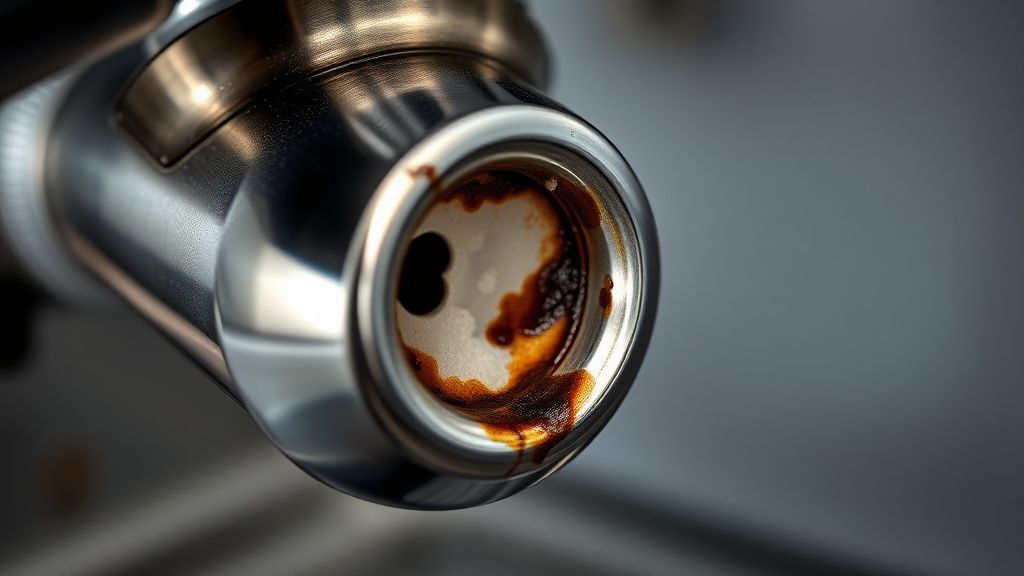
The Accademia uses an adjustable-height coffee spout. That's a selling point — you can accommodate different cup sizes. But that adjustable mechanism introduces additional internal crevices where buildup concentrates. The spout pivots on a hinged bracket, and the internal silicone tubing that routes coffee through this assembly makes a slight bend. That bend is a natural collection point.
On a fixed-spout machine like an older Gaggia Classic Pro not brewing due to a solenoid valve issue, or a Delonghi Magnifica, the dispensing path is simpler — straighter, shorter, with fewer geometric traps. The Accademia's dispensing engineering trades simplicity for user convenience, and the maintenance cost of that trade is exactly what you're reading about right now.
Field reports on coffee forums — particularly on Coffeetime.it (the Italian forum that has probably the most technically detailed Accademia threads), as well as English-language discussions on Reddit's r/superautomatics — consistently identify the spout assembly as the failure point. One thread from a user named "GaggiaOwner_DE" documented the progression: "Full flow week 1. Slightly reduced by month 2. Barely a trickle at month 4. Machine throws no errors. It just... does less."
That's the insidious part. The Accademia doesn't always throw an error for this. The machine continues operating normally by its own diagnostic logic, because the blockage isn't a catastrophic failure. It's gradual degradation. The pressure sensors don't always flag it until the restriction becomes severe enough to trigger a pump overload signal.
Diagnosing the Actual Location of the Blockage
Before you start disassembling things, you need to figure out which part of the flow path is actually blocked. This matters because the fix is different depending on where the restriction sits.
Step 1: Run a Hot Water Dispense Test
Don't brew coffee. Select hot water dispensing and run a full cycle. Observe the flow rate and compare it visually to what the machine produced when new (or to video references, since published specifications for Accademia hot water output volume per minute aren't readily available in public documentation as far as I can confirm).
- If hot water flows strongly but coffee flow is weak: The blockage is in the coffee-specific path — likely the brew unit exit, the internal coffee circuit, or the spout itself where coffee runs but hot water takes a separate path.
- If both hot water and coffee flow are weak: The blockage is upstream — likely in the main flow path, the heat exchanger tubing, or there's a significant calcification event in the boiler circuit.
Step 2: Remove and Inspect the Spout Assembly
The Accademia spout detaches. If yours has been in service for more than a year without being removed and manually cleaned, what you find when you pull it off will tell you a lot.
Pull the spout forward/down according to your specific model variant (there are minor differences between Accademia, Accademia Plus, and the slightly redesigned variants sold in different markets). Once detached, hold it up to a light source and look through the nozzle opening.
You should be able to see through to some degree of light. If it's completely dark — if the channel appears fully occluded — you have a significant blockage in the spout body itself.
Field observation from multiple technicians: The Accademia spout, when badly clogged, often contains a deposit that looks almost like compressed coffee puck material combined with a waxy, amber-colored oil layer. It doesn't look like scale. Scale is white and chalky. This is brown-black and semi-solid. It requires mechanical removal, not just chemical treatment.
Step 3: Check the Brew Unit Exit Port
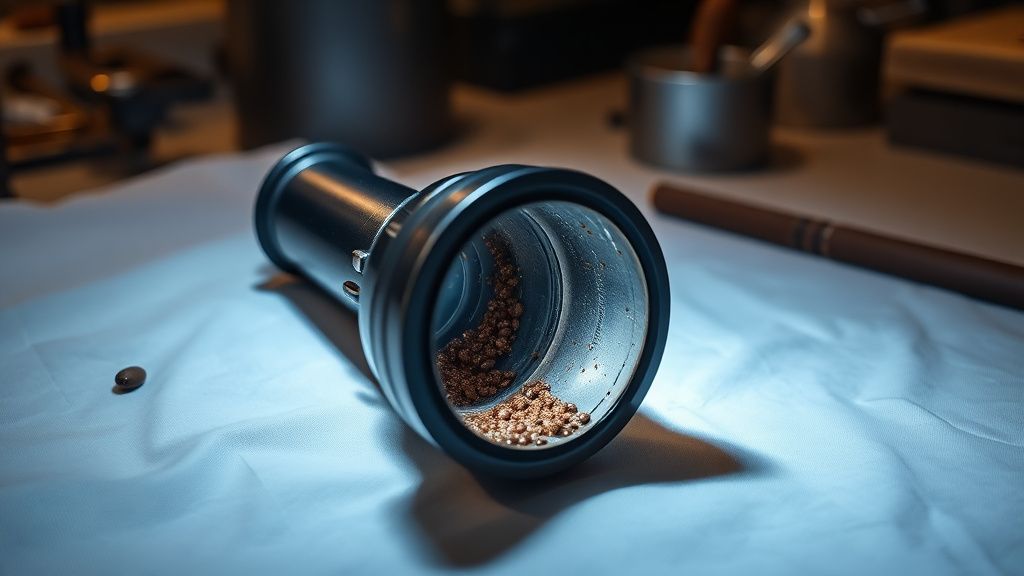
Access the brew unit by opening the side service door on the left side of the machine. Remove the brew group (refer to your model's manual — it's a handle-release mechanism on the Accademia). Look at the exit port where brewed coffee leaves the brew unit and enters the dispensing tube.
This port is a small rubber-rimmed aperture. It collects grounds residue and oil constantly. If you see visible buildup around this seal or obstructing the port, that's a contributing factor.
The Actual Fix: Step-by-Step Unclogging Process
Chemical Phase: Machine Cleaning Tablet Cycle
Before touching tools, run the machine's built-in coffee circuit cleaning program with a proper cleaning tablet. The Gaggia Accademia accepts standard 1.6g cleaning tablets — Gaggia-branded, Philips-branded, or generic equivalents.
The cleaning cycle pushes a hot detergent solution through the brew unit and coffee circuit under pump pressure. This is your first line of offense. It dissolves oil residue from surfaces it can reach.
Critical observation: The cleaning cycle does not fully clean the external spout assembly in most cases. The machine routes cleaning solution through the brew group, but the external spout sees only diluted residual solution. If your spout is badly blocked, the cleaning tablet cycle will improve but not resolve the issue.
Run the cleaning cycle. Wait 30 minutes. Attempt another brew. Evaluate.
Mechanical Phase: Manual Spout Disassembly and Cleaning
This is where most users stop short, and it's the step that actually matters.
What you need:
- Warm water (hot tap, not boiling)
- A small interdental brush or pipe cleaner
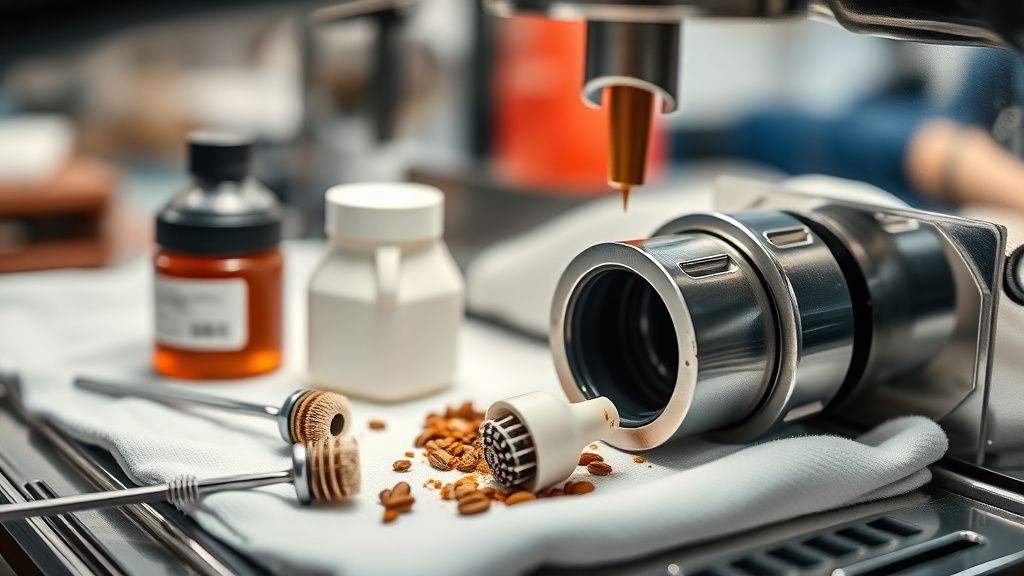
- A container of coffee machine cleaning solution (liquid, not tablet — Puly Caff, Cafiza, or similar)
- A thin wooden skewer or toothpick (not metal — you don't want to scratch the internal channel)
- About 20 minutes
Process:
- Remove the spout assembly completely from the machine.
- Soak it in a solution of coffee machine cleaner diluted per the product instructions, in warm water. Not boiling. Boiling can distort rubber components.
- Soak time: minimum 15–20 minutes for moderate blockage. For severe blockage — the kind where you're looking at solid deposits — extend to 45 minutes.
- After soaking, use the interdental brush to work through the internal channel of the spout. You're trying to mechanically dislodge what the chemical soak has loosened. You'll likely see brown-black paste coming out. This is normal. Keep going until the rinse water runs clear.
- Use the wooden skewer very gently to break up any solid deposit at the nozzle opening if the brush can't fully penetrate.
- Rinse thoroughly under running water. Hold the spout up to a light again. It should now show clear passage.
Reinstall and test.
Descaling Phase: If Hot Water Is Also Weak
If your earlier diagnostic test revealed weak hot water output as well, you have a calcification issue in the main circuit that needs a full descaling cycle.
Use a liquid descaling solution compatible with the Accademia — Gaggia/Philips descaler, or a citric acid-based alternative. The machine has a built-in descaling program that you access through the menu. Follow the program. It takes approximately 30 minutes and requires you to periodically place the machine's spout over a container as it dispenses the descaling solution in phases.
Important: Do not use vinegar as a descaling agent on the Accademia or any machine with rubber O-rings and seals in the brew group. The acetic acid in vinegar attacks rubber compounds over time. This is not theoretical — it's a documented degradation pathway that technicians see on machines where users have been "saving money" by using vinegar for years. The seals crack and fail. Then you have a much more expensive problem.
Why Standard Maintenance Schedules Fail Users
The Gap Between "Recommended" and "Required"
The Gaggia Accademia manual suggests running a cleaning cycle approximately every 200–300 coffees. This interval assumes average use, average water hardness, and — critically — average user behavior around rinsing after brewing.
Most people don't rinse. The machine prompts a rinse cycle at startup and shutdown, and a significant portion of users skip it or power the machine off from the wall switch before the rinse cycle completes. Every skipped rinse is another micro-increment of oil residue left in the hot circuit.
On the Italian forums, this creates a genuine tension. Experienced users argue that the machine's stated cleaning interval is optimistic even with perfect behavior. "200 coffees is marketing math," one user wrote on Coffeetime.it, in a thread that accumulated over 400 responses. "In practice, with medium-hard water and actual daily use, you're descaling every 6–8 weeks or you're accumulating damage."
Gaggia hasn't publicly responded to this characterization. Their official documentation stands as written.
The Prompt-Ignoring Phenomenon
The Accademia displays maintenance prompts on its interface. Descaling required. Clean the milk circuit. These prompts can be dismissed. And they can be dismissed repeatedly.
The machine allows this because forcing maintenance lockout would generate massive support volume and user complaints. But the design concession of allowing dismissal creates a well-documented failure pattern: users dismiss prompts for weeks, sometimes months, and the machine gradually degrades until flow rate drops to the point where they finally seek help.
At that stage, they're not dealing with a preventable maintenance event. They're dealing with a genuine repair situation.
Real Field Reports: What Technicians Actually See
Case: The "Just Serviced" Machine That Still Flows Poorly
This is common enough to be worth mentioning specifically. A machine goes through a full cleaning and descaling cycle. Everything checks out by the machine's own diagnostic. And flow is still noticeably reduced.
The cause in many of these cases is the brew unit exit seal — a small rubber gasket that surrounds the port where coffee exits the brew unit into the dispensing circuit. This seal degrades with age. When it hardens and loses elasticity, it partially collapses against the flow path, creating a restriction that neither cleaning tablets nor descaling solution can address.
The fix is seal replacement — about a €2–5 part, but one that requires proper identification of your Accademia variant (there are slight differences between production years), proper sourcing (third-party parts vary enormously in quality and dimensional accuracy), and careful installation.
Getting this wrong — installing a seal with the wrong durometer rating or wrong diameter — can cause a different failure mode: brewing at lower than spec pressure, producing under-extracted coffee, or creating a small leak inside the machine that drains into the drip tray without triggering any obvious error.
Case: The Rebuilt Spout That Still Doesn't Flow Right
Some users successfully clean the spout, reinstall it, and find that flow is improved but still not normal. Investigation in these cases often reveals that the internal dispensing tube — the silicone hose that connects the brew unit exit to the spout assembly — has developed a partial internal occlusion of its own.
This tube is not typically accessible without further disassembly. On the Accademia, accessing it involves removing the machine's top panel and partially dismantling the internal dispensing assembly. It's not a beginner repair. If you're at this stage, you're either a competent DIYer with the right documentation, or you're at a service center.
Counter-Criticism: Is the Accademia Actually Worse Than Competitors?
This is worth addressing directly because it comes up constantly in community discussions, usually framed as "should I have bought a [competitor model] instead?"
The honest answer is complicated. The Accademia's spout clogging problem is real, but it's not uniquely a Gaggia problem. DeLonghi's Dinamica Plus, the Jura E8, the Melitta Barista TS — all of these machines have documented spout and coffee circuit maintenance issues that their own communities discuss extensively. The specific geometry differs. The failure mode varies slightly. But the underlying physics are the same: coffee oil plus heat cycles plus calcium deposits equals eventual flow restriction.
What makes the Accademia thread count on this topic feel disproportionately high is likely a combination of factors: it's a popular machine at a price point where users have high expectations, it has a slightly more complex external spout than some competitors, and the Italian market — which generates a lot of the technical forum content — has a relatively hard water supply in many urban areas.
The actual maintenance burden on the Accademia, done correctly and proactively, is comparable to its competition. The problem is that most users aren't told this at point of sale, and the in-machine prompts don't convey adequate urgency.
Preventing the Recurrence: A Realistic Protocol
What Actually Works Long-Term
These aren't manufacturer talking points. These are operational observations from consistent use and repair patterns:
- Remove and manually rinse the spout weekly. Not with cleaning tablets. Just warm water and a quick rinse. Takes 90 seconds. This alone dramatically extends intervals between deep cleans.
- Never skip the startup/shutdown rinse cycle. The machine runs hot water through the circuit to flush residual coffee. This matters. Let it finish.
- Use a water filter. The Accademia accepts the INTENZA+ filter cartridge. If you're in a hard water area, this is not optional equipment — it's preventive maintenance infrastructure.
- Run a cleaning tablet cycle every 100–150 coffees rather than 200–300, especially if you're using darker roasts (which have higher oil content) or if you're skipping any part of the routine above.
- Remove the brew unit monthly, rinse it