Quick Answer: The orange light on your Nespresso Vertuo machine means it's time to descale — hard mineral deposits have built up inside the boiler and flow system, triggering a forced maintenance alert. Run the official descaling cycle with Nespresso's descaling solution, and the light clears. Ignore it long enough and you're looking at a dead heating element.
There's a specific kind of frustration that comes with a Nespresso Vertuo blinking orange at you first thing in the morning. You didn't ask for a maintenance reminder. You wanted coffee. And now there's this pulsing, amber accusation sitting on your counter demanding you do something about calcium carbonate before you've had caffeine.
I've pulled apart more Vertuo machines than I care to count, much like the detailed mechanical diagnostic work involved when you need to fix a Breville Barista Pro flashing drop icon or resolve water flow errors. The Plus, the Next, the Pop, the Lattissima variants — all of them. The orange light is one of the most misunderstood error states in the consumer espresso machine world, mostly because Nespresso's own in-box documentation is genuinely terrible at explaining why it happens, what it means mechanically, and what goes wrong if you skip it. Most people Google it, land on a forum post that says "just run the descaling cycle" and leave it at that.
That answer is correct but incomplete in ways that matter.
What the Orange Light Is Actually Telling You: The Thermoblock and Scale Accumulation Problem
The Nespresso Vertuo line uses a centrifugal brewing system — that rotating capsule mechanism is the whole marketing hook — paired with a compact flow-through thermoblock heater. This is not a traditional boiler. It's a narrow, coiled metal channel that water passes through rapidly and gets heated to brewing temperature almost instantly.
The engineering trade-off here is size versus scale tolerance. Traditional boilers in prosumer machines have volume. They can accumulate scale on internal surfaces for years before performance degrades noticeably. The Vertuo's thermoblock is small, tight, and precisely engineered, requiring consistent maintenance similar to how one might need to fix an Ecovacs Deebot T9 error 4 to keep the main brush running smoothly. When calcium and magnesium deposits — the main culprits in hard water areas — start crystallizing on the internal channel walls, the flow restriction happens faster and more critically.
The machine's firmware monitors this through a counter-based scale detection system, not a physical sensor. There's no calcium detector inside your Vertuo. The machine tracks brew cycles and applies a hardness preset (set during initial setup, often ignored by users) to calculate an estimated scale accumulation threshold. When that internal counter hits a programmed limit, the orange light trips.
This is both clever and slightly dishonest. "Clever" because it doesn't require expensive sensing hardware. "Slightly dishonest" because the alert timing is based on a statistical estimate, not your actual water quality. If you live somewhere with genuinely soft water and never adjusted the hardness setting, you're possibly being asked to descale a machine that doesn't urgently need it. If you live in London, Phoenix, or anywhere with legendarily hard water and you kept the default setting, you might be late to the party.
The counter doesn't care. It fires when it fires.
Orange Light States: They're Not All the Same
This is where people consistently get tripped up, including technicians who should know better.
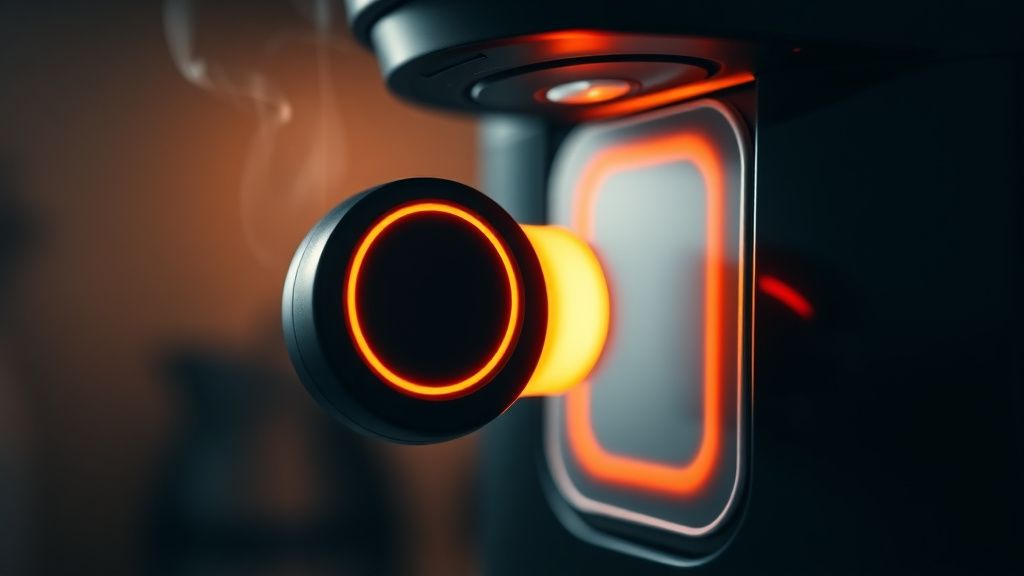
The Vertuo's orange indicator isn't a single-state alert. It communicates through blink patterns, and each pattern maps to a different internal state. Nespresso's official documentation lists these, but the explanations are written by someone who clearly never had to actually interpret them under stress.
Here's the practical breakdown:
Steady Orange Light — Descaling Required
The machine is operational but locked into a maintenance-pending state. It will still brew, at least initially, but the firmware is tracking this. Some Vertuo generations (particularly the Vertuo Next) will refuse to brew after a set number of additional cycles post-alert. Others will keep going until something fails. Don't count on which behavior your specific unit has.
Two Orange Blinks — Machine Needs Cooling Down or Thermal Fault
This one gets confused with descaling constantly. Two blinks means the thermoblock hit an overheat threshold. This sometimes happens right after a descaling cycle (the machine ran hot during the process), sometimes after multiple rapid consecutive brews, sometimes because something is actually wrong with the thermal cutout circuit. Letting the machine sit unplugged for 30 minutes often clears it. If it doesn't, you have a different problem.
Alternating Orange and White Blinks — Descaling Cycle in Progress
Once you've initiated the descaling cycle and the machine is mid-process, it uses this pattern to tell you it's working. If you see this and you haven't started a descaling cycle, something is stuck in a cycle state — usually from a user interrupting the process halfway through. This is a recoverable state but requires a specific button sequence to exit, which differs by Vertuo generation. Yes, it's a mess.
Persistent Orange After Completed Descaling — Counter Not Reset
The most common complaint in r/nespresso threads, app reviews, and every Facebook coffee group ever: "I did the descaling, but the orange light is still on."
This happens because the descaling cycle and the counter reset are two separate events. Running the descaling solution through the machine does not automatically tell the firmware the job is done. You have to manually confirm the cycle completion through a specific button-hold sequence. If you miss this step — and the instructions bury it — the counter stays at its limit, the light stays orange, and you think either the machine is broken or the descaling didn't work.
It's a UX failure, full stop. There's no reason this confirmation step can't be automated. It isn't.
The Actual Descaling Process: What the Manual Gets Wrong
Nespresso's official descaling instructions are adequate if you follow them perfectly in a controlled environment. Real kitchens are not controlled environments. Here's what actually happens.
What You Need
- Nespresso descaling solution (the official one, or a citric acid alternative — more on that below)
- A container that holds at least 1 liter of liquid
- About 20-30 minutes of uninterrupted time
- Water from your tap (not filtered, for this specific process)
The descaling solution is diluted into 500ml of water. This mixture runs through the machine in a two-phase cycle — a descaling flush followed by a clean water rinse. The whole cycle takes roughly 20 minutes on most Vertuo models.
Entering Descaling Mode
This is where generation-specific differences cause real confusion.
Vertuo Plus: Hold the button for 7 seconds until the light pulses orange, then press the button three times within 2 seconds.
Vertuo Next: Press and hold the button and lever simultaneously for 3 seconds.
Vertuo Pop: Similar to Next, but the lever mechanism differs.
Nobody keeps track of which model they have. They bought it two years ago, threw out the box, and now they're standing in their kitchen at 7am trying to remember if they have a Plus or a Next while reading instructions on their phone that apply to a different variant. Forum threads are full of this exact chaos.
The Descaling Solution Debate: Nespresso Brand vs. Third-Party vs. Citric Acid
Nespresso sells its descaling solution at a price point that generates genuine community irritation. The argument for using it is that it's formulated for the specific alloys and plastics in Nespresso machines and won't void warranty claims. This is the official position.
The counter-argument, which is well-developed in home espresso communities and on platforms like Home-Barista.com and r/espresso, is that descaling solutions are largely undifferentiated citric acid or lactic acid formulations and that food-grade citric acid dissolved in water at appropriate concentrations does the same job.
My honest technical take: citric acid works. I've cleaned machines with both. The results on scale removal are comparable. The risk with DIY citric acid solutions is concentration — too weak and you're not actually dissolving scale, too strong and you're potentially stressing internal seals over repeated cycles. If you know what you're doing, it's fine. If you're guessing at ratios based on a Reddit comment, use the official product.
What doesn't work and actively causes damage: vinegar. White vinegar is a popular folk remedy for descaling everything from kettles to espresso machines. The acetic acid in vinegar is less effective at dissolving calcium carbonate than citric acid, leaves a residue that's genuinely difficult to rinse out, and can degrade certain rubber seals and gaskets over time. The inside of a Vertuo that's been vinegar-descaled multiple times has a distinctive smell that's hard to mistake.
I've pulled apart machines where the previous owner had been running vinegar through them for years. The gasket degradation is real. Don't do it.
Real Field Reports: When the Orange Light Means Something Worse
Most of the time, orange light equals descale required, you descale, you're done. That's the 80% case. But there's a meaningful percentage of cases where the orange light is either a symptom of deeper damage or where the descaling process itself goes wrong.
Scenario 1: Scale so advanced the descaling cycle can't clear it
If someone has been ignoring the orange light for a long time — and people absolutely do, sometimes for months — the scale accumulation in the thermoblock can become partially calcified in ways that a single descaling cycle won't address. The machine may complete the descaling cycle, the orange light resets, and within 5-10 brews the orange light trips again. This is the thermoblock partially blocked, restricting flow enough that the temperature management system flags it repeatedly.
Running two consecutive descaling cycles with a fresh solution batch each time sometimes clears this. Sometimes it doesn't. At that point you're looking at a thermoblock replacement if you want to keep the machine, or an aggressive descaling soak which requires partial disassembly and isn't covered by warranty.
Scenario 2: The pump is struggling, not the scale
The Vertuo uses a small vibratory pump to push water through the system. These pumps have a service life, and in machines that are a few years old and heavily used, pump degradation can present symptoms that look like scale issues — inconsistent flow, pressure drops, longer heat-up times. The orange light is a scale indicator, not a pump indicator, but scale stress accelerates pump wear. Some users descale, find the performance doesn't improve, and assume the descaling didn't work. Sometimes the pump just needs replacement.
Scenario 3: Firmware-corrupted cycle state
This is genuinely an under-documented problem. If a descaling cycle gets interrupted — power outage, someone accidentally unplugging the machine, a curious child pressing buttons — the machine can enter a state where it believes a descaling cycle is in progress indefinitely. The light pattern is confusing, the machine won't brew, and the standard reset sequences don't always work cleanly.
There are documented workarounds on Nespresso's support community and on various appliance forums, but they're not consistent across generations. Some require holding the button for 40+ seconds. Some require specific button combinations. Some require contacting Nespresso support for a factory reset procedure they don't publish anywhere users can find.
The GitHub-equivalent community knowledge for this lives in scattered appliance repair forums, particularly ApplianceBlog.com and some older coffeegeek threads, where users reverse-engineered the button state machine through trial and error.
Counter-Criticism: Is Nespresso's Descaling Trigger System Actually Fair to Users?
There's a real criticism here that deserves honest treatment.
The counter-based descaling system, as implemented, is a revenue-generating mechanism as much as it is a maintenance mechanism. Nespresso sells descaling solution. The machine tells you to buy descaling solution on a schedule that's determined by a fixed counter, not your actual water quality. If you live somewhere with soft water and use filtered water in your machine, you may be descaling more often than you need to. The machine doesn't know.
This isn't conspiracy territory — it's just product design that serves multiple interests simultaneously, some of which are yours and some of which are Nespresso's. The legitimate maintenance need is real. Scale in a thermoblock is a genuine failure mode. But the timing and urgency of the alert could be calibrated to actual need with a cheap conductivity sensor, and that's not how it's built.
The secondary criticism is the counter reset UX problem mentioned above. Making the counter reset a manual, easily-missed step means a percentage of users will think their descaling failed, contact support, and either be walked through the reset or pushed toward purchasing a new machine. Whether this is intentional dark pattern design or just bad UX is a matter of interpretation. The outcome is the same.
On r/nespresso, this comes up regularly. Typical thread: "Descaled twice and light won't go off, machine is broken?" Response from power users: "Did you do the reset? It's the button hold at the end of the cycle." Original poster: "There's no mention of that in my instructions." And there often genuinely isn't — different instruction booklets with different Vertuo generations have inconsistent detail levels on this step.
The Water Hardness Setting: The Control Nobody Uses
Every Nespresso Vertuo has a water hardness setting that's configured through a specific button sequence during first setup or accessible afterward. Nespresso includes a test strip in the box to check your local water hardness. The hardness level you set determines how quickly the internal scale counter increments toward the descaling alert.
The percentage of users who ever use this test strip and correctly set the hardness level is, based on everything I observe in the repair and enthusiast community, extremely low. Most people set up the machine by plugging it in and pressing the button. The test strip stays in the box, which eventually gets recycled.
This means a significant portion of Vertuo machines are running on a default hardness setting that doesn't reflect actual conditions. In soft water areas, this means unnecessary descaling alerts. In hard water areas — and this is the dangerous direction — the machine may be under-counting scale accumulation and not alerting until more damage has occurred.
The setting is not complex to configure. It's just never explained at the moment when users are paying attention, which is during first setup. By the time the orange light appears a year later, nobody remembers there's a hardness calibration that affects this.
Preventive Maintenance: What Actually Reduces Orange Light Frequency
Assuming you live in a hard water area and want to genuinely reduce scale accumulation rather than just responding to the orange light when it trips:
Use filtered or softened water. A Brita-style pitcher filter meaningfully reduces the mineral load in tap water. This isn't anecdotal — it's basic chemistry. Lower mineral content means slower scale accumulation means the counter takes longer to hit the limit. This is the single most impactful thing a Vertuo user can do.
Set the water hardness correctly. Get the test strip (or a cheap TDS meter), measure your actual water, and set the machine accordingly. This calibrates the counter to your actual situation.
Don't interrupt descaling cycles. Once you start, finish. The incomplete cycle state issue is real and annoying to recover from.
Descale when the light first appears, not three months later. The longer you run scale-heavy water through a thermoblock that's already accumulating deposits, the faster the damage compounds. An early descaling cycle takes 20 minutes. A thermoblock replacement takes time, skill, or money.
The Repair Economics: When It's Worth Fixing vs. Replacing
Nespresso Vertuo machines sit in an interesting price tier — not cheap enough to be purely disposable, not expensive enough to justify professional repair at shop rates. The Vertuo Next retails around $150-200 new. A thermoblock replacement, if done professionally, likely costs $60-100 in parts and labor. A pump replacement is similar.
This means the repair-vs-replace math is genuinely close for older machines. If your Vertuo is two or three years old, outside warranty, and needs both a descaling cycle and a pump looking at, the economics are uncomfortable.
The environmental cost of this is real but largely invisible in the purchasing decision. Capsule waste from Nespresso machines is a documented problem. Machine-level waste compounds it. The descaling discipline that extends machine life isn't just economically motivated — it genuinely extends the useful life of hardware that has real manufacturing and disposal costs.
Nespresso offers a repair service and a machine recycling program, but the coverage and quality varies significantly by region. In some markets this works reasonably well. In others, support essentially directs you toward purchasing a new machine once something is technically wrong.