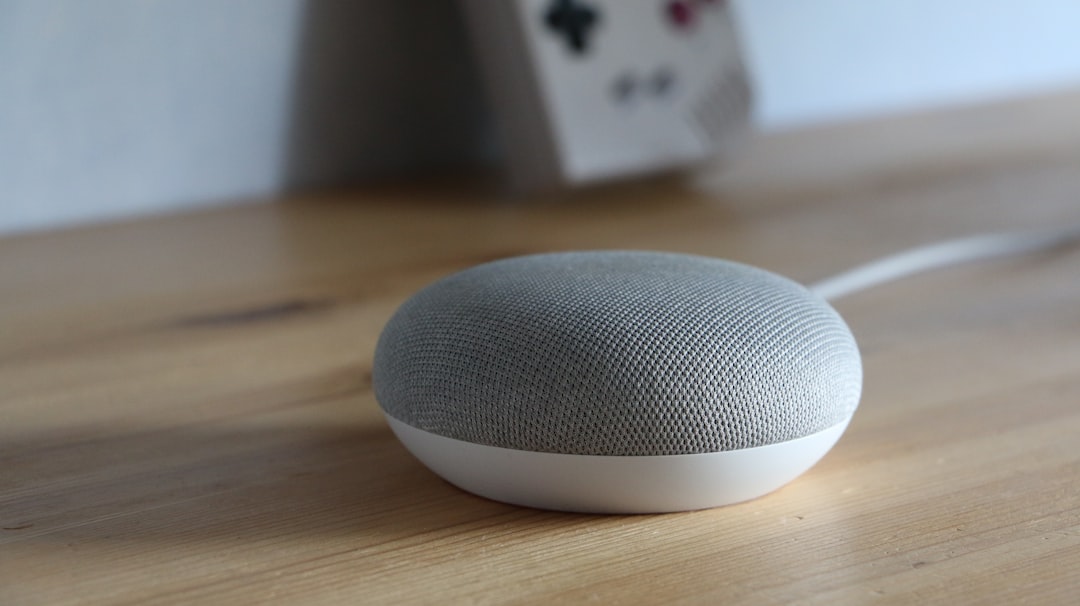
Quick Answer: Google Home Max drops Wi-Fi because of DHCP lease conflicts, router ARP table exhaustion, or the device's aggressive sleep-state power cycling that forces repeated DHCP discovery broadcasts. Fix it by assigning a static DHCP reservation in your router, flushing the ARP cache, and ensuring your router's lease time isn't shorter than 2 hours. Most cases resolve in under 10 minutes.
There's a particular kind of frustration that comes from a $399 smart speaker going offline in the middle of a dinner party, much like the annoyance felt when a Ring Doorbell Pro goes offline after a Wi-Fi change. Not a catastrophic failure — no smoke, no error beep, just silence. You walk over, the Google Home Max is sitting there, lights pulsing like it's thinking, and it has simply forgotten the network. Again.
I've torn apart more smart home hubs and speakers than I care to count. The Google Home Max, specifically, has a networking stack that behaves in ways that feel almost deliberately awkward in certain home network configurations. This isn't purely a hardware problem, as modern smart devices often face issues that feel like a Ninja Foodi lid error where persistent faults require specific resets. It's a system-level behavior problem that sits at the intersection of Google's firmware decisions, router vendor firmware, and the increasingly messy reality of modern home networks running 40+ devices simultaneously.
Let's get into exactly what's happening, why it keeps happening, and what actually fixes it versus what just kicks the problem down the road.
Understanding DHCP in a Smart Home Context: Why the Google Home Max Specifically Struggles
The Basic Mechanics Most Guides Skip
DHCP — Dynamic Host Configuration Protocol — is the system your router uses to hand out IP addresses to devices on your network. When the Google Home Max connects to your Wi-Fi, it sends a DHCPDISCOVER broadcast. Your router responds with a DHCPOFFER. The device accepts with a DHCPREQUEST. The router confirms with a DHCPACK. Four-way handshake, done.
The problem isn't the protocol. The protocol is fine. The problem is when this handshake happens, how often it needs to happen, and what breaks when it doesn't complete cleanly.
The Google Home Max runs a Linux-based firmware, though managing device health is crucial; if you struggle with other smart appliances, you might also need tips on fixing a Keurig K-Supreme that won't stop flashing. It has a Wi-Fi chip (historically Marvell-based in earlier revisions) that aggressively manages power states. When the device isn't playing audio, it cycles its Wi-Fi radio into low-power states to reduce heat and power consumption. This is sensible from an engineering perspective. The unintended consequence is that some routers interpret this as a device disconnect—much like how a Breville Barista Pro flashing drop icon signals an internal flow error—leading to IP conflicts and network drops.
When the Home Max wakes up and tries to resume using its previously assigned IP, it's now in conflict. Two devices, one IP. Neither works correctly. The Home Max, rather than gracefully handling this, frequently just drops off the network entirely.
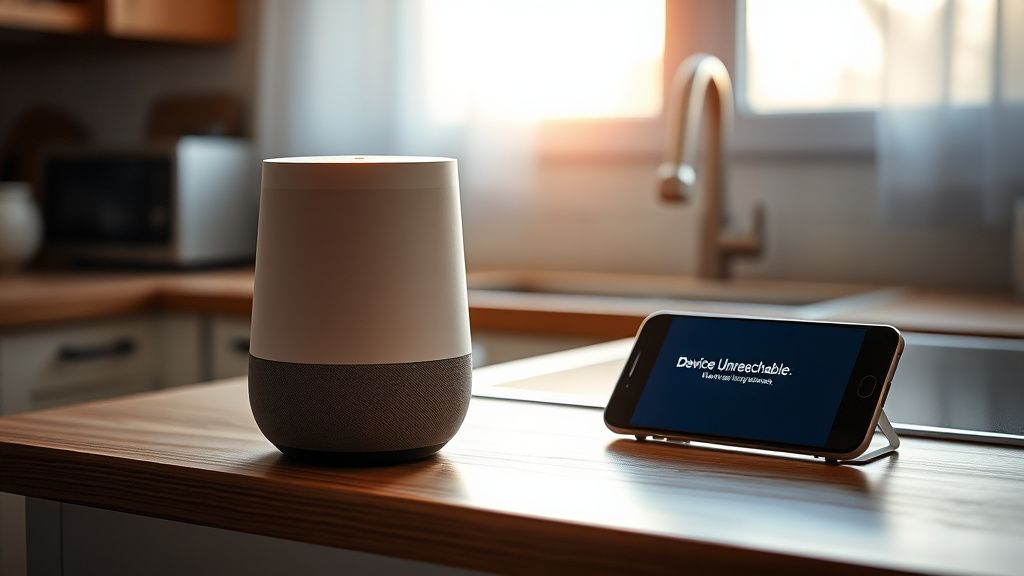
ARP Cache Exhaustion: The Part Nobody Talks About
In homes with 30, 40, 50+ connected devices — smart lights, thermostats, cameras, tablets, phones, laptops, game consoles — consumer routers start hitting their ARP table limits. The ARP table maps IP addresses to MAC addresses. When it fills up, the router starts evicting entries. If the Google Home Max happens to be in a sleep state when its ARP entry gets evicted, the next packet that hits the router destined for the Home Max results in an ARP request with no reply. The router assumes the device is gone. DHCP lease gets flagged as stale.
Most consumer routers have ARP tables sized for 128–256 entries, which can become as cluttered and problematic as a Roborock S7 MaxV displaying an error 10 when airflow is restricted. That sounds like a lot until you add a Ring Doorbell 4 stuck in a firmware loop or other smart home devices that constantly ping your network. I've seen homes legitimately hitting 60–80 active ARP entries with normal usage patterns, and that's before guests connect.
"The ARP table size on consumer-grade hardware is a real and underappreciated constraint. Vendors don't publish these limits prominently. You find out the hard way." — This is the kind of thing that surfaces in r/HomeNetworking threads once someone finally pulls Wireshark logs.
Google's Firmware and the "Helpful" Reconnection Logic
Here's where it gets genuinely messy from a firmware standpoint. Google's Home Max firmware includes reconnection logic that's designed to recover from Wi-Fi drops automatically. In theory, good. In practice, the recovery sequence sends a burst of DHCPDISCOVER packets that some router firmware interprets as a DHCP flood and temporarily rate-limits or drops. The device ends up in a loop: loses connection, tries to recover, gets rate-limited, fails to get an IP, appears offline.
Reddit threads from r/googlehome going back to 2018–2019 are littered with this exact failure mode. The thread "Google Home Max keeps dropping from network - anyone else?" accumulated hundreds of responses, most of them circling the same set of symptoms: works fine for days, suddenly offline, hard reboot brings it back temporarily, cycle repeats.
The community consensus at the time was "Google needs to fix this." Google did ship several firmware updates that apparently addressed some of this. But the problem didn't disappear. It just became less frequent — and more confusing, because now it was harder to reproduce consistently.
Real Field Reports: What Actually Triggers the Drop
Case 1: The ISP-Supplied Router Problem
The most common scenario I encounter is this: someone has an ISP-supplied combo modem/router — a device that's already running near its design limits for connected clients — and they've added the Google Home Max to an already crowded 2.4GHz band.
ISP-supplied routers are often configured with absurdly short DHCP lease times. I've seen Comcast/Xfinity and AT&T supplied devices configured for 30-minute or even 15-minute DHCP leases. The logic from the ISP's perspective is churn — they expect devices to connect and disconnect frequently in a retail modem deployment. In a home environment, this means your Google Home Max is going through a full DHCP renewal cycle every 15–30 minutes. That's a lot of broadcast traffic, and on a congested 2.4GHz band, some of those renewals fail.
When a DHCP renewal fails at the T2 timeout (typically at 87.5% of the lease period), the device falls back to broadcasting. If that also fails, the lease expires and the device is address-less until it completes a fresh full DHCP discovery. During that window — which can be several minutes on a congested network — the Home Max is effectively offline.
Case 2: The Third-Party Router with Default Settings
Even on better hardware — a TP-Link Archer, an ASUS RT series, a Netgear Nighthawk — default settings aren't always optimal for smart home devices. Default DHCP lease times vary wildly between vendors. Some default to 24 hours. Others default to 1 hour. The 1-hour lease time routers generate roughly 24x more DHCP renewal traffic per device per day compared to the 24-hour lease devices. In a house with 20 smart home devices, that's a meaningful difference in background broadcast traffic.
Case 3: The Mesh Network Complication
Google Home Max in a mesh network environment introduces additional failure modes. When the device roams between mesh nodes — say, from a node in the living room to one in the kitchen — the DHCP lease follows the device by MAC address in a properly configured mesh system. But if the mesh system's IP assignment logic has any latency, or if the previous node hasn't fully handed off the device context, the Home Max can briefly have conflicting network state.
I've seen this specifically with older Eero firmware and certain TP-Link Deco configurations where the Home Max would drop every single time it roamed, even on the same subnet. The device would sometimes pick up the same IP via DHCP reservation but still fail to communicate until the ARP cache updated across all mesh nodes. That propagation delay — sometimes 10–30 seconds — was long enough for the Google Home app to flag the device as offline.
The Actual Fix Process: Step by Step Without Cutting Corners
Step 1: Identify Your Current IP Assignment Method
Before you change anything, you need to know what you're dealing with.
- Open the Google Home app
- Navigate to your Home Max device
- Tap the gear icon → Device information
- Note the IP address currently assigned
Then log into your router's admin panel. Look for the DHCP client list or connected devices list. Find the entry for your Home Max (look for the MAC address or device name matching). Note whether it shows as a static assignment or a dynamic lease.
If you don't know how to access your router admin panel, the default gateway address (usually 192.168.1.1 or 192.168.0.1) is your entry point. Username and password are usually on a sticker on the router itself.
Step 2: Create a DHCP Reservation (Static IP via MAC Address)
This is the single most effective fix for recurring DHCP-related drops.
Router Admin → LAN Settings → DHCP → Address Reservation (or Static Lease)
You'll need:
- The MAC address of your Google Home Max (available in Device information in the Google Home app)
- An IP address outside the DHCP pool range but within your subnet
For example, if your DHCP pool hands out 192.168.1.100 to 192.168.1.200, assign your Home Max something like 192.168.1.50. It won't conflict with dynamic assignments and won't get handed to another device.
Different router interfaces call this different things:
- ASUS: Manually Assigned IPs around the DHCP List
- TP-Link: Address Reservation under DHCP
- Netgear: Address Reservation under Advanced → Setup → LAN Setup
- Eero: Done via the Eero app → Network → Reservations & Port Forwarding
- UniFi/Ubiquiti: Clients → Fixed IP Assignment
After saving this reservation, reboot your Google Home Max by unplugging it for 30 seconds. When it reconnects, it should pick up the reserved IP.
Step 3: Extend DHCP Lease Time
Even with a reservation, lease time matters because the device still goes through renewal cycles. Set your DHCP lease time to at least 24 hours, ideally 48 hours for smart home devices that don't move between networks.
Router Admin → DHCP → Lease Time → Set to 86400 (seconds) or 24 hours
Some ISP-supplied routers don't expose this setting in their UI. If yours doesn't, this is a good reason to put that router in bridge/passthrough mode and put your own router behind it — a conversation worth having if your ISP will allow it.
Step 4: Flush ARP Cache and Check for IP Conflicts
On a Windows machine connected to the same network:
arp -d *
On macOS:
sudo arp -ad
On Linux:
sudo ip neigh flush all
This clears stale ARP entries and forces fresh address resolution across your network. After flushing, wait 2–3 minutes before checking if the Home Max is back online.
Step 5: Check 2.4GHz vs 5GHz Band Assignment
The Google Home Max supports both 2.4GHz and 5GHz. The 2.4GHz band has better range and wall penetration but is significantly more congested and has lower throughput. The 5GHz band is faster and less congested but has shorter range.
For a stationary device like the Home Max, 5GHz is almost always preferable if signal strength is adequate (above -70 dBm). Forcing it to 5GHz can be done indirectly by:
- Creating a separate SSID for 5GHz only and connecting the Home Max to that SSID
- Using band steering on routers that support it, though band steering reliability varies significantly by vendor
The reason band assignment matters for DHCP: 2.4GHz band congestion directly causes packet loss. DHCP packets that get lost during congested periods are a non-trivial contributor to renewal failures.
Step 6: Factory Reset as Last Resort (And What It Actually Does)
A factory reset on the Google Home Max wipes the device's stored network credentials and all local configuration. It does not fix any router-side issues. If you factory reset without addressing the underlying DHCP configuration, you will be back in the same situation within days.
To factory reset:
- Locate the microphone mute button on the back
- Hold it for approximately 15 seconds until you hear the startup chime
- The device will reset and you'll need to set it up fresh via the Google Home app
Only do this if you've exhausted other options and suspect corrupted network credentials on the device itself.
Counter-Criticism and Debate: Is This Really Google's Problem?
There's a legitimate argument that what I've described above — DHCP lease management, ARP table sizing, band selection — is fundamentally router-side configuration that users should manage. Google's perspective, to the extent it's been communicated through support channels and firmware release notes (which are characteristically vague), seems to be that the Home Max behaves within standard networking protocols.
The counter-argument from the community is pointed: consumer smart home devices are sold on the premise that they just work. The Google Home Max was marketed at a premium price point. A device at that price tier should handle graceful DHCP renewal failures, conflict detection (DHCP RFC 5227 address conflict detection), and reconnection logic robustly — even on ISP-supplied routers with suboptimal settings.
The r/googlehome community has consistently pushed back on the framing that this is a "router configuration problem." The argument: Sonos, Apple HomePod, and Amazon Echo devices running on identical networks with identical router configurations don't exhibit the same failure patterns at the same frequency. If competing devices handle the same network environment more gracefully, the problem is at least partially in Google's implementation.
There's merit to both positions. Yes, a properly configured router with reasonable DHCP lease times and adequate ARP table capacity will largely eliminate this problem. Yes, Google could implement more robust reconnection and conflict-resolution logic. The fact that both are true simultaneously is exactly why this issue has persisted for years without a clean resolution.
The Firmware Update History Problem
Google's Home device firmware update process is opaque. Devices receive OTA updates automatically. There's no version number prominently displayed in the UI. There's no changelog accessible to users. When the Home Max behavior changed after a firmware update — sometimes getting better, occasionally getting worse — users had no way to correlate the behavior change to a specific firmware version.
This opacity is a genuine problem. It means:
- Users can't report "firmware X.Y.Z broke DHCP renewal"
- Support staff can't confirm firmware versions consistently
- Community troubleshooting can't exclude "maybe you're on a different firmware" as a variable
The Hacker News thread "Why don't consumer devices expose firmware version changelogs?" (circa 2021) touched on this directly in the context of Google Home devices. The consensus was that Google treats firmware as an internal implementation detail, not a user-facing piece of information. From an engineering management perspective, this reduces support ticket specificity but also reduces Google's accountability surface. That's not a neutral decision.
Deeper Issues: Why This Problem Persists in the Smart Home Ecosystem
The Ecosystem Fragmentation Reality
Smart home networking problems don't exist in isolation. The Google Home Max connects to a router made by a completely different company, running firmware from a third company (sometimes), operating on a radio spectrum shared with 15 other smart home devices from five different manufacturers. When something breaks, the failure space is enormous and the coordination between responsible parties is essentially nonexistent.
Router vendors don't test their firmware specifically against Google Home Max DHCP behavior. Google doesn't test its firmware against every router configuration. Neither party has strong incentive to fix problems that appear intermittent and environment-specific. Support tickets get closed as "environment issue — contact your ISP."
Users end up as the de facto integration testers for the entire ecosystem. This is not a niche problem. This is the operational reality of modern smart home deployment at scale.
The "Works on My Network" Development Problem
Google's engineering environment almost certainly uses enterprise-grade networking equipment. Ubiquiti, Aruba, or equivalent. These systems have generous ARP tables, configurable DHCP lease times, robust client tracking, and are managed by professional network engineers. The Google Home Max almost certainly never exhibited this problem in its development and