If your Instant Pot Vortex Plus is screaming like a jet engine or rattling like a loose hubcap, or making a loud grinding noise, you are likely dealing with a bearing failure or a physical obstruction in the convection fan assembly. The noise usually stems from a misaligned fan blade, a worn-out sleeve bearing, or thermal expansion causing plastic housing deformation. Before you toss it, verify the source: if the sound changes when you tilt the unit, it’s a physical friction issue. If it sounds like a grinding metal-on-metal buzz, your motor bearing is likely reaching its end-of-life cycle.
Understanding the Convection Fan Architecture and Thermal Dynamics
The Instant Pot Vortex Plus, much like its brethren in the crowded air-fryer market, relies on a high-speed DC motor coupled to a centrifugal fan blade—often referred to as an impeller—located directly above the heating element. From a systems engineering standpoint, this is a hostile environment. You have a motor tasked with moving massive volumes of air through a 400°F (204°C) chamber while simultaneously dealing with grease-laden vapors.
When users report "fan noise," they often confuse two distinct mechanical failure modes:
- Mechanical Vibration: The fan blade is physically touching the housing due to a loose screw or a warped mounting bracket.
- Bearing Fatigue: The motor’s internal bushings have dried out or lost their lubrication, leading to the signature "screeching" or "growling" sound.
The operational reality of these units is that they are built to be disposable consumer goods, not industrial convection ovens. The internal fan assembly is often held in place by nylon or low-grade plastic mounts that succumb to "heat creep." Over hundreds of cycles, the repeated thermal expansion and contraction cycles cause the chassis to shift by mere millimeters—enough to cause the fan to scrape against the ducting.
Real Field Report: The "Grease-Clog" False Positive
In the Discord server for small appliance repair, a recurring theme involves users tearing apart their Vortex Plus only to find the "mechanical failure" was actually a buildup of solidified oil and debris.
- The Scenario: A user reports a loud, rattling fan after cooking a batch of frozen wings.
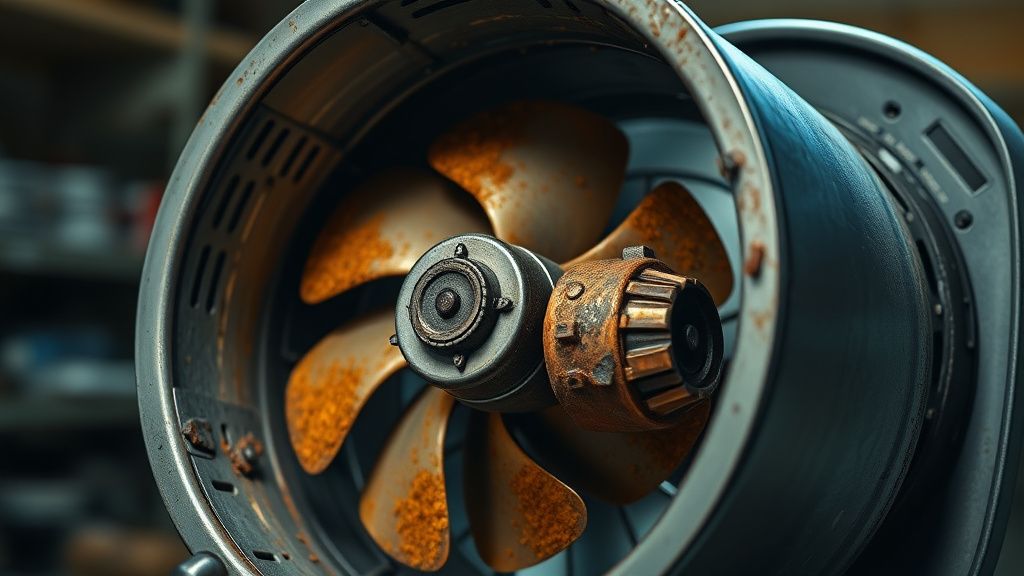
- The Diagnosis: The grease mist bypasses the crumb tray and coats the internal fan blades. As the debris hardens into a carbonized crust, the fan becomes unbalanced. Even a few grams of uneven weight at 3,000 RPM will induce severe harmonic vibration in the entire outer shell of the unit.
- The Fix: Before you even reach for a screwdriver, you need to perform a "deep clean" of the fan blades using an aerosol degreaser (food-safe, of course) and a soft brush. If the noise persists, proceed to the chassis disassembly.
Disassembly Protocol and Electrical Safety Warnings
Before you touch the internals, realize that you are working with a device that manages high-amperage heating elements and a capacitor-based control board.
Standard Operating Procedure:
- Hard Power Reset: Unplug the unit for at least 24 hours. The internal capacitors—designed to smooth out power surges—can hold a charge long after the plug is pulled.
- Tool Requirements: You will need a security-bit driver set (Torx T10, T15, and T20 are industry standards for these appliances) and a sturdy spudger for opening the plastic casing.
- The "Hidden Screw" Trap: Like many appliances from the last decade, manufacturers love to hide screws under rubber feet or behind the control panel sticker. For the Vortex Plus, check the underside of the unit and the rear intake vent area.
Troubleshooting the Motor Bearing and Impeller Balance
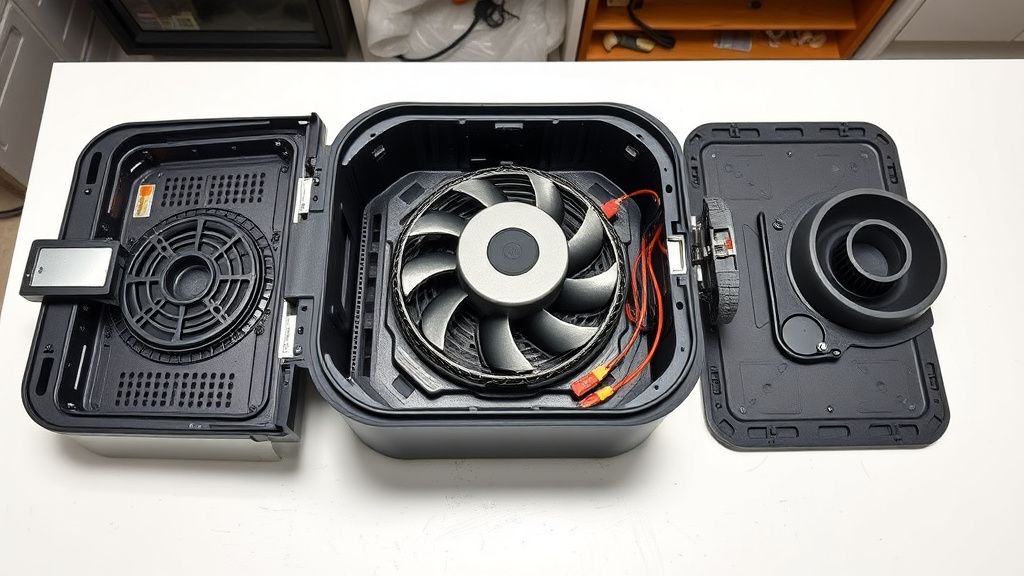
Once inside, examine the fan assembly. The impeller is usually a stamped aluminum piece. Check for "play" by grasping the fan blade and gently wiggling it along the axis of the motor shaft.
- The "Play" Test: There should be almost zero lateral movement. If you feel a "click-click" sensation, the sleeve bearing inside the motor is shot.
- The Lubrication Myth: You might see YouTube tutorials suggesting you spray WD-40 or machine oil into the motor housing. Do not do this. Most of these motors are sealed. Adding petroleum-based lubricants will only attract more dust and create a fire hazard once the unit reaches operating temperatures. If the bearing is gone, the motor unit must be replaced or the entire device decommissioned.
Industry Debate: Repairability vs. Planned Obsolescence
There is a significant divide in the repair community regarding "Fixing" vs. "Replacing." Some maintainers on iFixit argue that the effort required to source a replacement motor—which is often an OEM part exclusive to the manufacturer—is not worth the $80-$100 price tag when a new unit might be on sale for $120.
Conversely, the "Right to Repair" community points out that the fan motors are standard 120V AC or 24V DC motors. If you are handy with a soldering iron and can match the CFM (Cubic Feet per Minute) rating, you can often transplant a motor from a broken unit or an equivalent donor. However, the engineering compromise here is the wiring harness; manufacturers often use proprietary connectors to prevent easy component swapping.
The Impact of User Error and Maintenance Cycles
The "Vortex Plus" failure rate often spikes after the one-year warranty expires, which is no coincidence. It is an operational reality of modern kitchen hardware. The fan is the only moving part in the entire system, making it the primary point of failure.
- The Overload Factor: Users frequently pack the basket to the brim. This restricts airflow, forcing the fan to work harder against back-pressure, which increases the thermal load on the motor windings.
- The Cleaning Neglect: The rear intake vent is the "forgotten" part of the machine. If this is clogged with dust or grease, the motor loses its primary source of cooling, leading to early bearing seizure.
Advanced Workarounds: When You Can't Buy the Part
If you have successfully identified that the motor is failing but cannot find a replacement part, there are "macgyvered" solutions often discussed in open-source hardware forums. Some users have successfully retrofitted cooling fans from high-end computer power supplies (PSUs). While this requires significant electrical knowledge—matching the voltage, amperage, and thermal resistance—it is a viable workaround for those who refuse to send a perfectly good chassis to a landfill.
Warning: If you choose to modify the internal fan, you are overriding the thermal protection logic. Always use high-temperature, flame-retardant wiring and ensure your airflow remains unidirectional toward the heating element.
Why does my Instant Pot Vortex Plus make a loud grinding sound only after it reaches temperature?
This is a classic symptom of thermal expansion. As the metal housing heats up, the fan blade housing warps slightly. If your fan was already "barely touching" the side of the casing, the heat causes it to make full contact. Check for any loose screws on the internal fan shroud and ensure the fan is perfectly centered on the motor shaft.
Can I just use WD-40 to fix the screeching fan?
Absolutely not. WD-40 is a solvent, not a lubricant. It will clean out any remaining factory grease and then evaporate, leaving your motor bearing worse off than before. Furthermore, it is not food-safe and could vaporize into your cooking chamber. Use high-temp, food-safe silicone grease if you absolutely must, but be aware that it’s rarely a long-term fix for a worn bearing.
Is it safe to continue using the air fryer if the fan is noisy?
If the noise is just a hum, you might get away with it for a few more weeks. If it is a screeching or grinding sound, the motor is struggling. This creates excess heat in the motor windings, which can lead to an electrical short or, in worst-case scenarios, a localized fire. Stop using the unit until you have inspected the fan assembly.
Conclusion: The Operational Reality
The Instant Pot Vortex Plus is an efficient machine until it isn't. When the fan begins to howl, it is a signal that the appliance has reached its mechanical limit. Whether you choose to dive into the chassis for a repair or admit that the unit has served its purpose, the key takeaway is that convection fans in small appliances are consumables. Treat them with care—keep the vents clear, don't overload the basket—and you might squeeze an extra few years out of what is essentially a glorified, high-speed hair dryer for your chicken wings.