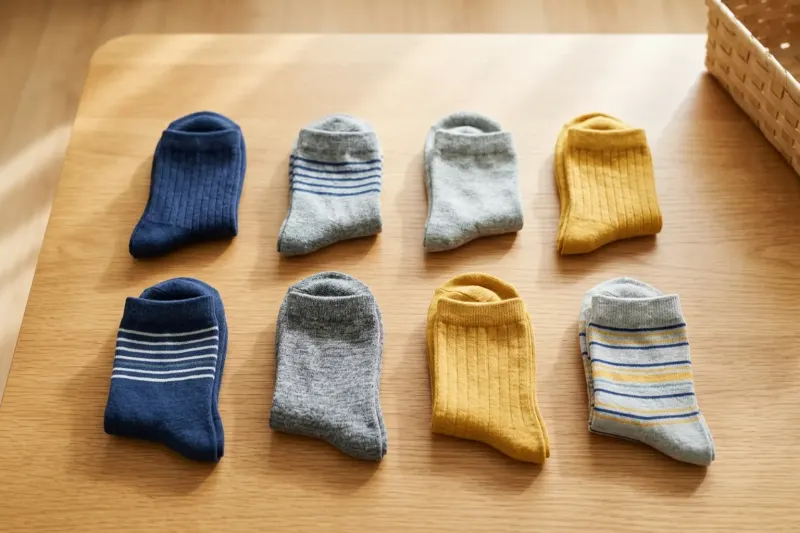
When faced with a full basket of clean laundry, pulling out eight to ten pairs of contrasting socks gives children ages 4 to 8 a focused, screen-free sorting and matching activity. Dumping an entire household load onto the floor often creates visual clutter, making it hard for young learners to distinguish subtle differences in cuff styles, heel shades, or fabric lengths. Selecting a small, curated set of clean, dry socks lets caregivers guide children step-by-step through distinct classification challenges: matching identical mates, grouping items by a single visible rule, building repeating color patterns, and practicing one-to-one counting. Guidance from public early-learning frameworks shows that regular domestic routines offer practical opportunities to explore nonstandard measurement, set totals, and sequence prediction without commercial kits. This guide outlines structured, low-friction activities organized by age and complexity, keeping table or floor play calm, safe, and collaborative under active adult supervision.
Sort by One Feature Before Combining Rules
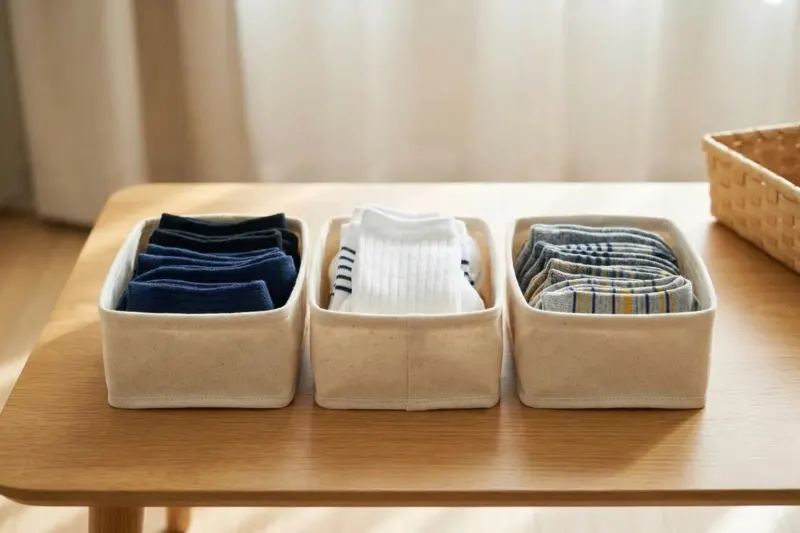
Children classify objects with greater confidence when focusing on one obvious physical feature before attempting to coordinate multiple conditions at once. The Early Childhood Learning and Knowledge Center at headstart.gov observes that early learners naturally compare items along single dimensions—such as length, wearer, or base color—before balancing overlapping criteria. For children ages 4 to 5, begin with a straightforward sorting task: separate socks into two distinct bins or piles using a single rule, such as adult socks versus child socks, or solid white socks versus colored socks. To reduce visual search fatigue, adopt a staging method documented by networkchildcare.com. Lay one sock from each pair in an orderly horizontal row across the rug or table, placing the matching mates into a shallow basket. The child draws one sock from the basket, scans the displayed row, and places it next to its partner. This structured setup eliminates the frustration of rummaging through an unstructured pile. Once a child matches single features consistently, introduce dual-attribute classification for children ages 6 to 8. Prompt the player to identify items that meet two criteria at once, such as finding socks that are both small and striped. If a child groups two items unexpectedly—for example, placing a child crew sock with an adult athletic sock because both have gray heels—ask them to explain their thinking rather than marking it wrong. Guidance from the National Association for the Education of Young Children at naeyc.org highlights that acknowledging a child's observed categories supports meaningful math dialogue and validates flexible classification reasoning.
Build Linear Repeating Sequences and Predictions
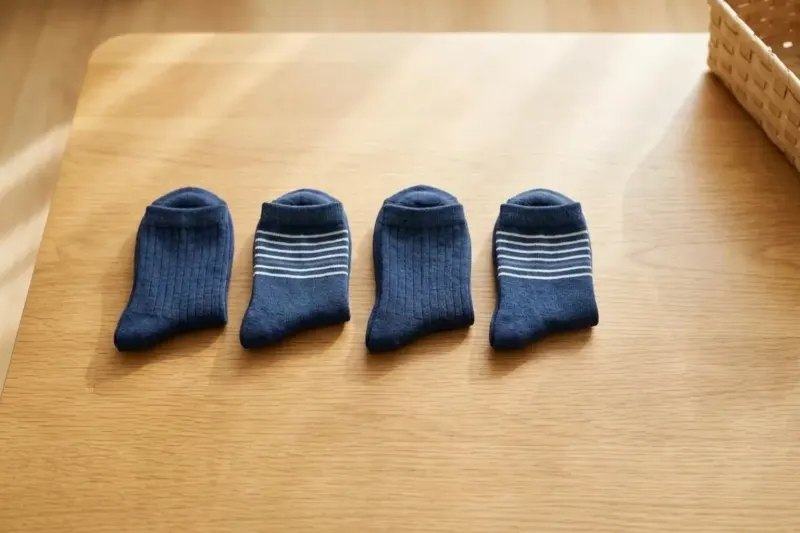
Arranging socks in alternating lines turns laundry into an intuitive demonstration of sequence structure and pattern prediction. An activity guide from Michigan State University Extension at msu.edu outlines an accessible sequencing exercise: gather two socks of one solid color and three of another, align them horizontally in an alternating sequence (such as navy, white, navy, white, navy), describe the order aloud together, and invite the child to identify which color belongs next. Caregivers can adjust the pattern difficulty to match the child's experience. A simple alternating pattern (AB), such as black, red, black, red, works well for children ages 4 to 5 who are practicing two-step rhythms. A double repeat pattern (AABB), such as short ankle sock, short ankle sock, tall knee sock, tall knee sock, helps children distinguish length and height differences while maintaining an orderly rhythm. For children ages 6 to 8, a three-unit sequence (ABC or AAB)—such as solid, striped, polka dot, solid, striped, polka dot—encourages closer tracking of multiple visual features across a longer line. If a child hesitates or places an unexpected item, avoid pointing out the error directly. Instead, point to each sock in sequence while chanting the pattern with a clear rhythm: 'Navy, white, navy, white... what comes next?' Hearing the verbal rhythm often helps children identify the next logical piece when visual inspection alone feels challenging.
Count Sets, Pairs, and One-to-One Matches
Counting socks while pairing and folding them provides a practical way to connect verbal numbers to physical quantities. Guidance from naeyc.org explains that reciting numbers by rote is distinct from understanding cardinality—the mathematical concept that the final number counted represents the total quantity in the set. To reinforce one-to-one correspondence, children benefit from touching each item individually as they count aloud. Begin by counting the flat, unpaired socks one by one as they leave the basket: 'One, two, three, four, five, six.' Once the child matches the items into pairs, shift the counting unit to the newly formed sets: 'One pair, two pairs, three pairs.' For children ages 6 to 8 who are exploring early multiplication or skip-counting, point out that three pairs equal six individual socks, demonstrating skip-counting by twos (two, four, six). Rolling or folding paired socks also provides a natural closing step. Folding the elastic cuff of one sock over its partner requires using both hands together. If tight athletic bands are difficult for smaller hands to stretch, demonstrate a simple flat fold: lay both socks flat against each other and fold them in half across the middle. This keeps the pair organized in the drawer without frustrating hand strength.
Safety Checks and Material Boundaries
Everyday household items make accessible activity supplies, but establishing clear safety boundaries is essential. The National Day Nurseries Association at ndna.org.uk notes that sock-sorting play requires careful pre-screening of all materials by an adult and continuous adult supervision throughout the activity. Before starting, an adult should inspect all socks and the surrounding room. Check for small loose parts by removing infant booties, socks with peeling silicone traction dots, attached decorative pom-poms, buttons, pins, or loose unraveling threads that could pose a choking hazard. Never assume that a child's age alone eliminates the hazard of mouthing objects. Keep all cleaning supplies strictly inaccessible: store concentrated liquid detergent pods, powders, and fabric sprays in locked overhead cabinets well away from the play area. Never use laundry baskets containing residual detergent dust or unwashed, soiled garments. Set floor boundaries by conducting the game on a low table or a clean carpeted floor. If an activity involves carrying matched pairs across a room to a dresser, make sure children are barefoot or wearing rubber-soled shoes; running or walking on smooth hardwood or laminate floors in socks presents a significant slipping hazard. Finally, keep sessions between 10 and 20 minutes. Ending the game while energy remains positive keeps household routines calm and engaging.
Selecting Sock Sorting Rules by Age and Experience
| Situation | Consider | Why |
|---|---|---|
| A child is age 4 or easily overwhelmed by visually cluttered displays. | Lay one sock from each of 4 to 6 pairs in a visible line, keeping matching mates in a shallow bin. | Limits visual clutter and simplifies matching to direct one-to-one comparisons. |
| A child is ages 4 to 5 and readily matches identical colors. | Sort socks into two functional piles: adult sizes versus child sizes. | Introduces nonstandard length and size comparisons based on a single observable physical feature. |
| A child is ages 6 to 8 and understands single-attribute matching. | Build multi-tier patterns (such as AABB or ABC) or sort by two simultaneous criteria (such as small and striped). | Exercises multi-attribute classification and linear sequence prediction using familiar household textiles. |
Hypothetical Worked Session: A 15-Minute Three-Stage Activity
This hypothetical session illustrates how a caregiver can structure a 15-minute screen-free laundry activity for a 5-year-old child using 8 pairs of clean, dry socks (16 individual items total: 4 adult pairs and 4 child pairs in solid and patterned fabrics). The activity takes place across a cleared table measuring approximately 90 cm by 60 cm (35 in by 24 in) at an estimated material cost of $0.00. Stage 1 (Pair Matching, 5 minutes): The caregiver aligns four child socks in a horizontal row and places the four matching mates into a shallow basket. The child pulls one mate at a time and places it beside its partner. Stage 2 (Single-Attribute Sorting, 5 minutes): The caregiver combines all 16 socks into an open tray and invites the child to sort them into two piles based on wearer: grown-up socks and kid socks. Stage 3 (Pattern Sequence, 5 minutes): Using four solid blue socks and four gray socks, the caregiver lays out a line: Blue, Gray, Blue, Gray, Blue, and prompts the child to complete the sequence. All durations, dimensions, and item counts are illustrative suggestions rather than fixed rules.
- Unsorted Basket
- Pairing Zone
- Pattern Sequence Line
When this approach is not a good fit
This activity is unsuitable for unsupervised play, for children who mouth fabrics without continuous one-on-one adult monitoring, or in settings where laundry cannot be inspected beforehand for loose threads, pins, and small decorative trims. It is also unsuitable near wet utility sinks, open laundry chutes, unwashed laundry piles, or stored chemical detergents and pods.
PUT THIS GUIDE TO USE
Find an activity for your family
Sources & further reading
AI-assisted writing and concept images. Sources and automated checks support the process; an adult should check materials and adapt activities to their child.
How we create our guides · Suggest a correction