When you need a low-prep activity on a quiet afternoon, a paper shape hunt turns ordinary household items into a direct matching game. Children take hand-cut paper outlines—such as circles, squares, and triangles—and walk through designated living areas to spot matching profiles in wall clocks, picture frames, cushions, and rugs. Following early geometry and literacy activity models from cooperative extensions and public broadcasting programs, this hunt channels energy into careful looking rather than running. All cutting happens while seated at a table under adult supervision before anyone moves around the room.
Set Ground Rules and Clear the Room
Before bringing out paper or scissors, set physical boundaries for the activity. Limiting the search to one or two tidy rooms keeps children within your line of sight and prevents rushing into hallways. Enforce a strict no-climbing rule: all target items must sit at or below eye level. Close doors leading to stairwells, bathrooms, utility closets, and home offices. Walk the search floor first to clear loose charging cables, sliding rugs, and fragile keepsakes, following household child-safety guidelines from Penn State Extension. Require a steady walking pace: the game centers on careful looking, not sprinting.
Related guide: 10 No-Prep Indoor Games for Kids Ages 4–8
Cut Templates and Prep Recording Sheets
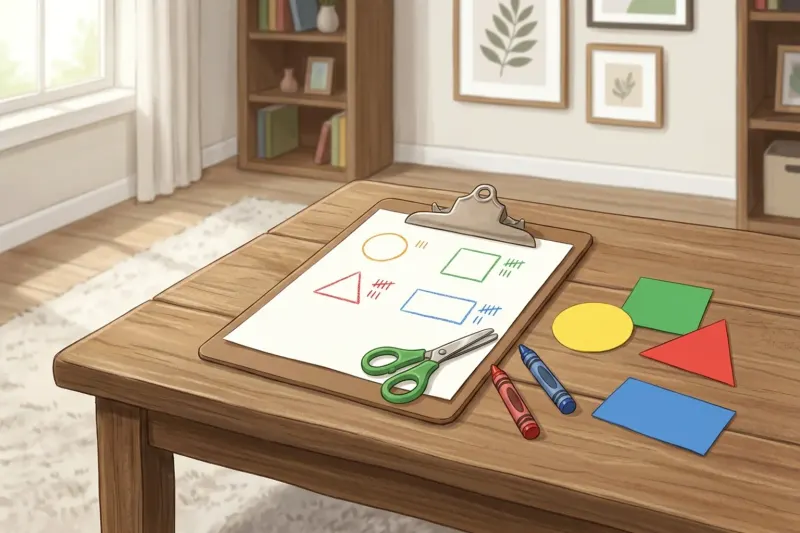
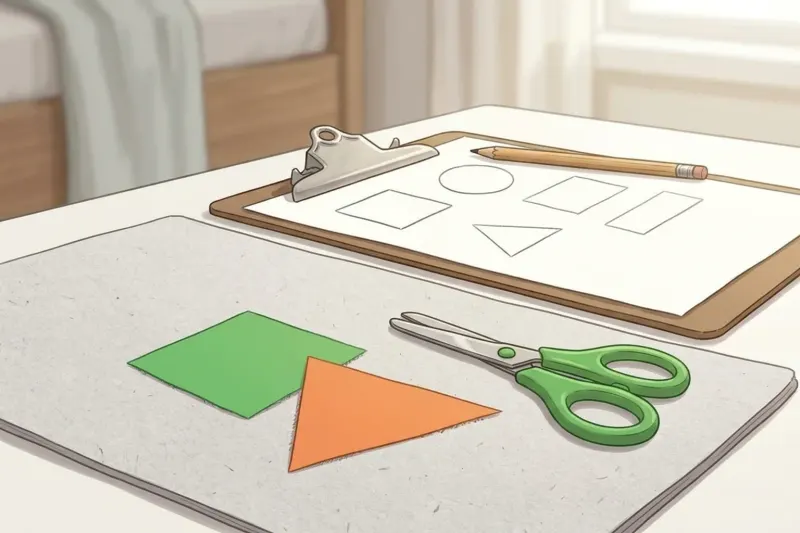
The hunt uses paper cutouts as physical matching cards. Cut all shapes at a cleared table before beginning the search, keeping scissors away from walking paths. Adult supervision is essential whenever children handle scissors. For children ages 4 to 7, supply safety scissors with rounded, blunt tips and covered blades. Children age 8 can manage larger child scissors with safety edges, following tool manufacturer safety standards from Fiskars. An adult can cut the shapes ahead of time if a younger child is still building hand control. Cut primary two-dimensional silhouettes from plain or colored paper: a circle about 10 cm across, a square about 10 cm by 10 cm, a rectangle about 8 cm by 13 cm, a triangle with a 10 cm base, and an oval about 8 cm by 12 cm. Hand each child a rigid clipboard or firm piece of cardboard fitted with plain paper and a non-toxic pencil or crayon. A mobile board lets children record their finds without pressing marking tools against walls or furniture.
Related guide: Five-Minute Waiting Games for Everyday Errands
Follow the Five-Step Routine
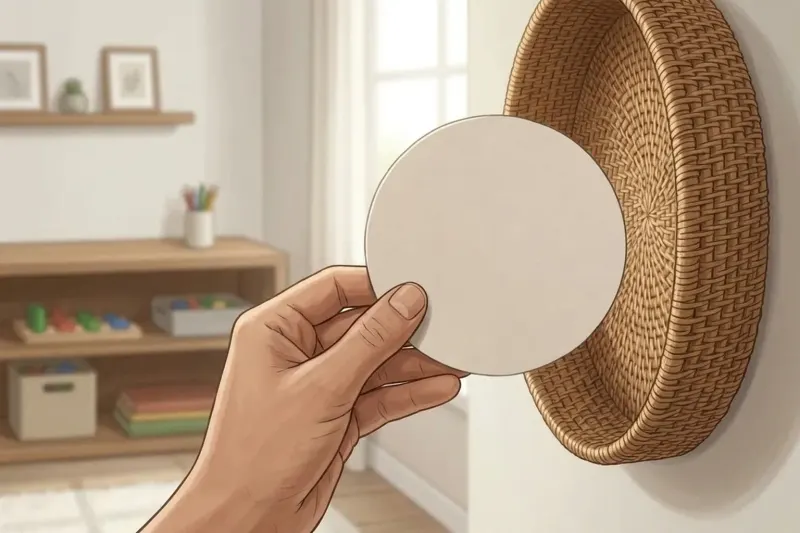
A structured routine keeps the hunt organized and prevents children from pulling books and decorations off shelves. Michigan State University Extension outlines a five-part progression that links paper templates to room observation. First, the child selects one paper cutout card at the main prep table. Second, holding the card, the child walks the designated zone at an ordinary walking pace. Third, the child holds the paper cutout close to an item—without touching delicate surfaces—to compare edges and corners. Fourth, the child names both the shape and the object aloud (such as, 'The wall clock is a circle'). Fifth, the child pauses, sets the clipboard on the floor or a table, and places a tally mark inside that shape's box on their tracker sheet. Leave every object where it rests. Keeping books, cushions, and framed pictures in place avoids household mess and eliminates post-game cleanup disputes.
Related guide: Small-Space Indoor Scavenger Hunts
Adjust Rules by Age Band
You can adapt the search rules depending on each child's familiarity with shapes, following early learning frameworks from PBS KIDS and Penn State Extension. For ages 4 to 5, focus on primary two-dimensional outlines (circle, square, rectangle, triangle). An adult walks directly alongside the child while they place tally marks inside pre-drawn shapes on their clipboards. For ages 6 to 7, introduce shapes such as the oval, rhombus, or trapezoid. Children count sides and corners, recording names and numbers while an adult supervises from a seated spot in the room. For age 8, extend the search to three-dimensional solids (cylinders, cubes, rectangular prisms, and spheres). Children write item names and classifications on an inventory list. For children ages 6 to 8, use standard geometric terms. Encourage words such as 'rhombus' instead of 'diamond', and prompt them to count 'sides and angles' rather than informal corners.
Wrap Up and Store Supplies
Wrap up the activity while children remain engaged, usually after 15 to 25 minutes of hunting. Return to the prep table to count findings together. Total the tally marks in each category, letting children count aloud to practice number sequences. Slip reusable paper cutouts into an envelope or folder for future afternoons. Return pencils and clipboards to their storage bins, leaving the living area tidy and immediately back to normal.
Shape Hunt Configuration Decisions
| Situation | Consider | Why |
|---|---|---|
| Participant is 4 or 5 years old and still building scissor dexterity | An adult cuts templates in advance, or supervises the child using blunt-tip safety scissors while seated at a table | Prevents hand fatigue and keeps cutting tools stationary before the child begins walking |
| Child easily spots basic two-dimensional shapes within a few minutes | Switch to three-dimensional solid shapes such as cylinders, cubes, and rectangular prisms | Expands the search without extra supplies by directing attention to volume and solid form |
| Search area is small or contains delicate household decor | Limit the search perimeter to a single low bookshelf or a designated rug boundary | Keeps walking paths clear and reduces the risk of accidental contact with breakable items |
| Children of different ages (for example, ages 4 and 8) participate together | Give basic 2D flat shapes to the younger child and 3D solid classifications or side-counting to the older child | Enables both children to search the same room at their own pace without competing for the same targets |
Hypothetical Walkthrough: 20-Minute Living Room Hunt
In this hypothetical example, an adult and a 5-year-old child set up a 20-minute hunt in an apartment living room measuring about 4.5 m by 4.0 m (15 ft by 13 ft). Setup takes about 5 minutes: sitting together at a low coffee table measuring 90 cm by 50 cm (35 in by 20 in), they cut four paper shapes (a 10 cm circle, a 10 cm square, an 8 cm by 12 cm rectangle, and a 10 cm triangle) using blunt-tip safety scissors. The walking search runs for roughly 12 minutes under continuous adult supervision. Walking at a normal pace, the child finds five rectangular picture frames on a low sideboard, two circular pillows on the sofa, four square floor tiles along the entryway boundary, and one triangular shelf bracket. The child marks tallies on an A4-sized clipboard (approximately 21 cm by 30 cm / 8.3 in by 11.7 in). Pack-up takes about 3 minutes: templates slide into a paper folder, and the clipboard returns to a cubby, leaving the living room in its original state.
- Preparation Table & Seated Station
- Sofa & Cushion Search Area
- Low Bookshelf (Rectangles & Squares)
- Wall Art & Low Sideboard (Frames & Solids)
- Clear Walking Lane (Trip-Free Zone)
When this approach is not a good fit
This activity is unsuitable for children under age 4 due to the use of cutting tools and the abstract nature of matching 2D outlines to room fixtures. It should not take place in kitchens, garages, utility rooms, or near accessible heating elements, loose electrical cords, or unstable, top-heavy furniture. It is also unsuitable for high-energy gross-motor play, as the game requires a measured walking pace to prevent trips and collisions.
PUT THIS GUIDE TO USE
Find an activity for your family
Sources & further reading
- Preschool Activity Pages: Shape Hunt - MSU Extension
- Nurturing Learning in Three- and Four-Year-Olds: Language and Literacy - Penn State Extension
- Keeping Children Safe at Home - Penn State Extension
- Kids Scissors and School Tools - Fiskars
- Math Milestones: Shapes for Age 6 - PBS KIDS
- Exploring Shapes - PBS KIDS
AI-assisted writing and concept images. Sources and automated checks support the process; an adult should check materials and adapt activities to their child.
How we create our guides · Suggest a correction