When bad weather keeps young children cooped up in an apartment or modest house, open floor space quickly disappears. Letting children sprint down narrow hallways invites bumped corners, bruised shins, and tipped lamps. An indoor scavenger hunt built around firm physical perimeters channels that restless energy into calm, focused observation. By relying entirely on items already sitting on your shelves and setting clear non-climbing rules, you can run an engaging search game without scrambling furniture or collecting clutter across the home.
Establish the Search Zone and Ground Rules
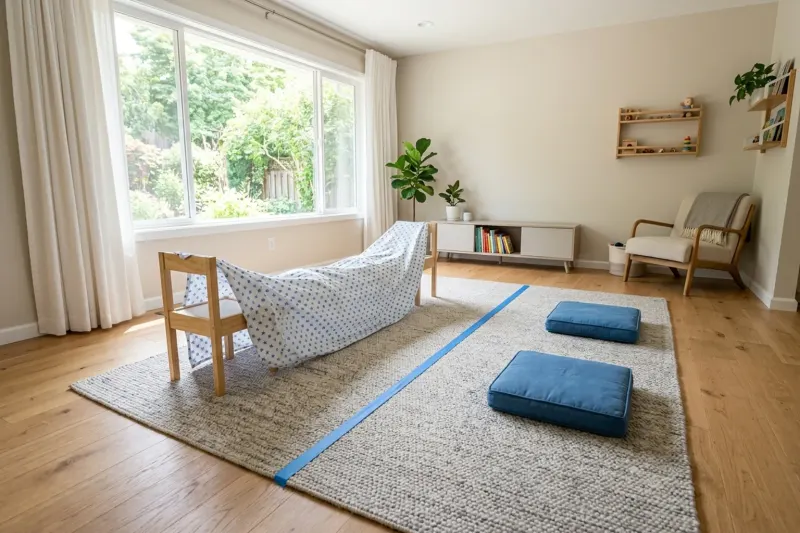
Before announcing any hunt, designate the exact perimeter of the game. Confining play to a single common room prevents collisions in tight doorways and keeps children away from cooking surfaces, water heaters, and front entryways. Continuous adult supervision is required to ensure these boundaries hold throughout the activity.
- **Set vertical limits:** Keep all clues and targets at or below your child's shoulder height. Enforce an unbending no-climbing rule: children must never step onto dining chairs, ottomans, coffee tables, or sofa arms to reach an item.
- **Insist on walking feet:** Require children to walk at all times to prevent slips on hard flooring or sliding rugs.
- **Clear transit corridors:** Tuck power cords against the wall and shift footstools out of central pathways before handing out the first clue.
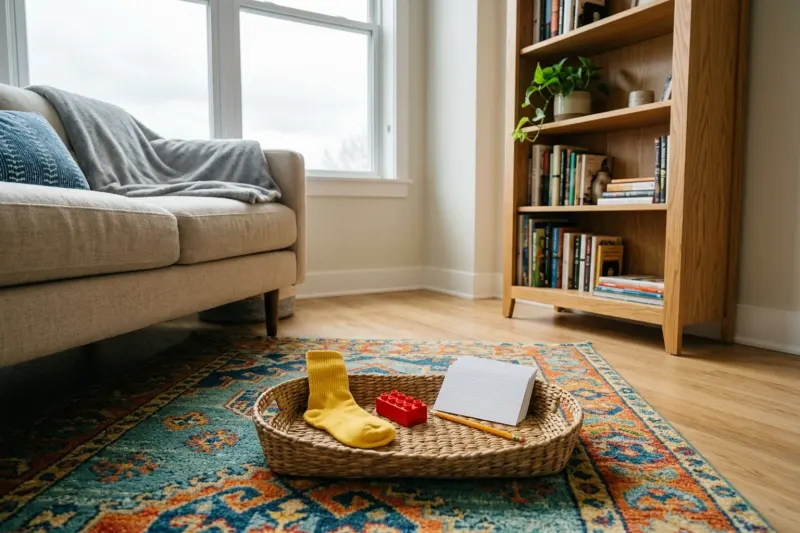
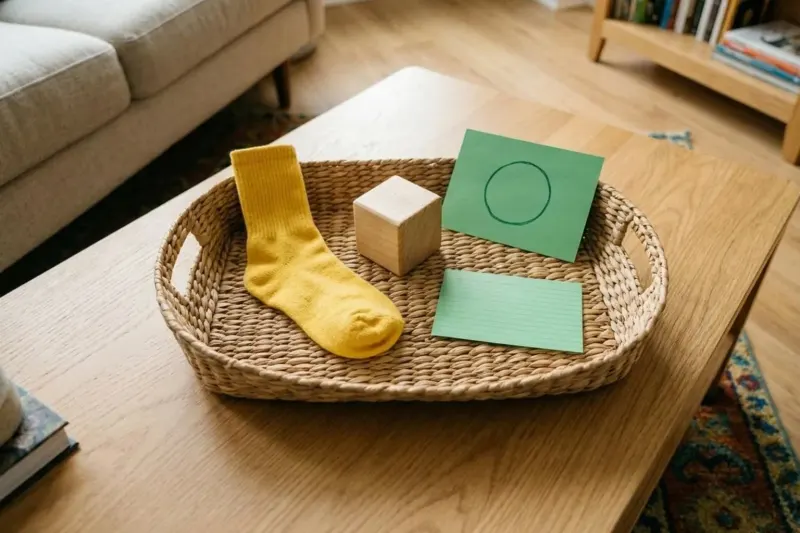
- **Set up a home base:** Place an empty shoe box, shallow woven basket, or flat tray on an area rug or low table. Children must walk back to deposit each found item into this tray before receiving their next prompt, preventing them from carrying armfuls of loose belongings.
Related guide: 10 No-Prep Indoor Games for Kids Ages 4–8
Sensory and Attribute Search Routines
For children ages 4 to 6, prompt-based hunts focused on physical textures, colors, and basic attributes offer concrete goals that require close looking rather than frantic speed. Educational guidance from Mount Sinai Parenting Center suggests comparative challenges—such as identifying an object with a specific texture, followed by one with the opposite trait—to help young children practice sorting and categorization.
Offer prompts one at a time on scrap paper or index cards:
- **Texture pairings:** Request something smooth (like a plastic building block or a polished drink coaster), followed by something rough (like an unlaundered washcloth or a corrugated cardboard sleeve).
- **Comparative weight:** Ask for an item that feels light (such as a cotton ball or foam building cube), followed by one that feels heavier in the hand (such as a sturdy board book).
- **Color and geometry:** Direct the search toward obvious shapes visible across the room, such as a circular jar lid, a square drink coaster, or two green clothing items.
In especially small layouts where floor pathways are tight, use a spot-and-point format. The child stays on the central base rug, scans the room, and points out the item that matches the card without moving it.
Related guide: Five-Minute Waiting Games for Everyday Errands
Measurement and Comparative Math Hunts
For children ages 5 to 7, scavenger hunts can introduce basic comparison concepts without requiring rulers. The National Association for the Education of Young Children highlights non-standard measurement activities as practical tools for practicing everyday comparison.
Hand the child a single household item to serve as their standard measuring tool—such as an unsharpened wood pencil, an interlocking plastic block, or a paper strip cut to 15 centimeters (6 inches). Adult supervision is necessary whenever children handle small household pieces like buttons or paper clips to ensure safe sorting.
| Prompt Type | Clue Given to Child | Household Target Examples |
|---|---|---|
| Exact Match | Find an item roughly equal in length to your pencil | Children's toothbrush, marker, toy spoon |
| Shorter Than | Find two sturdy objects shorter than your plastic block | Wide plastic bottle cap, large button, game die |
| Longer Than | Find one soft item longer than two pencils placed end to end | Hand towel, folded winter scarf, clean athletic sock |
| Quantity Sort | Collect exactly four safe items that fit inside a small paper cup | Large paper clips, buttons, wooden craft sticks |
Using uniform reference units keeps the game centered on checking dimensions rather than pulling half the toy box onto the rug. After finding an item, the child returns to the base station to place the objects side by side before moving on.
Related guide: Living-Room Movement Games With No Jumping
Sequenced Clue Trails and Index Card Paths
For children ages 6 to 8, a linked path of written cards encourages careful reading and spatial sequencing. West Virginia University Extension and Michigan State University Extension highlight simple clue trails as practical ways to connect literacy practice with physical indoor movement.
Write or sketch four to six numbered clues on individual index cards. Place each at a known landmark before starting, with each card directing the child to the next spot:
1. **Card 1 (Handed directly to the child):** "Look under the folded green blanket on the armchair."
2. **Card 2 (Under the blanket):** "Check the lowest shelf where animal picture books sit."
3. **Card 3 (On the book shelf):** "Look inside the left rain boot by the entryway bench."
4. **Card 4 (Inside the boot):** "Find the final card resting beneath the desk lamp on the small side table."
To expand the game, flip roles. Give an older child four blank cards and invite them to write a sequence within the same room for an adult or sibling to follow. Creating the clues asks them to evaluate landmarks and write clear location directions.
Structured Pack-Away and Room Reset
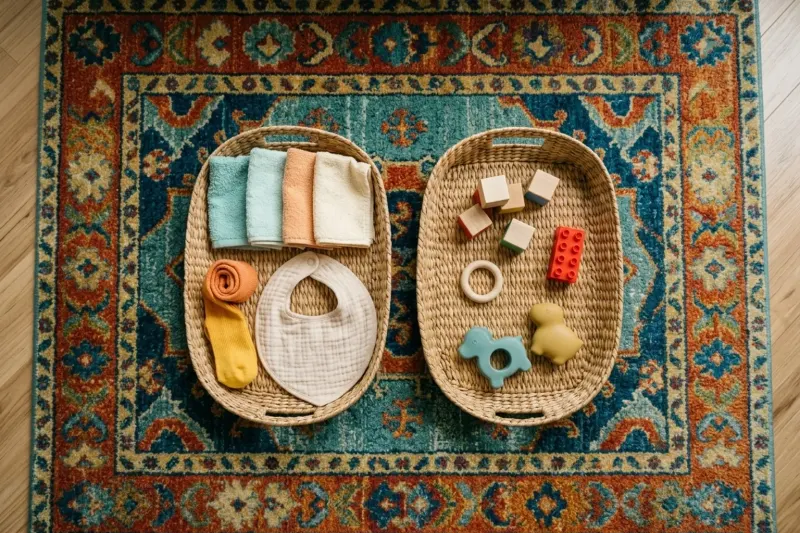
A scavenger hunt in a compact home should end with a clean floor rather than scattered belongings. Build the tidy-up step directly into the game by treating it as a final sorting challenge.
- **Return by category:** Direct the child to walk items back to their storage spots by group. Return all books first, followed by plastic toys, and finish with fabric items.
- **Check the perimeter:** Walk the room boundaries together from the central rug to make sure all low cabinet doors and storage bins opened during the search are pushed shut.
- **Store clue cards:** Have the child collect index cards in numerical order and secure them with a rubber band inside an envelope for the next rainy morning.
Wrapping up with a quick reset leaves the living room safe and fully usable for the rest of the household.
Choosing the Right Scavenger Hunt Structure
| Situation | Consider | Why |
|---|---|---|
| Very tight room with heavy furniture and minimal floor clearance | Spot-and-Point Observation Hunt | Eliminates physical retrieval and collisions while keeping the child engaged from a single base location. |
| Single child aged 4 to 5 with early verbal vocabulary | Single-Attribute Sensory Search | Allows the child to focus on one concrete physical property (such as soft, rough, or blue) at a time. |
| Child aged 6 to 8 capable of independent reading | Written Clue Card Sequence | Incorporates multi-step literacy clues and lets older children create return trails for adults. |
| Two siblings playing together in a shared space | Cooperative Measurement Match | Pairs children to compare objects against a common measuring unit without competitive rushing. |
Hypothetical Apartment Living Room Session
In a hypothetical 3.0 m by 4.0 m (10 ft by 13 ft) living room, an adult sets up a 6-item attribute hunt. Total prep time is approximately 5 minutes, using zero purchased materials ($0 cost). The adult designates a 1.5 m by 2.0 m (5 ft by 6.5 ft) central rug as the sole search boundary. The adult provides a paper cup and 6 index cards with drawn icons (a circle, a wavy texture line, a square, a blue dot, a heavy dot, and a feather symbol). The child spends 15 to 20 minutes walking from the rug to the low shelving unit 1.0 m (3.3 ft) away, fetching one item per card, placing it in the cup, and resetting the floor afterward.
- Low Bookshelf (Permitted Search Zone)
- Central Area Rug (Walking Zone)
- Base Station Coffee Table & Basket
- Sofa Boundary (No-Climb Barrier)
When this approach is not a good fit
This activity is unsuitable in rooms with open renovations, exposed wiring, non-anchored leaning mirrors or heavy tall bookcases, or where continuous adult supervision cannot be maintained to enforce no-climbing rules.
PUT THIS GUIDE TO USE
Find an activity for your family
Sources & further reading
- https://parenting.mountsinai.org/tip-of-the-week/indoor-scavenger-hunt-ideas
- https://www.naeyc.org/resources/blog/preparing-young-children-school
- https://www.canr.msu.edu/resources/preschool-activity-pages-scavenger-hunt
- https://extension.wvu.edu/files/d/3ff2d956-97e4-48d9-abdd-fdb4ce8663a8/make-reading-come-alive-digital.pdf
- https://extension.psu.edu/programs/betterkidcare/news/supporting-fine-and-gross-motor-skills-in-and-out-of-the-classroom
AI-assisted writing and concept images. Sources and automated checks support the process; an adult should check materials and adapt activities to their child.
How we create our guides · Suggest a correction