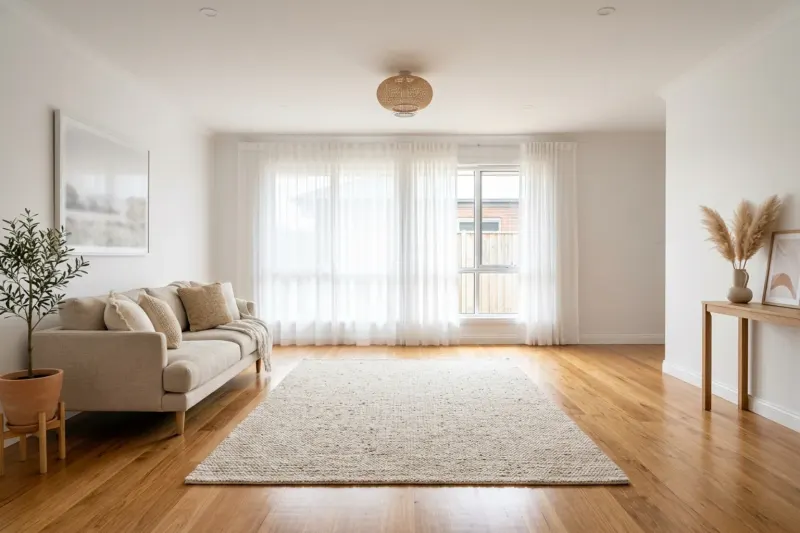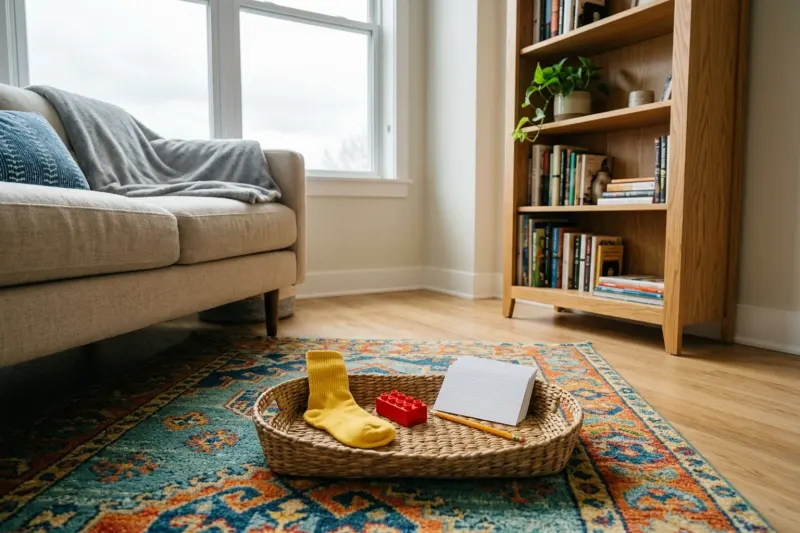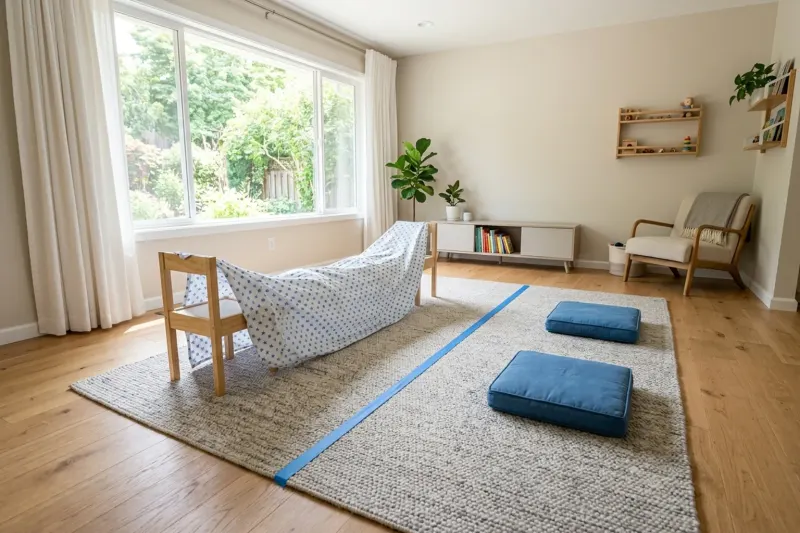
On a day when jumping would disturb the neighbors, a slow line walk or a brief freeze game gives you another way to play together. Clear a suitable patch of floor first. Keep movements gentle, take turns, and skip any idea that does not fit the room or your child.
Clear a suitable place to play
Move loose clutter and check the play area for slippery surfaces, cables, sharp edges and unstable furniture. Leave enough clear room for the actual movement; a fixed distance does not certify that a space is safe. An adult should supervise and adjust or stop the game as needed.
Keep doorways and exits clear. Take turns on a narrow route instead of sending children in opposite directions. Choose a seated or still game when there is not enough suitable space.
Related guide: 10 No-Prep Indoor Games for Kids Ages 4–8
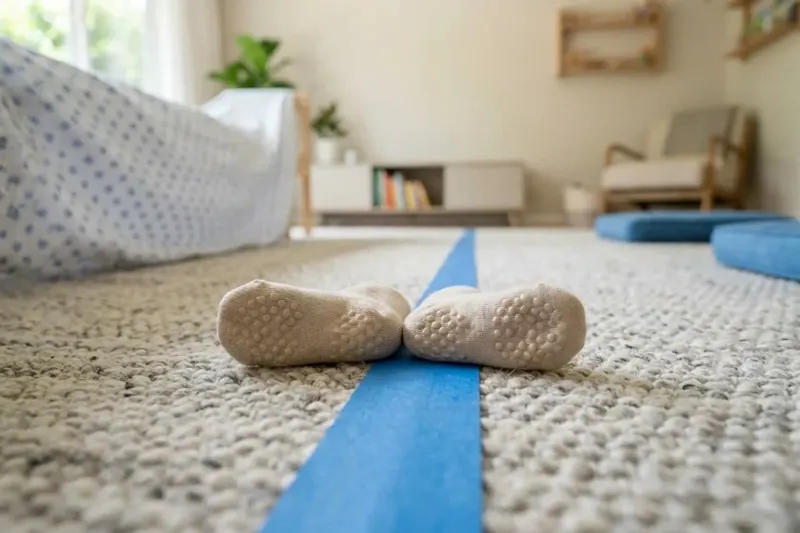
Follow a line at walking pace
Use an existing line or pattern on the floor if it provides a clear, suitable route. If you choose tape, check both the floor maker’s and tape maker’s guidance and try it in an inconspicuous area first. Low-tack tape is not guaranteed to be safe for every finish or carpet.
Walk slowly beside or along the line, then stop and turn carefully before coming back. Change the pretend setting rather than adding speed: perhaps it is a path through a quiet forest. Keep turns short and follow the child’s interest.
Skip backward walking, objects balanced on the body and additional challenges if they make the route less steady. There is no required track length; use only the clear space you actually have.
Related guide: Small-Space Indoor Scavenger Hunts
Try a gentle animal walk
Imitating animal gaits spreads a child's weight across hands, knees, and feet, minimizing vertical impact against floorboards. Early childhood physical activity programs frequently recommend crawling variations to engage large muscle groups silently.
- **Bear Walk:** Place hands and feet flat on the floor with hips lifted. Walk forward slowly using opposite hand and foot steps.
- **Crab Walk:** Sit on the floor, place palms flat behind the hips, lift the seat 5 cm (2 in) off the floor, and shuffle backward or sideways.
- **Penguin Waddle:** Keep arms pressed straight against the sides and take small, short steps landing flat on the heels.
- **Snake Slither:** Lie prone on the stomach across a flat rug, pulling forward with forearms while keeping legs trailing flat behind.
Keep circuits relatively short—around 3 meters (10 ft) per animal style—to help children maintain control and stay clear of walls.
Related guide: Five-Minute Waiting Games for Everyday Errands
Keep the route simple
A simple clear route is enough. You do not need a chair tunnel, cushion bridge or climbing obstacle to make floor-level play interesting. Leave unstable furniture and loose, sliding cushions out of the route.
An adult can suggest a pretend destination or demonstrate a comfortable movement on the floor. Let the child choose whether to join, and offer a seated version if that is a better fit. Stop if the child is uncomfortable, tired or moving faster than the space allows.
Pause for a slow-motion statue
Classic freeze games often prompt sudden skid stops and loud stomps. Switching to slow-motion cues preserves the engagement while keeping the floor quiet.
| Game Variation | Movement Rule | Freeze Cue Condition |
|---|---|---|
| Gliding Glaciers | Slide soles along the carpet continuously | Freeze on one foot for 3 to 4 seconds |
| Slow Marching | Lift knees up to hip level in slow motion | Freeze instantly with both feet planted flat |
| Sock Glide Bocce | Slide rolled socks underhand across smooth floor | Hold posture until sock stops moving |
For sock glides, set an empty cardboard shoebox on its side against a baseboard as the opening target. Children sit or kneel 2 meters (6.5 ft) away and slide rolled athletic socks across the rug or wood floor, aiming for the opening without throwing or tossing overhead.
Choosing Low-Impact Indoor Movement Activities
| Situation | Consider | Why |
|---|---|---|
| The room has only a small clear patch | Try a still or seated game | A small space does not need an obstacle course. |
| The floor finish is unfamiliar | Use an existing visual line instead of adding tape | Low-tack tape is not compatible with every surface. |
| More than one child wants a turn | Use one clear route and take turns | Adjust the setup to the children and the actual space. |
Hypothetical Apartment Setup: A 400 cm by 300 cm Living Space
Hypothetical example: a caregiver clears a small part of the living room and uses a line in the floor pattern as a slow walking route. One child walks to its end and stops while the other waits beside the adult. They swap roles, then choose a seated guessing game. No tape, chair tunnel or additional equipment is needed. This is an illustrative option, not a tested activity or a guarantee of quiet floors.
When this approach is not a good fit
Skip movement play where the floor is slippery, furniture is unstable, access is blocked or the adult cannot supervise. A quiet seated game may be a better choice. Adapt activities to the child rather than using an age label as proof of suitability.
PUT THIS GUIDE TO USE
Find an activity for your family
Sources & further reading
AI-assisted writing and concept images. Sources and automated checks support the process; an adult should check materials and adapt activities to their child.
How we create our guides · Suggest a correction