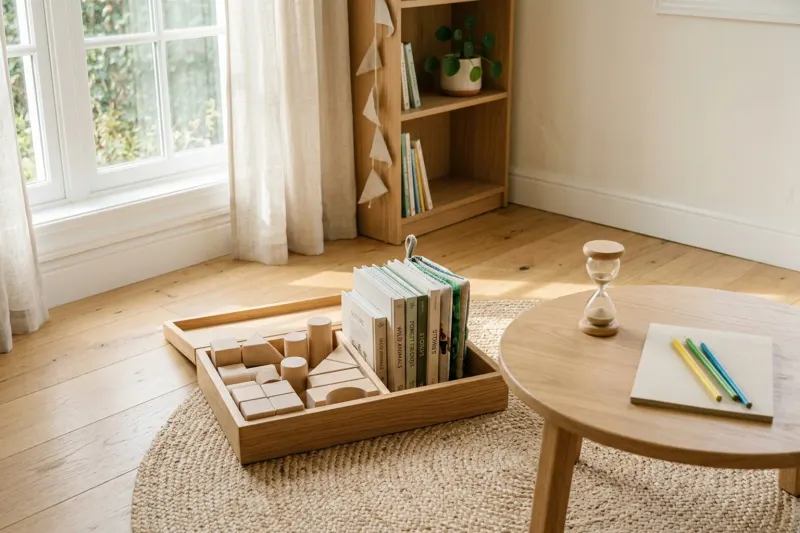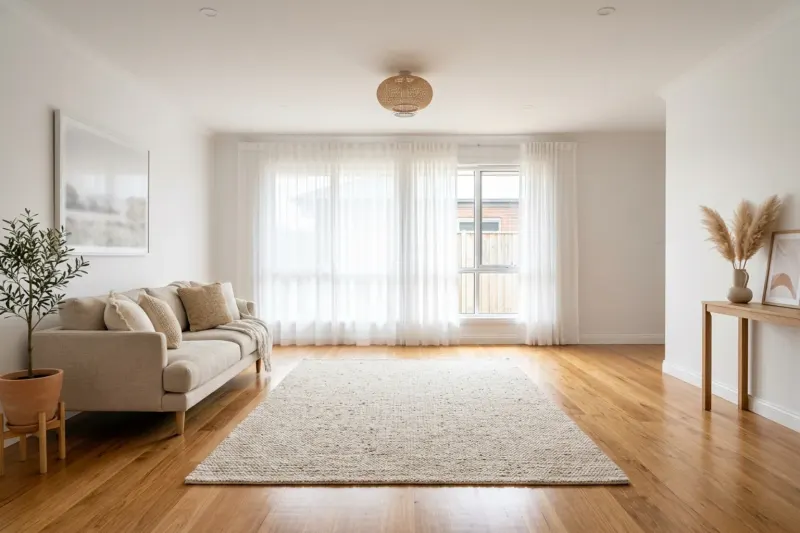
When poor weather, limited square footage, or tight daily schedules keep children inside, setting up active play without pulling out board games or craft supplies can feel tricky. For children ages 4 to 8, high-energy games do not need specialty equipment or printed mats. The ten activities below draw directly from structured youth recreation programs run by organizations like Playworks and university cooperative extensions. Each game uses spoken cues and ordinary floor space, offering practical ways to channel physical movement safely in standard living rooms and hallways.
Clear the Floor and Check the Room First
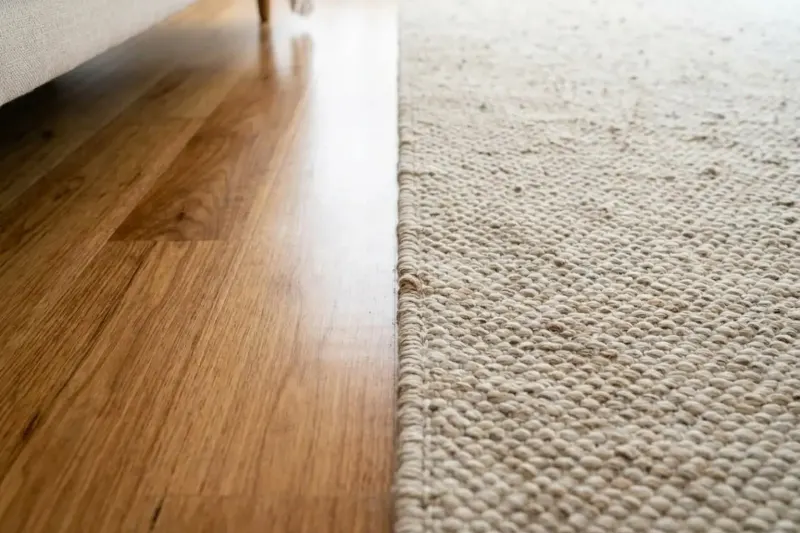
Before starting any physical games indoors, active adult supervision is essential to prevent trips and collisions. Clear an open buffer of at least 1.5 to 2 meters (5 to 6.5 feet) around the central play space. Push lightweight coffee tables, floor lamps, and footstools against the wall. Check the floor for stray toys, pet accessories, or loose power cords. If you have smooth hardwood, laminate, or glazed tile floors, have children play in rubber-soled athletic shoes or bare feet; standard socks without non-slip treads can cause slips during quick turns. When using an area rug as a boundary line, verify that it has a non-skid pad underneath so it does not slide on impact.
Related guide: Five-Minute Waiting Games for Everyday Errands
Movement and Stop Games
Stop-and-go formats set physical boundaries and train quick responses to verbal cues while using zero materials.
- **Red Light, Green Light**: Players line up along one wall while an adult or selected player stands at the opposite end of the room facing the wall. When the leader calls "Green light," players move toward the finish line. On "Red light," the leader spins around, and players must freeze instantly. For indoor residential settings, adapt "Green light" to require tiptoeing, heel-to-toe walking, or slow-motion lunges. This simple rule prevents running into drywall or sliding into baseboards.
- **Up, Down, Stop, Go**: This call-and-response game keeps children in their own personal spots without wandering into furniture. In the standard version for ages 4–5, the caller gives direct instructions: "Up" means reaching tall overhead, "Down" means squatting low, "Stop" means freezing, and "Go" means jogging in place. For ages 6–8, switch to opposite commands: "Up" prompts a low squat, "Down" prompts an overhead stretch, "Stop" triggers jogging in place, and "Go" requires a complete freeze. If someone misses a cue, they do a non-punitive reset—such as five jumping jacks or a high-five—and keep playing.
- **Simon Says**: The caller calls out body movements, such as "Simon says touch your knees" or "Simon says balance on one foot." Players only follow the cue if it begins with the phrase "Simon says." When a command is spoken without that phrase, players stay completely still. To keep the game cooperative and avoid excluding younger children, drop the knockout rule. When a player reacts to a bare prompt, they do a quick toe-touch and rejoin the next round.
Related guide: Screen-Free Quiet Time for Kids Ages 4–8
Story and Movement Imitation Games
Narrative prompts allow gross-motor activity in a fixed spot, keeping feet anchored and preventing collisions in shared rooms.
- **Running Through the Forest**: Each child stands in an agreed spot on a rug or mat. A leader narrates an imaginary hike while players jog in place. As the story unfolds, children respond to physical cues in the terrain: ducking down when low tree branches appear, jumping straight up over fallen logs, swinging their arms in swimming motions across a river, and jogging rapidly in place when an animal approaches. The stationary format lets children run at full effort without moving laterally.
- **Run, Fly, or Swim**: Drawn from Penn State Extension rainy-day activity guides, this prompt links animal categories to three stationary movements. Agree beforehand on the actions: quick stepping in place represents running, flapping extended arms represents flying, and breaststroke arm movements represent swimming. The caller announces an animal—such as "trout," "robin," "cheetah," or "pelican"—and children switch to the matching action as soon as they identify how it travels.
Related guide: Small-Space Indoor Scavenger Hunts
Spatial and Line-Jump Games
These activities rely on room architectural features like wood planks, tile grout lines, or rug borders to guide balance and directional hops.
| Game | Recommended Space | Primary Movement Pattern | Reset Rule on Missed Cue |
|---|---|---|---|
| Land, Sea, Air | Edge of secured area rug or tile seam | Forward and backward two-foot hops | 3 jumping jacks, rejoin line |
| Four Corners | Open room with 4 accessible corners | Quiet walking pace to room corner | Sit down for 1 round, return |
- **Land, Sea, Air**: Pick an existing floor line, such as a tile seam or the edge of a non-slip rug. Players stand side by side behind the line with feet together. The caller uses three random cues: "Land" (stay behind the line), "Sea" (jump forward over the line with both feet together), and "Air" (jump straight up and land in the same position). When a jump is missed, the child completes three jumping jacks and returns to the line.
- **Four Corners**: Identify four safe, accessible corners in a cleared space. One child stands in the center with eyes closed and counts backward from 10 to 0 aloud. During the countdown, the remaining children walk quietly to any corner. At zero, the counter points toward one corner before opening their eyes. Any players standing in that corner sit down for a single round before joining the next countdown.
Observation and Improvisation Games
When room space is limited or group energy needs settling before a quiet period, these seated observation and verbal games emphasize attention without heavy foot traffic.
- **Emotion Freeze**: Pick four emotional expressions and poses before beginning, such as silly, surprised, calm, or sleepy. The caller turns away and counts aloud from 1 to 5 while players dance or stretch in place. On "Freeze!" players hold one of the agreed poses. The caller turns around, names one emotion, and any player holding that pose completes five deep breaths before the next round begins.
- **What Are You Doing?**: Adapted from classic theater improv, this two-player exchange challenges verbal and motor coordination. Player A mimes an everyday task, such as brushing teeth. Player B asks, "What are you doing?" Player A names an entirely different action, such as "I am tying my shoes." Player B immediately begins miming shoe-tying. The exchange continues back and forth without pauses, with each child naming a distinct physical action from the one they are demonstrating.
- **Rhythm Detective**: Children sit in an open circle on the floor. One child, acting as the detective, steps outside the room or turns away. The seated group silently picks a leader who starts an unamplified percussion pattern—such as thigh-slapping, finger-tapping, or gentle clapping. Everyone in the circle copies the beat. The detective returns to the center. Every 5 to 10 seconds, the secret leader switches the rhythm without speaking, and the rest of the group follows along. The detective gets three attempts to spot the leader.
Matching Indoor Games to Space and Group Factors
| Situation | Consider | Why |
|---|---|---|
| Tight room space (under 2 m / 6.6 ft of open walkway) | Running Through the Forest or Up, Down, Stop, Go | Both activities keep players in a fixed stationary spot, eliminating the risk of bumping into furniture or walls. |
| Slippery floors (polished hardwood, tile, or unanchored runners) | Emotion Freeze or Rhythm Detective | These seated or slow-pacing formats avoid lateral running, rapid stops, and jumping that can cause slips on smooth flooring. |
| Mixed age spans (younger children ages 4–5 playing with ages 7–8) | Simon Says with non-elimination rules | Allows older children to practice complex impulse control while keeping younger players fully engaged without sudden eliminations. |
| Shared residential building with downstairs noise sensitivity | What Are You Doing? or Rhythm Detective | Generates verbal interaction and finger-tapping percussion without repeated jumping, stamping, or floor impacts. |
Hypothetical Living Room Layout and Game Session
In a hypothetical 3.5 m by 4 m (11.5 ft by 13 ft) living room, a caregiver arranges a 20-minute movement block for two children (ages 5 and 7). First, an open central perimeter of 250 cm by 300 cm (8.2 ft by 9.8 ft) is cleared by sliding an ottoman against the side wall. The caregiver places a non-slip pad under a 160 cm by 230 cm (5.2 ft by 7.5 ft) flat-weave rug. For the first 8 minutes, the pair plays 'Land, Sea, Air' using the straight edge of the rug as the line marker, restricting jumps to 30 cm (12 in) hops. For the final 12 minutes, they switch to 'Running Through the Forest', maintaining designated standing positions 100 cm (3.3 ft) apart to avoid accidental arm contact during imaginary swimming and jumping gestures.
- Play Area Rug
- Sofa Buffer Zone
- Wall Boundary / Caller Station
- Stationary Player Spot A
- Stationary Player Spot B
When this approach is not a good fit
These active indoor games are unsuitable in rooms with exposed electrical cords, unpadded coffee table glass, free-standing unstable lamps, or unrestrained household pets. They are also not suitable without constant adult supervision if children have mobility limitations requiring leveled assistance, or when floor socks without rubber grips are worn on slick wood or laminate floors.
PUT THIS GUIDE TO USE
Find an activity for your family
Sources & further reading
- playworks.org
- playworks.org
- playworks.org
- playworks.org
- playworks.org
- playworks.org
- playworks.org
- psu.edu
- playworks.org
- playworks.org
AI-assisted writing and concept images. Sources and automated checks support the process; an adult should check materials and adapt activities to their child.
How we create our guides · Suggest a correction