When you want a fast, low-friction family activity for children ages 4 to 8, standard board games can bring unexpected obstacles. Packaged games frequently feature tiny plastic tokens that present hazards for younger siblings, dense text that pre-readers cannot decode, and competitive scoring structures that frustrate early players. A paper-based picture quiz avoids these issues entirely. By folding one sheet of standard paper into a series of covered quadrants or flaps, you create an interactive guessing game where simple drawn hints replace written questions. A 4-year-old can take part by folding panels, coloring broad shapes, or shouting out guesses, while a 7- or 8-year-old can handle safety scissors to cut lift-up flaps and sketch zoomed-in visual details. With one sheet of paper, certified non-toxic coloring tools, and seated adult supervision, caregivers can launch an inclusive, screen-free evening activity in under ten minutes.
Folding Choices and Scissor Safety by Age
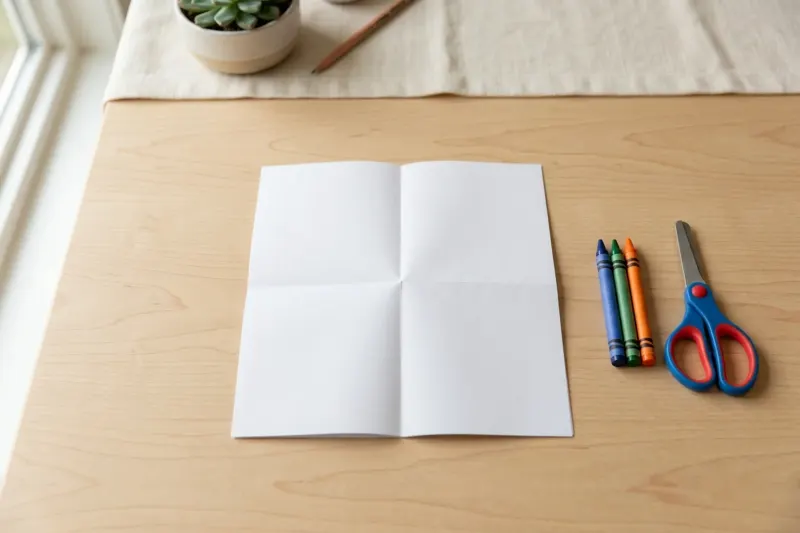
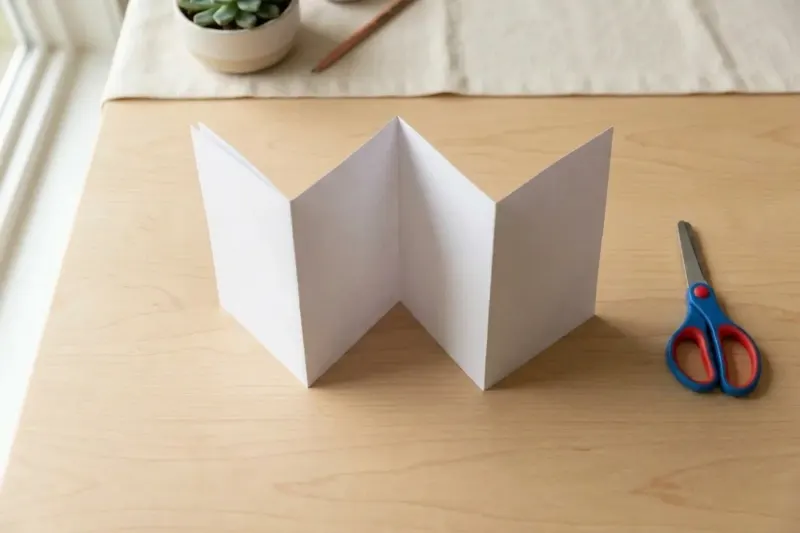
The physical structure of your quiz sheet should match the motor readiness of the children participating. According to the U.S. Consumer Product Safety Commission (CPSC) Age Determination Guidelines, children ages 4 to 5 are developing bilateral coordination and can make simple snips along straight lines with blunt 5-inch safety scissors, but their blade tracking is still maturing and requires seated direct supervision. Pathways.org notes that mature scissor control and the ability to cut accurately along folded lines develop more fully between ages 6 and 8. For households with a 4-year-old, an entirely fold-based design is the safest choice. Take an 8.5 by 11-inch (21.6 by 27.9 cm) sheet of copy paper and fold both outer edges inward so they meet at the center line. This gatefold creates two concealing doors that open to reveal interior drawings without any cutting required. For children ages 6 through 8 who show steady grip and control with blunt-tip child scissors, you can fold the sheet into eight equal rectangles and make three short, straight cuts to form four lifting window flaps. Keep scissors stored when not in use, ensure all cutting happens while seated at a clear table, and place any trimmed paper scraps directly into a bin so infants or crawling toddlers sharing the room cannot mouth them.
Related guide: No-Jump Living Room Games: Gentle Ways to Play
Choosing Safe, Certified Art Materials
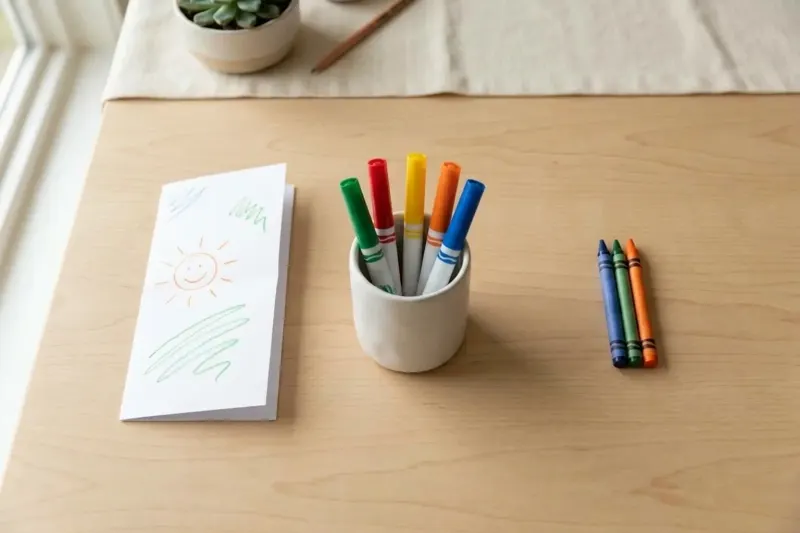
Early childhood craft games often involve young players who rub their eyes, touch their faces, or occasionally mouth drawing tools, making supply safety essential. The CPSC Art and Craft Safety Guide (Publication 5015) specifies that all children's art materials sold in the United States must comply with the Labeling of Hazardous Art Materials Act (LHAMA) and ASTM D-4236 standards. Look for supplies certified with the Art and Creative Materials Institute (ACMI) AP Non-Toxic seal, which indicates that a toxicologist has evaluated the formula and found no acute or chronic health hazards. Standard wax crayons, solid wooden colored pencils, and washable water-based broad-line markers meet these criteria. Publication 5015 warns against giving children art supplies labeled with Cautionary Labeling (CL) seals, such as solvent-based permanent markers, rubber cement, or adult alcohol inks, which release volatile organic vapors and present skin-absorption hazards. Although the AP seal indicates low toxicity under anticipated use, it does not mean products are edible or universally non-toxic if consumed in quantity. An adult must remain at the table to supervise play, prevent children from chewing on marker caps, and ensure hands are washed after the activity.
Related guide: Backyard Nature Hunt on Mowed Lawn Turf
Designing Visual Clues for Mixed Skill Levels
The primary design challenge in mixed-age play is giving pre-readers and fluent readers equal opportunity to participate. Instead of written trivia, each hidden panel holds a simple hand-drawn clue that points to a familiar household item, animal, or snack. Younger children may feel overwhelmed by freehand drawing, so caregivers can guide them toward single, bold features. For a 4-year-old contributor, an adult can suggest coloring the yellow curve of a banana, the spotted wing of a ladybug, or the round black tires of a wagon. If a preschooler struggles to draw freehand shapes, an adult can lightly pencil an outline for the child to fill with crayon. Older children ages 6 to 8 can explore visual perspective by sketching close-up details or partial silhouettes, such as the bristles of a toothbrush, the serrated edge of a house key, or the dial of an analog clock. This visual clue format removes reading barriers, allowing younger children to rely on color and shape recognition while older siblings experiment with careful observation. Before drawing starts, remind children that these sketches are quick clues rather than finished art projects, keeping the mood relaxed and unhurried.
Related guide: A 15-Minute Calm Play Routine for Ages 4 to 8
Cooperative Game Rules and Reveal Mechanics
Competitive trivia often leads to conflict when siblings of different ages play together, as older children process language and visual cues more rapidly. Guidance from Children and Screens on early childhood media use and family interaction highlights that collaborative, responsive routines support calm engagement without digital stimulation. You can adapt the picture quiz by treating the game as a shared household mission rather than an individual contest. Instead of awarding points to the quickest individual guesser, the entire family works together to identify every clue within a set pool of total hints. During a turn, the illustrator acts as the clue host and lifts their paper flap slightly to reveal roughly one-third of the drawing. The rest of the family gets two collaborative guesses after talking together about what they see. If the object remains hidden, the host opens the flap halfway and gives one verbal hint, such as naming the room where the item lives. If necessary, the host opens the flap completely for a final combined team guess. Working toward a shared household score keeps play calm, prevents older children from dominating the game, and gives younger children the unhurried space they need to contribute.
Choosing Sheet Fold Layout and Reveal Mechanics
| Situation | Consider | Why |
|---|---|---|
| Preschool child (age 4–5) participating with developing scissor grip | No-cut bi-fold or 4-panel gatefold layout | CPSC Age Determination Guidelines show cutting precision is still developing at ages 4–5; folding eliminates blade risks while providing concealed panels. |
| School-age child (age 6–8) with steady scissor control | 8-panel grid with sliced window flaps using blunt-tip scissors | Pathways.org motor milestones indicate mature bilateral hand coordination develops between ages 6 and 8, allowing straight snips under seated adult supervision. |
| Mixed-age siblings playing together | Cooperative household clue pool with shared guesses | Guidance from Children and Screens emphasizes collaborative engagement to avoid the frustration caused by competitive disparities in processing speed. |
Hypothetical Worked Example: 4-Panel Mystery Clue Sheet
In this hypothetical setup, an adult caregiver and two children (ages 4 and 7) make an evening picture quiz using one standard 8.5 by 11-inch (21.6 by 27.9 cm) sheet of copy paper. The adult folds the sheet in half horizontally and vertically, creating four quadrants that each measure 4.25 by 5.5 inches (10.8 by 14.0 cm). The paper is folded like a booklet so outer faces conceal the interior drawing areas. Using AP-certified wax crayons, the 4-year-old spends an estimated 5 minutes coloring a yellow curve for a banana in Quadrant 1. The 7-year-old spends 5 minutes sketching the metal teeth of a house key in Quadrant 2. The caregiver draws a green turtle shell in Quadrant 3, leaving Quadrant 4 blank for a shared bonus round. During the 12-minute guessing phase, each player reveals one-third of their drawing by sliding a plain cover sheet downward, allowing the rest of the group two shared guesses before a complete reveal. No points are deducted for incorrect guesses, keeping participation high across the entire 22-minute session.
- Quadrant 1 (Top Left Clue)
- Quadrant 2 (Top Right Clue)
- Quadrant 3 (Bottom Left Clue)
- Quadrant 4 (Bottom Right Clue)
When this approach is not a good fit
This activity is unsuitable for unsupervised sessions, workspaces containing utility blades or adult shears, or households where small torn paper scraps could present a mouthing hazard for infants or crawling toddlers. It is also unsuitable as a solitary activity, as clue-and-reveal guessing requires at least two interacting participants.
PUT THIS GUIDE TO USE
Find an activity for your family
Sources & further reading
AI-assisted writing and concept images. Sources and automated checks support the process; an adult should check materials and adapt activities to their child.
How we create our guides · Suggest a correction