When planning an outdoor scavenger hunt for children ages 4 to 8, limiting the activity to open, mowed lawn turf keeps play focused and avoids common yard hazards. Many traditional scavenger lists send children rummaging through garden mulch, brush piles, or dense fence lines. However, public health agencies identify tall grass, unmanaged ground cover, and damp leaf litter as primary residential harborages for ticks and stinging insects. By replacing collection bags with an observation-only card and marking clear boundaries several paces inward from yard perimeters, parents and caregivers can run an engaging, screen-free hunt without specialized equipment. An adult must remain directly present throughout the activity to reinforce boundaries, assist early readers, and conduct a routine tick check as soon as children return indoors.
Mark Boundaries on Short Mowed Turf
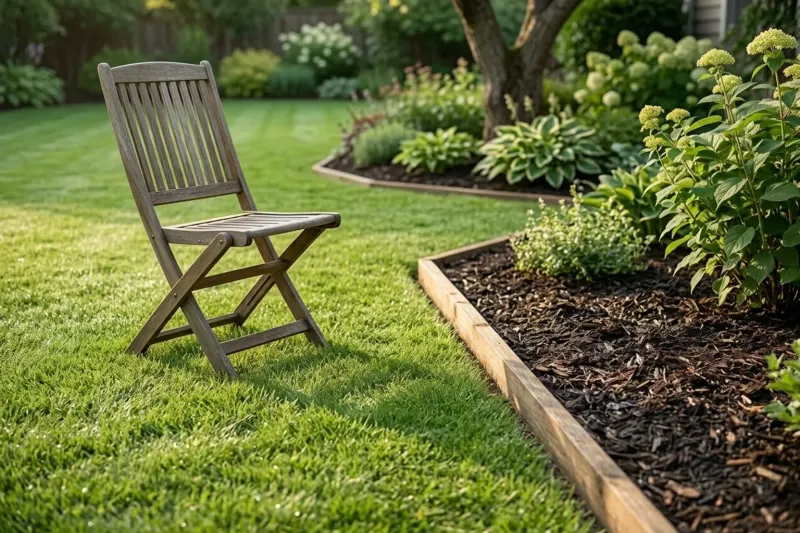
Before handing a child an observation sheet, walk the yard together to identify the search area. The Centers for Disease Control and Prevention (CDC) notes that blacklegged ticks and biting insects frequent humid, wooded edges, leaf litter, and tall grass in residential yards. Because of this, open lawn turf mowed short provides the safest ground for young children. Establish a clear perimeter buffer of at least 5 to 7 feet (1.5 to 2 meters) inward from any property fence lines, untrimmed hedges, mulch beds, compost bins, and woodpiles. Point out immovable physical landmarks that mark where the play zone ends, such as the edge of a patio or a line between cut grass and garden soil. Direct, continuous adult supervision is required for this age group: position yourself along the perimeter buffer so you physically separate children from out-of-bounds areas like air conditioner units, low tree branches, and shaded stone piles. Staying within a few paces allows you to redirect children before they reach overgrown borders.
Related guide: Printable Neighborhood Walk Hunt for Ages 4 to 8
Prepare an Age-Appropriate Observation Board
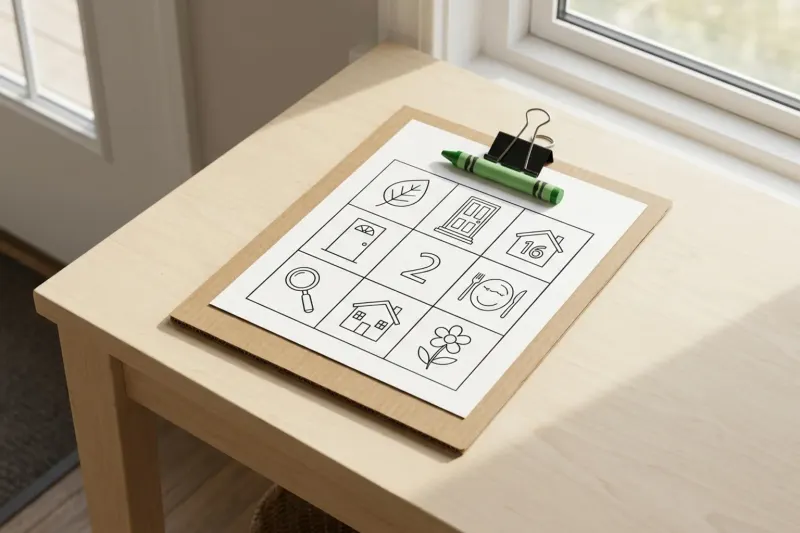
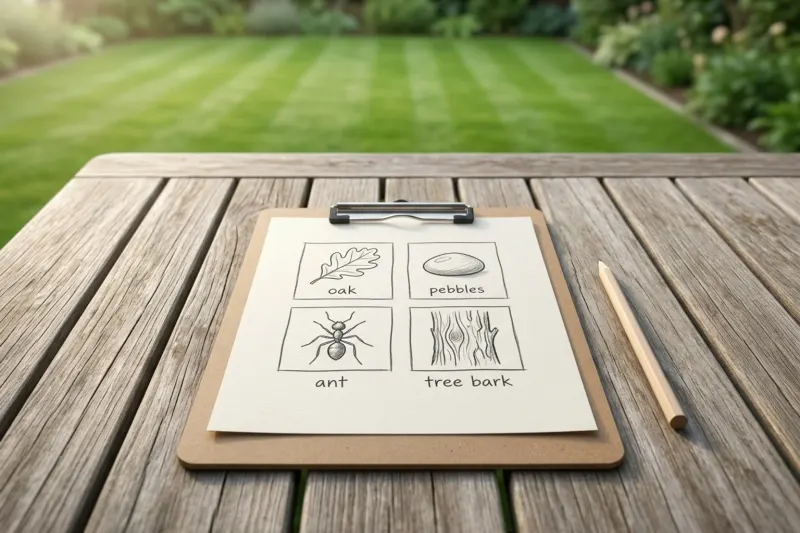
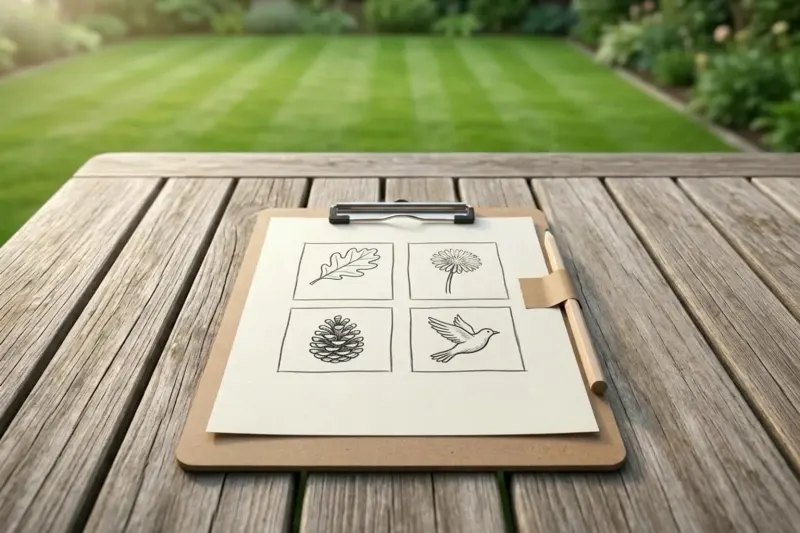
An outdoor hunt for young children functions best as an observation checklist rather than an open collection task. Guidance from early childhood resources at the Texas A&M Forest Service emphasizes that young learners identify natural objects by broad sensory traits such as color, texture, and shape rather than formal botanical classifications. For children ages 4 to 5 who are pre-readers, draw a grid of four to six large squares on heavy paper, filling each with a bold color patch or simple line drawing such as a green leaf, a yellow dandelion head, a smooth gray stone, or a brown fallen twig. For emerging readers ages 6 to 8, create a grid of six to nine boxes containing simple words paired with small check boxes, such as rough tree bark, clover patch, ant trail, and dry seed pod. Secure the sheet to a piece of rigid scrap cardboard measuring roughly 8.5 by 11 inches (22 by 28 cm) using a binder clip or masking tape. Attach a single blunt pencil or crayon with tape to prevent it from dropping into the grass. Using a sturdy backer avoids loose paper blowing away in the wind and keeps children looking around the yard rather than managing loose cards or handheld screens.
Related guide: 10 No-Prep Indoor Games for Kids Ages 4–8
Set Look-Only Rules for Plants and Yard Wildlife
Youth nature education resources from Mahoney's Garden and Doing Good Together recommend framing backyard exploration around non-destructive observation. Explain the rules before leaving the porch: living plants remain rooted, and resting wildlife stays undisturbed. For living greenery, children can mark items off by looking closely or touching with a single gentle finger, avoiding snapping live twigs, stripping tree bark, or plucking garden flowers. For prompts requiring physical inspection, such as fallen leaves, pinecones, or dry acorns, children should examine only items resting loosely on top of mowed grass. Do not allow children to lift heavy landscape timbers, reach under decorative stones, or search inside dense shrubs where yellowjackets or spiders may hide. When observing backyard wildlife such as earthworms, solitary bees, and songbirds, children should observe from an upright, standing distance of several paces. A wide, shatter-resistant plastic magnifying glass can be provided under adult guidance so children can view surface textures up close without placing their fingers near plant saps or stinging insects.
Related guide: A 15-Minute Calm Play Routine for Ages 4 to 8
Complete the Indoor Transition and CDC Tick Check
Bringing children indoors safely requires a consistent post-activity routine. The Centers for Disease Control and Prevention (CDC) advises that checking skin for ticks immediately after outdoor activities and showering within two hours significantly reduces the risk of Lyme disease and other tick-borne infections. Begin the transition at the doorstep by having children take off shoes on the porch or entry mat. Remove outer socks, pants, and shirts immediately and place them into the laundry hamper; running dry outdoor clothes in a household dryer on high heat for 10 minutes kills unattached ticks lingering on fabric. Have children wash hands and wrists thoroughly with warm water and soap for at least 20 seconds. Next, inspect the child's skin under bright indoor lighting, examining the seven key areas highlighted by the CDC: inside and around the ears, under the arms, throughout the hair and scalp, inside the belly button, around the waistband, between the legs, and behind the knees. Finally, guide the child into a shower or bath within two hours of coming indoors, which helps rinse away unattached ticks and offers a second visual check.
Setup and Safety Decisions for Yard Hunts
| Situation | Consider | Why |
|---|---|---|
| The yard features perimeter garden beds, stone walls, or unmanaged woodpiles. | Keep all checklist items centered strictly on the open, mowed grass lawn. | CDC guidance identifies leaf litter, perimeter brush, and rock crevices as primary habitats for ticks and stinging insects. |
| The participating child is 4 or 5 years old and cannot read written words. | Use a four-box grid featuring bold color swatches and clear outline drawings. | Visual icons allow pre-readers to match real-world items independently without adult reading assistance. |
| A child attempts to pull leaves from shrubs or pick planted garden blossoms. | Enforce an eyes-only rule for live plants and restrict touching to loose surface items on the lawn. | Protects cultivated landscape plants and keeps hands away from thorns, skin-irritating saps, and concealed insects. |
| The outdoor space is a small patio or yard with minimal open turf. | Direct checklist prompts toward sensory and overhead items such as cloud textures, birds in flight, and ant trails. | Enables an active observation session without requiring expansive grass or dense plantings. |
Hypothetical Example: A 20-Minute Turf Observation Walk
A caregiver and a five-year-old child conduct a hypothetical 20-minute hunt in a 40-foot by 50-foot (12-meter by 15-meter) residential yard. The adult clips an 8.5-inch by 11-inch cardboard backer holding a six-box illustrated sheet to a clipboard and attaches a crayon. The caregiver establishes a visible safety boundary 6 feet (1.8 meters) inward from the yard fencing and flowerbeds, positioning an adult lawn chair along the perimeter to maintain direct supervision. Over roughly 15 minutes, the child walks the open grass, spotting a clover leaf, a yellow dandelion head, rough tree bark, and a dropped brown twig. At the 18-minute mark, they return indoors. Outdoor clothes go directly into the dryer on high heat for 10 minutes, hands are washed for 20 seconds, and the caregiver carries out a CDC-recommended seven-zone skin check before the child showers.
- Mowed Turf Active Play Zone
- Adult Supervision Station
- Perimeter Buffer (Off Limits: Tall Weeds and Fences)
- House Patio and Transition Entryway
When this approach is not a good fit
This activity format is unsuitable for backyards containing unmanaged poison ivy, active stinging insect ground nests, loose construction debris, unprotected standing water, or unrestrained unfamiliar domestic animals. It is also unsuitable for independent, unsupervised play for children ages 4 to 8.
PUT THIS GUIDE TO USE
Find an activity for your family
Sources & further reading
- Centers for Disease Control and Prevention - Preventing Tick Bites
- Texas A&M Forest Service - Early Childhood Activities
- Doing Good Together - Nature Scavenger Hunt
- Mahoney's Garden - Nature Scavenger Hunt for Kids
AI-assisted writing and concept images. Sources and automated checks support the process; an adult should check materials and adapt activities to their child.
How we create our guides · Suggest a correction