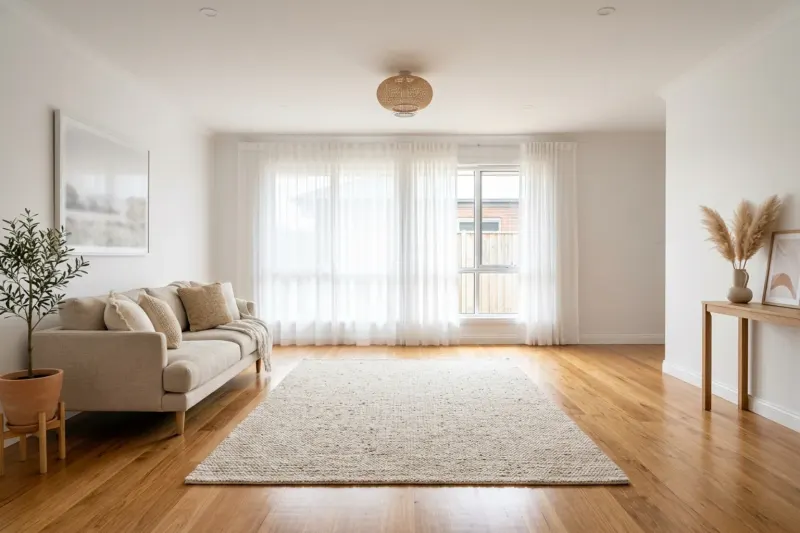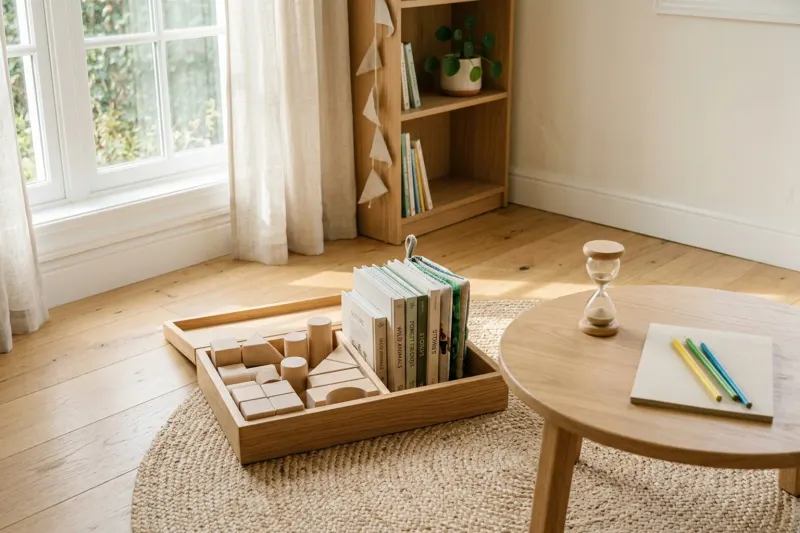
When late afternoon brings restlessness and competing household demands, a focused fifteen-minute play break offers a predictable, screen-free pause for both you and your child. To start this routine, clear a small work surface, put phones in another room, silence background screens, and place two simple, age-appropriate activities within reach. Guidance from the American Academy of Pediatrics and the Kids Mental Health Foundation highlights how child-led play routines help families share focused attention when adults step away from teaching or correcting. Instead of organizing complicated crafts or multi-piece board games, this short routine relies on familiar, purpose-made materials, quiet adult presence, and consistent start-and-stop cues that keep play grounded and manageable. Continuous direct adult supervision throughout the session ensures that materials stay safe and the setting remains calm.
Setting Up a Dedicated, Screen-Free Zone
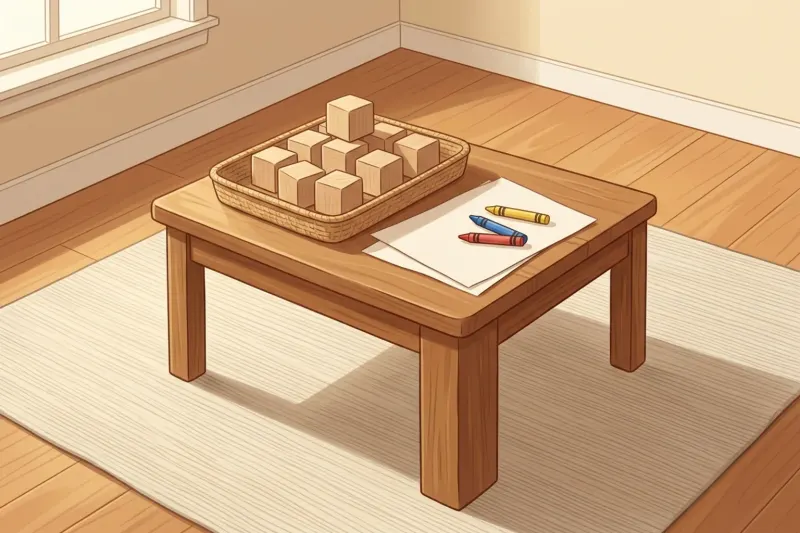
A calm play break begins with adjusting the physical environment to cut down on unnecessary sensory input. Visual clutter, open toy bins, and background devices easily pull children ages 4 to 8 in multiple directions. The American Academy of Pediatrics recommends designating clear media-free times and locations at home, noting that background televisions and digital notifications constantly draw adult attention away from shared activities. Before beginning, move personal phones out of sight, mute tablet alerts, and switch off household screens entirely. Next, define a physical boundary for the activity. A cleared kitchen table or an illustrative 47-by-47-inch (120 by 120 cm) woven rug provides an obvious visual perimeter for play. Clear the surrounding floor of stray items, loose charging cords, and shoes to eliminate tripping risks and visual distraction. Keeping the play contained within a distinct perimeter signals that this time is a calm, focused pause rather than an open-ended run around the house. Ensure the seating is comfortable and that lighting is gentle, using indirect natural daylight or a shaded lamp rather than harsh overhead fixtures. Continuous direct adult supervision is essential throughout the entire session to monitor physical safety and maintain a supportive presence.
Related guide: 10 No-Prep Indoor Games for Kids Ages 4–8
Choosing the Right Low-Friction Materials
The materials you offer should require almost no setup and zero complicated instructions. Toys with complex multi-step rules or dozens of loose accessories often create friction and frustration rather than a relaxed rhythm. Instead, select one or two open-ended, purpose-made options that invite hands-on exploration. Safety standards should always lead your selection. Verify that any art supplies carry the ASTM D-4236 designation, which confirms compliance with the federal Labeling of Hazardous Art Materials Act (LHAMA) for non-toxic formulations. While the U.S. Consumer Product Safety Commission (CPSC) identifies small parts fitting inside a 1.25-inch cylinder as choking hazards under 16 CFR Part 1501 for children under 3, caregivers should never rely solely on a single measurement cutoff or assume that an older child cannot choke. Children ages 4 to 8 may still mouth objects or handle materials unpredictably, and younger siblings may wander into the area. Always avoid small loose parts, uncertified craft items, and small improvised components like dry beans, buttons, or loose beads. Safe, practical choices include a basket of 10 to 15 smooth, purpose-made wooden building blocks, several sheets of heavy unlined paper paired with jumbo soy or beeswax crayons, or two tubs of non-toxic modeling dough with a sturdy wooden roller. Keep material quantities modest: offering an illustrative set of 12 blocks rather than an overflowing bin of 80 keeps the play surface orderly and helps children focus on deliberate building.
Related guide: Screen-Free Quiet Time for Kids Ages 4–8
Following Your Child's Lead Without Quizzing
In everyday life, caregivers spend hours directing schedules, checking homework, and managing household chores. During this dedicated play break, adopting a non-directive approach inspired by positive parenting practices—such as the PRIDE skills outlined by Cincinnati Children's and the Kids Mental Health Foundation—shifts the focus away from adult instruction. You serve as an attentive companion rather than an instructor or supervisor evaluating a final product. To keep the atmosphere calm and low-pressure, focus on three straightforward communication habits. First, avoid asking test questions like 'What color is that block?' or 'Can you draw a house?' Questions turn casual play into a performance task and can make young children self-conscious. Second, let your child lead the build. If your child lays blocks in an irregular line or colors across a page without a defined pattern, resist straightening the objects or demonstrating a 'proper' way. Giving children ownership over their play fosters relaxed engagement. Third, rely on calm descriptive narration and labeled praise. Describe what you see: 'You are placing three blue blocks side by side.' When your child shares an item or handles paper gently, acknowledge it specifically: 'Thank you for handing that crayon to me so gently.' You can also use parallel play. If your child rolls dough, take a small portion and roll your own shape beside them without turning it into a competition. This quiet companionship shows your undivided attention without adding pressure.
Related guide: Five-Minute Waiting Games for Everyday Errands
Keeping the Fifteen Minutes on Track and Wrapping Up
A clear, consistent schedule helps children pace their play and transition away from the activity without frustration. You can organize the 15-minute window into four predictable segments. The first two minutes serve as a quiet setup: invite your child to the cleared area and offer two straightforward choices, such as 'Would you like to build with blocks or draw with crayons today?' Let your child bring the selected tray to the table. The next ten minutes are dedicated to focused play: sit side by side, maintain calm narration, and stay fully engaged while keeping continuous direct adult supervision over the space. Between minutes 12 and 13, offer a calm, neutral verbal reminder. Say, 'We have two minutes left of our play break before the blocks go back into the basket.' Giving advance warning lets your child complete their current step without feeling rushed or cut off. The final two minutes belong to tidy-up: pack away the materials together as part of the routine. Putting 10 to 15 blocks into a storage basket takes under a minute and leaves the area ready for the next part of the day. If realistic challenges arise—such as your child demanding that you draw for them—respond with warm encouragement: 'I enjoy watching what you create, and I will draw over here on my paper.' If energetic throwing begins, calmly reset the expectation: 'Blocks stay on the table to keep our break calm. If they are tossed, we put them back in the basket until tomorrow.' Keeping your voice neutral avoids power struggles and keeps the break peaceful.
Play Break Material and Boundary Options
| Situation | Consider | Why |
|---|---|---|
| Afternoon overstimulation following classroom hours or screen exposure | Heavy unlined paper with jumbo non-toxic soy or beeswax crayons | Paper provides a low-sensory visual surface with zero mechanical sounds, flashing lights, or digital prompts. |
| Toddler or infant siblings present in the immediate household room | Purpose-made solid wood stacking blocks measuring at least 2 inches (5 cm) across | Exceeds standard small-parts dimensions and reduces choking risks for younger siblings while under direct adult supervision. |
| Child repeatedly demands that the adult draw or build for them | Parallel play using separate materials paired with descriptive narration | Preserves child agency and prevents the session from turning into adult performance or evaluation. |
| Child resists ending the activity when the play period concludes | A predictable 2-minute verbal warning followed by shared basket collection | Advance notice allows mental shifting, reducing transition friction compared to sudden interruptions. |
Hypothetical Worked Setup: The Dining Table Pause
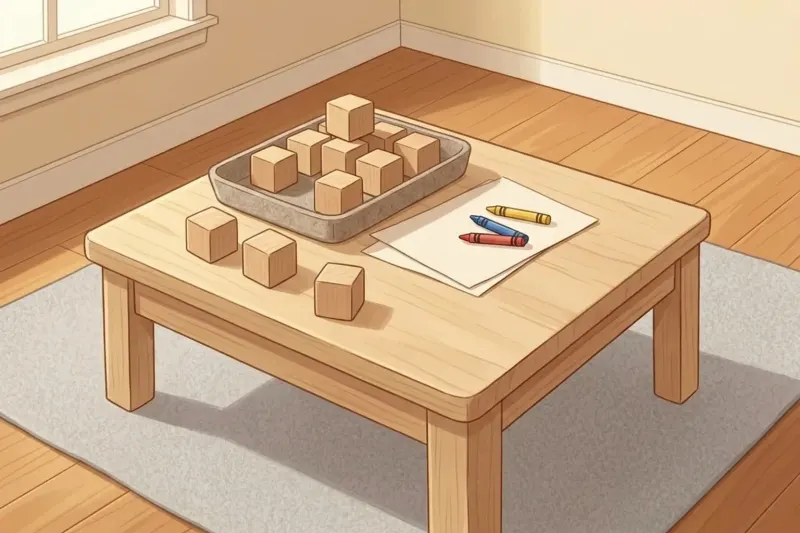
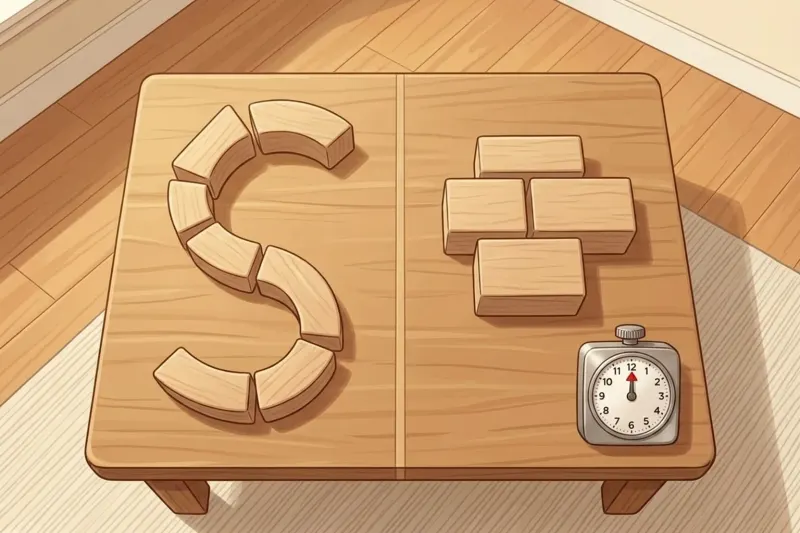
Consider a caregiver and a six-year-old child using a dining table measuring an illustrative 36 by 60 inches (91 by 152 cm). The caregiver clears a central space of about 24 by 24 inches (61 by 61 cm), places all phones in an adjacent room, and turns off background music and screens. On the table sits a shallow basket holding 12 large wooden blocks measuring 2 by 2 inches (5 by 5 cm) and three sheets of heavyweight paper with three jumbo non-toxic crayons. For the first two minutes (0:00 to 2:00), the child picks the wooden blocks and lines them up along the table edge. From minutes 2:00 to 12:00, the caregiver sits alongside under continuous supervision, rolling a block gently in hand and noting, 'You are placing the smooth blocks in a long line.' At minute 12:00, the caregiver says, 'We have two minutes left before our blocks go back into their basket.' At minute 13:30, both child and caregiver place the 12 blocks back into the basket, finishing the routine at 15:00. (All dimensions, material counts, and times are illustrative hypothetical examples.)
- Child Play Area
- Adult Play Area
- Material Basket
- Visual Timer
When this approach is not a good fit
This quiet play routine is unsuitable during severe emotional distress, acute fatigue, or genuine hunger, where children need direct physical comfort, food, or sleep rather than tabletop activities. It is also unsuitable whenever continuous direct adult supervision cannot be maintained, such as while managing hot cookware in the kitchen or attending to household maintenance.
PUT THIS GUIDE TO USE
Find an activity for your family
Sources & further reading
- American Academy of Pediatrics - The Power of Play
- HealthyChildren.org - The Power of Play
- Kids Mental Health Foundation - Intentional Child Time
- Atlas Psychology Collective - Special Time
- Cincinnati Children's - Positive Parenting
AI-assisted writing and concept images. Sources and automated checks support the process; an adult should check materials and adapt activities to their child.
How we create our guides · Suggest a correction