When an afternoon outside risks turning into dragging feet or aimless wandering, a color-and-pattern walk gives children ages 4 to 8 an engaging focus. Rather than gathering loose outdoor items or racing ahead down the block, children carry lightweight paper swatch cards to locate matching color tones and repeating shapes in their everyday surroundings. Early learning frameworks note that spotting alternating AB or ABB sequences gives young children a direct method to examine structural details in their built and natural environment. Because navigating neighborhood blocks involves driveways and street crossings, active adult supervision is essential along the entire route.
Route Selection and Street Safety Basics
Before heading out the front door, plan a walking loop with wide, level sidewalks and clear sightlines. Guidance from the National Highway Traffic Safety Administration (NHTSA) notes that children under age 10 lack the perceptual depth and judgment to evaluate vehicle speeds and stopping distances reliably. For this reason, an adult must accompany children near roadways at all times.
NHTSA pedestrian rules require walking on dedicated sidewalks whenever available. If your neighborhood lacks sidewalks, walk on the road shoulder facing oncoming traffic, remaining as far to the outer edge of the roadway as possible. Keep these physical routines steady throughout the walk:
- **Curb Positioning:** Have the supervising adult walk on the street side of the sidewalk, keeping the child toward the interior yard or fence line.
- **Driveway Awareness:** Pause before every intersecting driveway or alley apron. Scan together for white reverse backup lights, turning tires, or engine sound before stepping across.
- **Street Crossings:** Cross only at marked crosswalks or street corners. Model looking left, right, and left again before stepping down from the curb, and maintain visual awareness until reaching the opposite sidewalk.
- **Plant Safety:** The USDA Forest Service and CDC caution against touching three-leaflet plants such as poison ivy and poison oak. In keeping with nature safety guidance from Ohio State University Extension, instruct children never to touch or taste wild berries, seeds, mushrooms, or unfamiliar leaves.
Related guide: Recycled Box Neighborhood: A Build-and-Play Guide
Making Swatch Cards and Search Windows
You do not need specialized educational materials or store-bought matching cards for this activity. A few sturdy scrap index cards, cardboard rectangles, or hardware store paint samples work well. As highlighted in early learning modules from the Maine Department of Education, simple paper references marked with crayon or washable marker give children concrete comparison tools without adding weight or clutter to pockets.
Prepare two simple handheld tools before stepping outside:
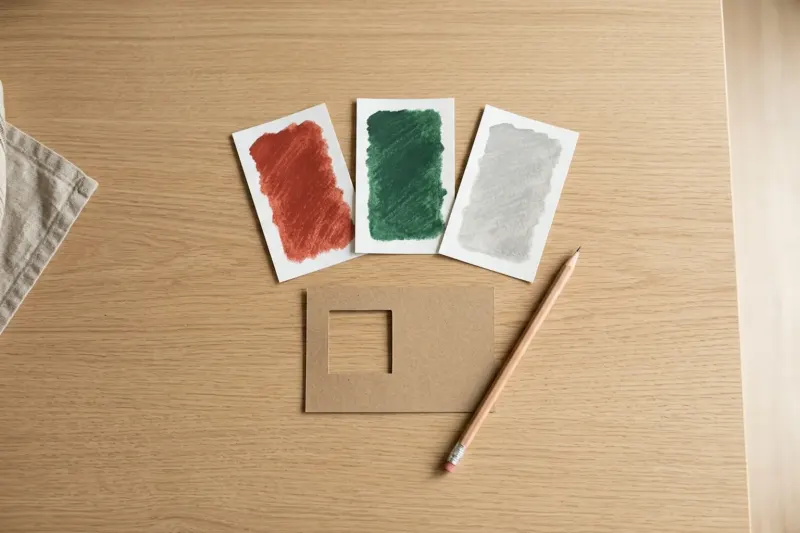
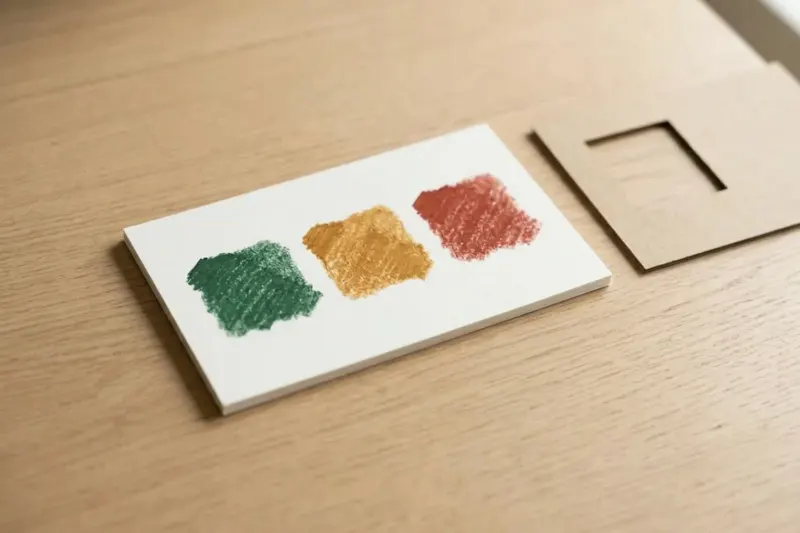
1. **Color Tone Strips:** Cut an index card into three lengthwise strips. Mark three distinct swatches on each strip using crayons or markers. Starting with one neutral tone and two distinct colors—such as sidewalk gray, leaf green, and brick red—gives children clear targets without visual overwhelm.
2. **Pattern Frame Cards:** Cut a square window roughly 5 cm by 5 cm (about 2 inches by 2 inches) out of the middle of an index card or greeting card scrap. Holding this viewing aperture over fence pickets, brick courses, or bark textures isolates repeating visual units from surrounding background clutter.
Keep materials safely stowed in an adult pocket or attached to a light cardboard clipboard so hands remain free when crossing streets or holding hands.
Related guide: Single-Box Cardboard Builds for Ages 4–8
Running the Color and Pattern Search
Structuring the walk into two sequential search challenges keeps young children focused on one visual detail at a time rather than becoming distracted by competing elements.
### Round 1: Color Matching and Tone Comparison
Hand your child a single color strip. Invite them to spot a surface or structure along the path that shares a similar hue. When an item is found, stop on a wide, stable section of sidewalk away from driveways to compare the card against the object:
- Is the real-world surface lighter or darker than the crayon swatch?
- Does bright sunlight or tree shade change how the color looks to your eye?
- Is the surface flat and glossy, or textured and broken by grain?
### Round 2: Spotting Repeating Arrangements
Once children have compared a few colors, shift attention to structural patterns. Early learning resources from Head Start highlight methods for identifying and naming the core repeating unit in everyday surroundings. Encourage children to look for sequences along fences, paving stones, and buildings, focusing on observing and stating the exact order of parts.
| Location | Everyday Pattern Example | Sequence Structure |
|---|---|---|
| **Sidewalk Surface** | Concrete slab, expansion joint, concrete slab, expansion joint | AB Linear Sequence |
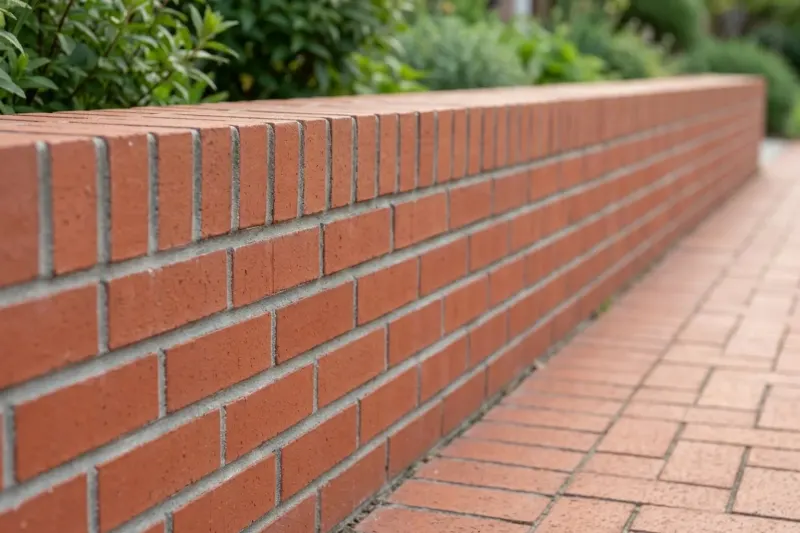
| **Brick Wall** | Stretcher brick, mortar line, stretcher brick, mortar line | AB Repeating Grid |
| **Wood Picket Fence** | Upright slat, open gap, upright slat, open gap | AB Spatial Sequence |
| **Leaf Structure** | Central stem vein, branching side rib, branching side rib | Bilateral Branching |
| **Drainage Grate** | Steel bar, open slot, steel bar, open slot | AB Geometric Grid |
Related guide: Draw-a-Story: A Cooperative Paper Game
Speaking the Pattern Aloud on the Move
When your child spots a repeating pattern, say the sequence aloud together to reinforce the underlying rhythm without turning the stroll into a drill. For example, point to a garden wall and say: *"Brick, line, brick, line. What comes next?"* Prompting children to name the following element helps them isolate the core unit of repeat.
Keep verbal pacing conversational and clear:
- **Use Plain Descriptive Words:** Stick to direct, physical descriptors such as *wide, narrow, wide, narrow* or *rough, smooth, rough, smooth*.
- **Follow Leave No Trace Principles:** Keep natural elements where they grow. Following outdoor stewardship guidelines, observe leaves, moss patches, and pinecones on the ground or branch rather than plucking or disturbing them.
- **Maintain a Gentle Walking Pace:** Avoid rushing or turning the walk into a scramble search. Federal physical activity guidelines from the U.S. Department of Health and Human Services highlight regular daily movement for young children (at least 3 hours daily across light-to-vigorous intensities for ages 3 to 5, and 60 minutes or more daily for ages 6 and older). A 20- to 30-minute structured walk provides steady, gentle active time while keeping children safely within arm's reach of an adult.
Returning Home and Drawing Observations
Conclude your walk by practicing standard outdoor transition habits. The CDC recommends performing a quick visual check on shoes, socks, ankles, and pant cuffs for hitchhiking debris or ticks after spending time near grass or trail shoulders. Have children wash their hands thoroughly with soap and water upon coming indoors.
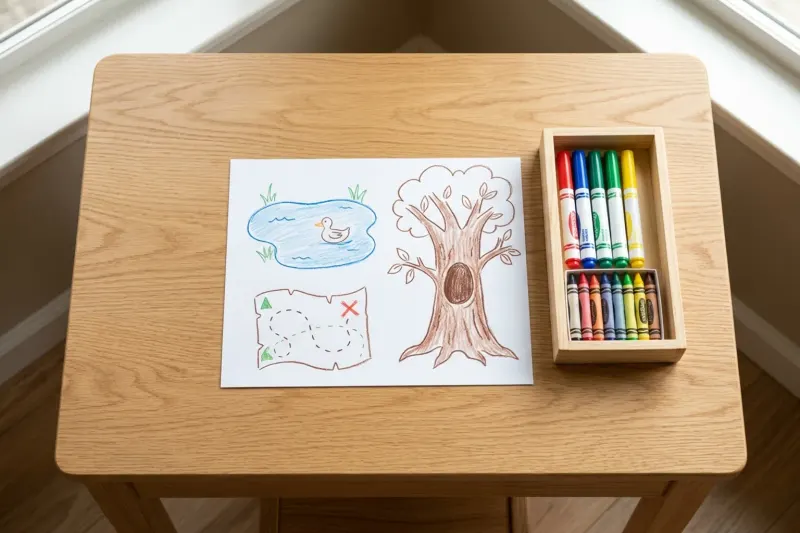
To wrap up calmly, offer a blank piece of paper and crayons so children can sketch one favorite pattern or color sequence they noticed outside. Drawing a simple series of alternating fence slats, sidewalk squares, or leaf ribs provides a quiet, focused transition into the rest of your afternoon.
Walk Setup and Routing Decisions
| Situation | Consider | Why |
|---|---|---|
| Walking in a neighborhood with narrow sidewalks and frequent driveway cutouts | Keep the child on the inner lawn side of the sidewalk and pause together at every driveway apron | Keeping the adult between the child and the roadway while scanning driveways aligns with NHTSA vehicle alertness guidelines. |
| A 4-year-old child who finds identifying abstract sequences difficult | Focus only on finding one specific color match (such as mailbox blue or brick red) | Single-attribute matching keeps visual exploration manageable before introducing alternating repeating units. |
| Walking through a community park trail with dirt shoulders and tall grass | Walk strictly in the center of the cleared path and avoid brushing against trailside weeds | CDC tick prevention recommendations advise staying centered on trails to avoid contact with brush and leaf litter. |
| An older child (ages 7 to 8) who identifies simple AB patterns immediately | Look for multi-attribute or geometric sequences, such as ABB paving stones or branching leaf ribs | Introducing secondary visual attributes provides appropriate challenge without altering pedestrian safety routines. |
Hypothetical Walk Scenario: Neighborhood Block Loop
An adult and a 6-year-old child plan a 25-minute loop around a suburban block (estimated route length: 0.5 miles or 0.8 km). Prep takes roughly 5 minutes: the adult cuts two 7.5 cm by 12.5 cm (3 in by 5 in) index cards, coloring three squares (navy blue, golden yellow, slate gray) on one and cutting a 5 cm by 5 cm (2 in by 2 in) aperture window in the other. Materials cost is negligible (under $0.50 using household scrap paper). Walking on a 1.2 m (4 ft) wide concrete sidewalk, the child spots a painted yellow fire hydrant, holds the card 15 cm (6 in) away to compare the yellow tone, and notes it is brighter than the crayon mark. Two minutes later, along a wooden fence, the child uses the window card to isolate pickets, calling out 'slat, space, slat, space' (an AB sequence). The pair completes the loop at a calm pace, returning home for a quick ankle and shoe tick check before washing hands with soap and water.
- Roadway / Curb Edge
- Adult Walking Path (Street Side)
- Child Walking Path (Interior Side)
- Driveway Hazard Pause Zone
- Interior Lawn / Low Fence Border
When this approach is not a good fit
This activity is unsuitable alongside high-speed roads lacking dedicated sidewalks, through dense unmarked brush or unmaintained woods where tick or poisonous plant hazards are elevated, or during wet, freezing weather where slippery pavement increases fall risks.
PUT THIS GUIDE TO USE
Find an activity for your family
Sources & further reading
AI-assisted writing and concept images. Sources and automated checks support the process; an adult should check materials and adapt activities to their child.
How we create our guides · Suggest a correction