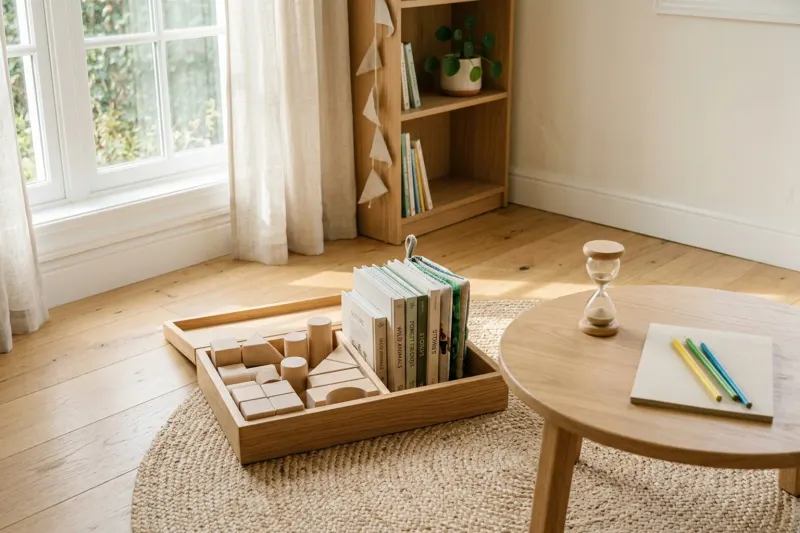
If you need a calm, low-prep table activity for two to four children, Draw-a-Story turns a single sheet of paper into a collaborative game. Instead of working separately on individual sheets, players pass one page back and forth, adding a single visual element and one spoken line of a story during each turn. Penn State Extension emphasizes process-focused art, where open-ended exploration takes precedence over producing a finished display piece. Using standard, non-toxic drawing supplies and clear turn-taking guidelines, children ages 4 to 8 can build a scene together in about fifteen to twenty minutes without specialized kits or complex rules.
Material Safety and Table Setup
Before gathering players, check that all drawing media carry appropriate child-safety certifications. Under the federal Labeling of Hazardous Art Materials Act (LHAMA) and U.S. Consumer Product Safety Commission (CPSC) regulations, art materials sold in the United States must undergo toxicological evaluation under ASTM D-4236. Look for packaging that explicitly states conformance to ASTM D-4236 or displays the Art and Creative Materials Institute (ACMI) AP non-toxic seal. Do not supply adult illustration markers, solvent-based pens, permanent markers, or spray fixatives, as these products carry cautionary labels and are not suitable for young children. Physical hazards also require advance planning. The CPSC small-parts test cylinder measures 1.25 inches (3.18 cm) in diameter and 2.25 inches (5.72 cm) in length, but adhering to dimensions alone does not eliminate choking risks, nor does reaching age 4 guarantee that a child will never mouth an object. Removable marker caps, pen nibs, and fractured crayon pieces can present serious airway hazards whenever toddlers or younger preschoolers are in the home. When younger siblings are near the activity space, select large, solid triangular crayons or single-piece drawing tools without small detachable caps, and maintain active adult supervision throughout the session. Paper dimensions depend on the number of players and the size of your furniture. A standard sheet of letter paper measuring 8.5 by 11 inches (21.6 by 27.9 cm) works smoothly for two children seated side by side at a kitchen counter or small table. When three or four children participate, upgrade to 12 by 18 inch (30.5 by 45.7 cm) construction paper or a section of roll paper cut to roughly 18 by 24 inches (45.7 by 61.0 cm). If the paper slides across a slick laminate or wood tabletop during drawing turns, anchor each corner using a short strip of low-tack painter tape.
Related guide: Screen-Free Quiet Time for Kids Ages 4–8
Core Rules and Turn Structure
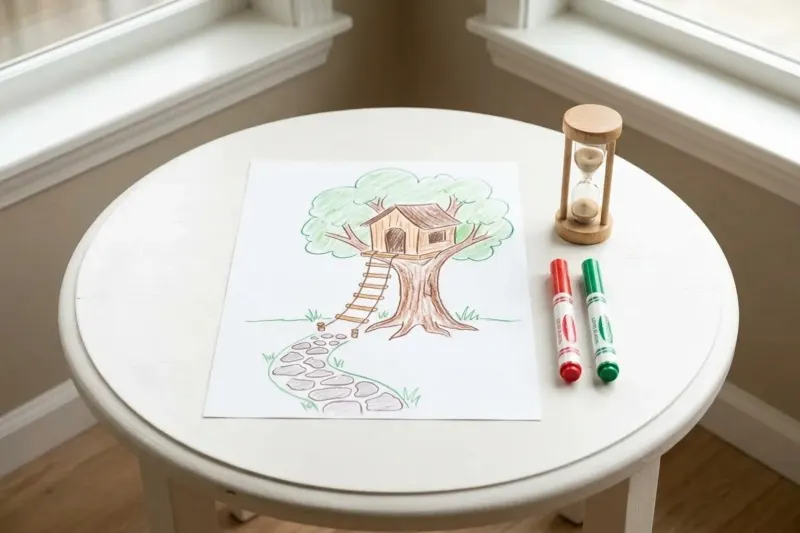
Set two non-negotiable boundaries before anyone touches a marker: players may connect their drawing to an existing element or place it anywhere in open space, but no one may cross out, scribble over, or alter another child's drawing. Agreeing to this ground rule upfront establishes mutual respect for every mark on the paper. Turn 1: Setting the Anchor. The first player takes one marker or crayon and draws a single starter element within an agreed window of one to two minutes. This could be an open doorway, a hollow tree trunk, a boat, or an unusual animal. As the player places the tool back in the center tray, they say the opening line aloud: 'Once upon a time, a small turtle discovered an old wooden box hidden under some leaves.' Passing the Paper. In a two-player game, the starting child gently slides the sheet across the table to their partner. For three or four players seated around a table, establish a clockwise rotation. If passing a large sheet of butcher paper risks tearing, keep the sheet stationary in the center and let players take turns leaning in or shifting seats. Turn 2: Extending the Scene. The next player examines the drawing, adds one visual detail, and speaks the next sentence in the narrative. For instance, the second child might sketch three small gold circles inside the box and say: 'When the turtle lifted the lid, three glowing coins were resting on a velvet pillow.' Cycles and Closing. Play continues in rotation, with each participant contributing one visual detail and one spoken sentence per turn. A game generally completes after two or three full rounds around the table. The final player adds a concluding detail, such as a closing door, a setting sun, or a celebratory feast, and speaks the final sentence: 'The turtle shared the coins with the forest mice, and they all celebrated before bedtime.' Conclude the activity by reading through the full sequence together from the visual clues.
Related guide: Five-Minute Waiting Games for Everyday Errands
Supporting Hesitant or Reluctant Players
Children occasionally freeze when asked to draw in front of peers, worried that their rendering will not look realistic. Penn State Extension notes that children between ages 4 and 8 show diverse mark-making styles, ranging from uncontrolled motor scribbles to symbolic shapes and early representational scenes. Removing pressure regarding artistic realism keeps participation voluntary and comfortable. Replace evaluative praise with descriptive observations. Compliments like 'That is such a pretty picture' inadvertently steer children toward seeking approval for artistic polish. Instead, state factual observations about their lines: 'I see three long orange zigzags across the top corner' or 'You connected that blue curve directly to the tree trunk.' This neutral language keeps the conversation focused on story mechanics rather than drawing quality. Offer concrete, low-stakes choices when a child struggles to start. If a player says they do not know what to draw, present two neutral story paths: 'Would you like our character to travel under the ground or fly into a cloud?' Once the child selects a direction, invite them to place a simple mark—such as three blue dots for raindrops or a brown line for a tunnel—to mark that path. Validate non-representational and abstract marks. Remind players that simple squiggles, loops, dots, and hash marks carry narrative meaning. A cluster of gray ovals can serve as stepping stones, a swirl of green can represent wind through bushes, and a grid of black lines can stand for a garden fence.
Related guide: Paper Shape Hunt: A Simple Setup for Ages 4–8
Three Structural Paper Formats
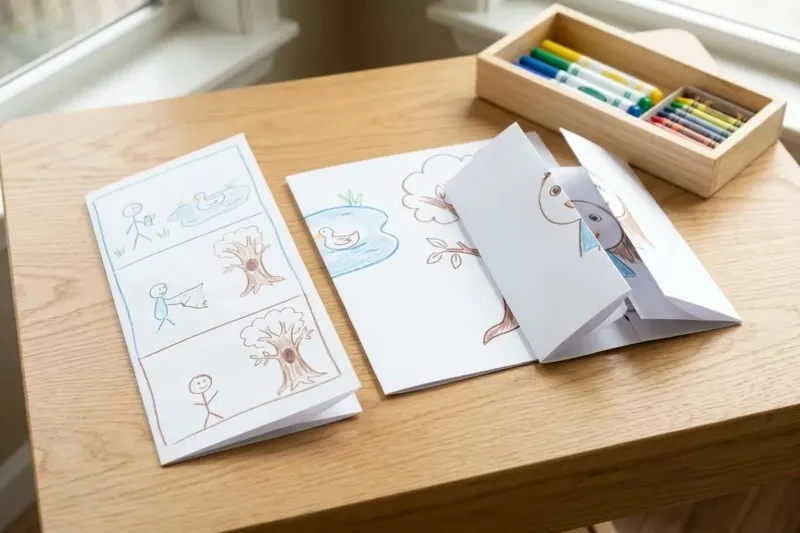
Changing how the paper is folded or sectioned alters the pace of the game while retaining the core turn-taking rules. Open Canvas. Lay a single sheet flat on the table without folds or section dividers. All participants draw on the same visual surface, allowing paths, ladders, and streams to connect disparate items across the page. This freeform setup suits younger children (ages 4 to 5) who prefer navigating space without strict visual borders. Three-Panel Comic Strip. Accordion-fold an 8.5 by 11 inch (21.6 by 27.9 cm) sheet into three vertical columns. The first player draws the beginning scene in Panel 1, the second player illustrates the central problem or action in Panel 2, and the third player (or first player returning) illustrates the resolution in Panel 3. This physical layout offers structured spatial guidance for children ages 6 to 8 who enjoy linear storytelling. The Folded Character Reveal. Fold a sheet horizontally into three equal sections. The first child draws a character's head and neck on the top third, extending two small neck lines slightly over the crease into the middle panel before folding the top section backward out of sight. The second child draws the torso and arms from those neck lines down to the next fold, extending waist markers past the second crease. The third child draws the legs and feet on the bottom panel. Unfolding the full paper reveals an unexpected hybrid character that the players name and narrate together.
Choosing Your Drawing Format and Supplies
| Situation | Consider | Why |
|---|---|---|
| Two players seated side-by-side at a standard dining table | Standard letter paper (8.5 by 11 inches / 21.6 by 27.9 cm) in open-canvas format | Allows easy visual sharing and physical rotation without crowding small table spaces. |
| Three or four players sharing a coffee table | Large construction or roll paper (roughly 18 by 24 inches / 45.7 by 61.0 cm) | Provides sufficient surface area so children do not compete for drawing room or bump hands. |
| Toddlers or younger preschoolers present in the room | One-piece triangular jumbo crayons without detachable caps, under direct adult supervision | Eliminates small marker caps that can present choking hazards; age alone does not guarantee a child will not mouth supplies. |
| Older players (ages 7 to 8) who enjoy linear plot structures | Three-panel accordion-folded strip (beginning, middle, resolution) | Offers an explicit visual boundary for each sequential story event. |
Worked Activity Example: A Two-Player Animal Trail Game
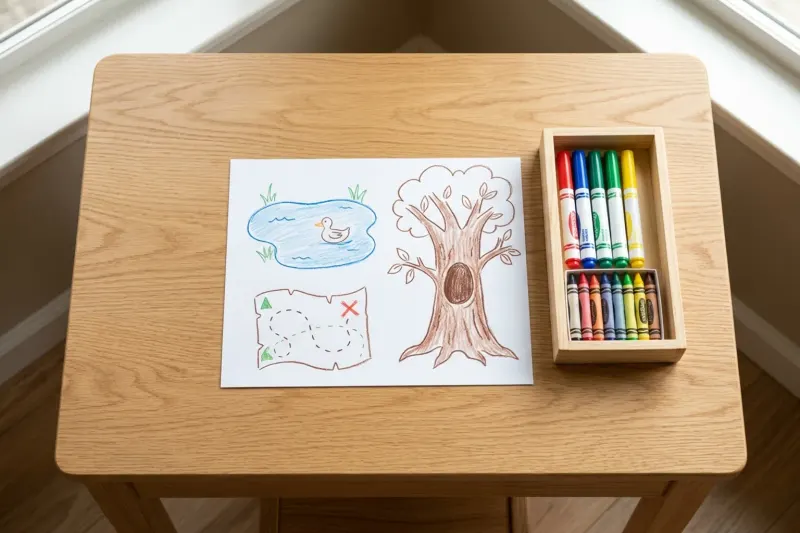
A caregiver sets out a single 8.5 by 11 inch (21.6 by 27.9 cm) sheet of copy paper, four non-toxic washable markers conforming to ASTM D-4236 (illustrative cost under $4.00), and a two-minute sand timer on a cleared kitchen table. Child A (age 5) starts the timer, draws a small blue pond with three green lily pads, and states: 'A friendly otter was swimming in a cold river looking for lunch.' After roughly 90 seconds, Child A slides the page to Child B (age 7). Child B draws a winding brown pathway leading from the pond to a hollow red tree trunk, adding: 'The otter climbed onto the path and saw a map hidden inside an old oak tree.' The paper passes back for Round 2, where Child A draws a silver key next to the tree and explains the map led to a buried treasure chest. Child B concludes the game in Round 3 by drawing a large open treasure chest filled with shiny stones and speaking the closing line: 'The otter shared the colorful stones with all the animals in the forest.' Total activity time measures approximately 12 minutes across four turns.
- Shared Drawing Sheet (21.6 x 27.9 cm)
- Crayon and Marker Tray
- Player 1 Seating Zone
- Player 2 Seating Zone
- Turn Timer (Sand Hourglass)
When this approach is not a good fit
This activity is unsuitable for children who are currently in an aggressive scribbling phase, as the game requires respecting existing marks on a shared page. It is also unsuitable for independent solo play, high-energy movement periods, or spaces where art materials cannot be supervised around mouthing toddlers.
PUT THIS GUIDE TO USE
Find an activity for your family
Sources & further reading
- Penn State Extension: See, scribble, print
- Penn State Extension: Children's Art
- NAEYC: Creating Play-Based Experiences
- U.S. Consumer Product Safety Commission: Art Materials
- American Academy of Pediatrics: Choosing Safe Art and Craft Supplies
AI-assisted writing and concept images. Sources and automated checks support the process; an adult should check materials and adapt activities to their child.
How we create our guides · Suggest a correction