When an empty delivery carton lands on the living room floor, children ages four to eight often want to turn it into a fort, car, or tunnel immediately. You do not need a stack of cartons, specialty kits, or hours of prep to make that happen. A single clean corrugated box provides plenty of material for a complete afternoon project. Following guidance from the National Association for the Education of Young Children on tinkering at home, simple open materials let children design, attach, and decorate their own play spaces without complicated rules. When an adult handles the heavy trimming beforehand, children can safely customize the structure using blunt-tip scissors, masking tape, crayons, and paper plates. This guide helps you inspect your box, set up clear safety rules, and choose between three single-box builds matched to your available floor space.
Box Inspection and Basic Safety Rules
Before bringing any shipping carton into a crafting area, inspect its surfaces closely. Transit boxes frequently pick up road dirt, packing grit, and sharp metal staples. Use pliers to extract any industrial staples, and strip away plastic banding or fiberglass packing tape that can scratch wrists. Never reuse boxes that previously held raw meat, poultry, or harsh household chemicals, as porous cardboard holds onto moisture and chemical odors. Active adult supervision is necessary throughout every phase of these builds. Keep high-risk utility blades, razor knives, and box cutters completely out of children's reach on a dedicated adult work counter. For children between four and eight, provide blunt-end safety scissors sized for small hands so they can cut paper accessories safely. Use the standard preschool scissors rule recommended by Head Start: teach children to keep scissor blades closed in their fist with the finger loops pointing outward when handing them to another person. Choking prevention remains a concern for young children as well. Never assume that age alone makes small objects safe or rely strictly on a single measurement threshold to decide safety. Instead of using small improvised items like loose bottle caps, plastic tabs, small beads, or dried beans, choose purpose-made, large items such as full-sized paper plates, wide paper tape, or flat cardboard cutouts for vehicle dials and decorations.
Related guide: 10 No-Prep Indoor Games for Kids Ages 4–8
The Sit-In Vehicle Build
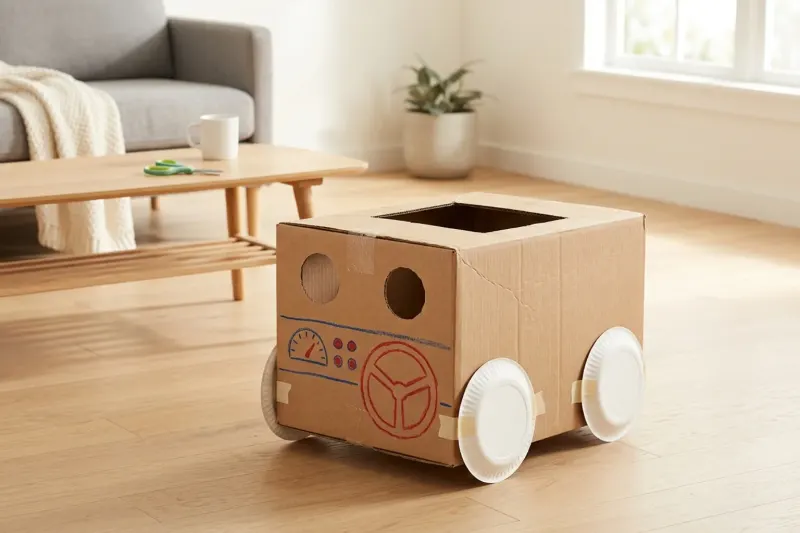
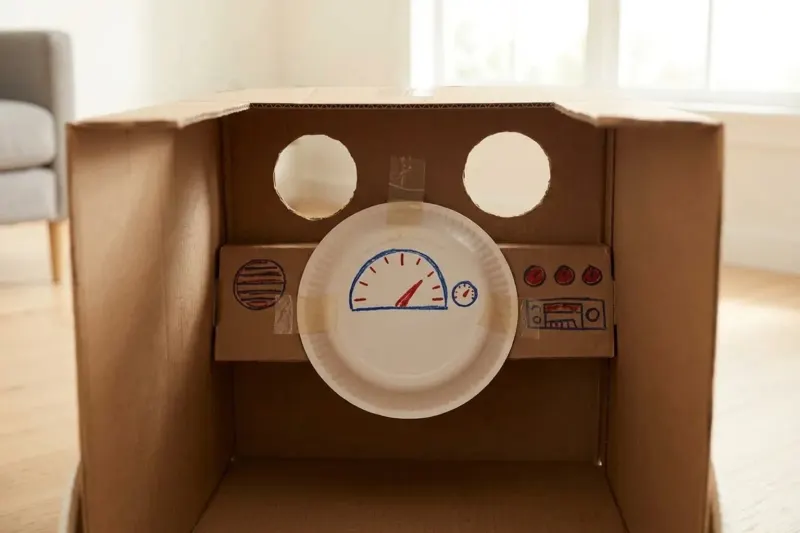
A medium or large moving carton quickly converts into an indoor pretend vehicle, following craft designs from PBS KIDS for Parents. Place the box upright on its bottom surface. An adult trims away the top four flaps using a utility knife on a firm mat, or folds the flaps outward and secures them against the outer box walls with wide paper tape to reinforce the rim. When sizing the vehicle walls, cut the front edge low enough that your child can look directly over it while seated flat on the bottom, preserving full line-of-sight across the room and preventing tipping. An adult can also cut round openings on the sides to let in extra light and air. For assembly, give your child five standard uncoated paper plates. Tape four plates to the outside bottom corners as wheels, and tape the fifth plate to the inside front wall as a steering wheel. Children can use broad-line washable markers, crayons, or colored masking tape to draw dials, headlights, and license plates. Pre-tearing strips of low-tack painter's tape along a table edge lets young children grab strips independently without wrestling with a heavy plastic dispenser.
Related guide: Paper Shape Hunt: A Simple Setup for Ages 4–8
The Crawl Tunnel and Pop-Up Box
When you have a long rectangular box and open floor space, you can set up a low indoor tunnel based on movement activities from Penn State Extension. Cut away or fold back both short ends completely so the box forms an open hallway. Both ends must remain unobstructed at all times to guarantee continuous ventilation, clear sightlines into the box, and a quick exit route if a child wants to crawl out. Never tape flaps shut, and do not drape blankets or coats over the openings. Set the tunnel on a flat carpeted floor well away from stairs, electrical cords, and sharp furniture corners. If your box is taller rather than long, convert it into an open pop-up box instead. Tape the bottom closed and fold the top flaps down along the outside walls so the top opening stays clear. A child crouches inside the box while an adult counts or recites a rhyme, standing up promptly on a predetermined cue word. Maintain at least three feet of open floor around the box so standing up does not lead to bumped heads or elbows against nearby tables.
Related guide: Screen-Free Quiet Time for Kids Ages 4–8
Tabletop Roadways and Cave Playsets
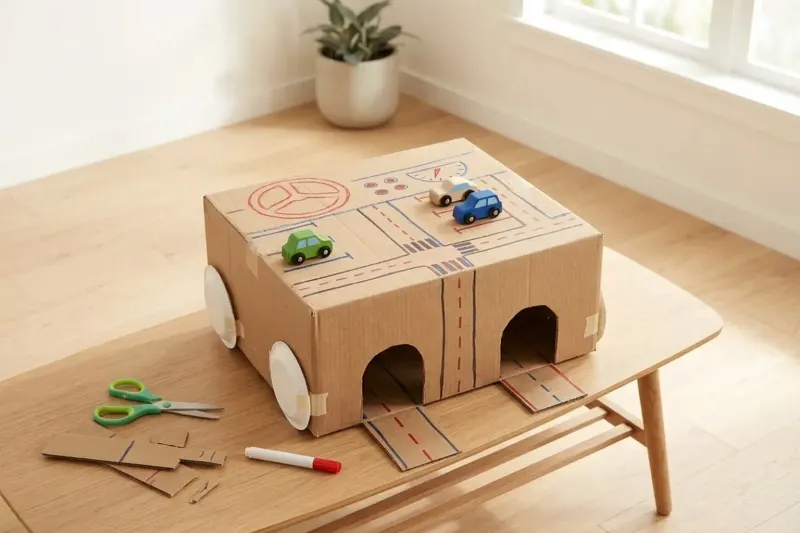
Shallow cartons and small delivery boxes work well for tabletop play setups, drawing on play designs from PBS KIDS for Parents. Turn the clean box upside down on a low activity table so the broad bottom becomes an elevated deck. An adult cuts archways measuring approximately four to five inches wide along the lower rim of opposite sides to create drive-through tunnels for miniature toy cars or small animal figures. Children can draw lanes, parking bays, and crosswalks directly across the top surface using crayons or markers, or tape paper ramps from the box down to the table so vehicles can roll between levels. When tabletop car play is finished, flip the carton upright to make a soft indoor toss target, adapted from Penn State Extension recreation activities. Have your child crumple sheets of recycled newspaper or scrap paper into soft balls larger than two inches across. Tape a standing line on the floor roughly four feet away and take turns tossing the soft paper balls into the open box. Lightweight paper balls remove the risk of broken lamps or dented walls while offering an engaging tossing game.
Pacing the Activity and Managing Waste
Breaking the project into distinct stages keeps the crafting space organized and prevents frustration. University of Maine Cooperative Extension youth project guidelines indicate that activities for early elementary ages work best when kept within realistic attention spans, generally running between twenty and forty minutes for focused crafting before moving into open-ended play. Plan for approximately ten minutes of adult prep and cutting, twenty minutes of child decorating and taping, and thirty minutes of pretend play. Because cardboard structures occupy floor space, set a clear plan for storage. If your family keeps a vehicle build for several days, slide it flat against an interior wall out of walkways each evening. When cardboard panels become softened, bent, or creased, pull away any remaining plastic tape and place the cardboard into your municipal recycling bin.
Choosing Your Single-Box Project
| Situation | Consider | Why |
|---|---|---|
| You have a large rectangular moving box and an open living room carpet. | Open Crawl Tunnel | Cutting away opposing ends creates immediate gross motor movement with full visibility and continuous airflow. |
| You have a medium square carton and a child interested in pretend driving. | Sit-In Vehicle | Offers contained seated play with simple paper plate controls and a low front wall that keeps sightlines clear. |
| You have a shallow delivery box and limited open floor space. | Tabletop Roadway and Cave | Resting an inverted box on a table creates multi-level car play without taking over walking paths. |
Hypothetical Worked Build: Sit-In Play Car
In this hypothetical example, a parent converts one single-wall corrugated carton measuring approximately 24 by 18 by 16 inches (61 by 46 by 41 cm). The adult spends about 10 minutes trimming the top flaps and cutting the front wall down to a height of 10 inches (25 cm) from the floor so the seated four-year-old child can see forward clearly. The child then spends roughly 20 minutes attaching four 9-inch (23 cm) paper plates as wheels using masking tape, taping a fifth plate to the interior as a steering wheel, and coloring headlights with broad-line markers. Estimated out-of-pocket cost is under $2.00 using standard household paper goods and scrap tape.
- Cardboard Box Car (61 x 46 cm)
- Clear Floor Buffer Zone
- Low Craft Supply Mat
When this approach is not a good fit
This activity is unsuitable for boxes with heavy industrial staples, grease or food residues, damp walls, or prior chemical storage. It is also unsuitable in cramped rooms where a three-foot perimeter cannot be cleared of sharp furniture corners or trip hazards.
PUT THIS GUIDE TO USE
Find an activity for your family
Sources & further reading
AI-assisted writing and concept images. Sources and automated checks support the process; an adult should check materials and adapt activities to their child.
How we create our guides · Suggest a correction