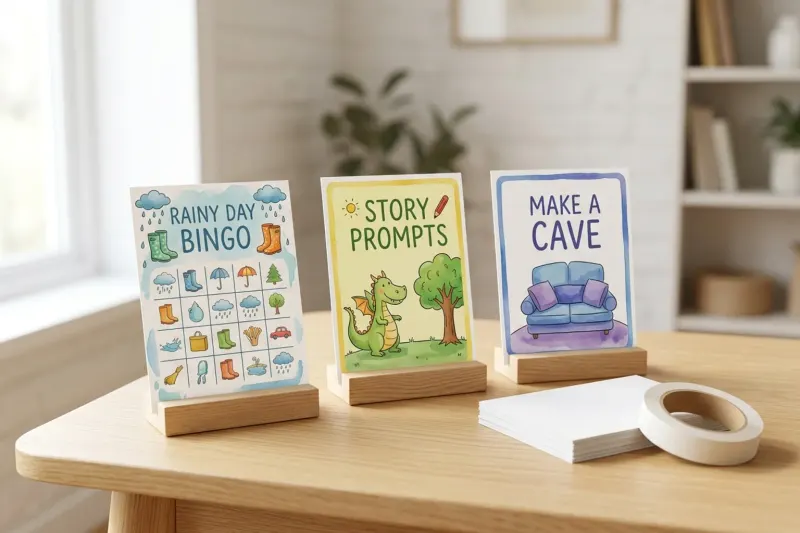
When persistent rain or cold weather closes off the backyard, managing children's energy indoors requires simple structure. A deck of printable activity cards provides an orderly rhythm that keeps four- to eight-year-olds engaged without chaotic running. By printing prompts on standard letter-size paper or cardstock (8.5 × 11 inches / 21.6 × 27.9 cm) and dividing them into three distinct types—active gross-motor movement, quiet table focus, and gentle scavenger hunts—caregivers can alternate bursts of physical play with calm seated tasks. The Centers for Disease Control and Prevention (CDC) guidelines note that children ages 6 and older need at least 60 minutes of daily moderate-to-vigorous physical activity, while preschoolers ages 3 through 5 require regular activity throughout the day. This guide explains how to format your card layout, select large household props that avoid choking hazards, set up clear floor boundaries, and pace turns safely under adult supervision.
Card Layout and Cutting Guidelines
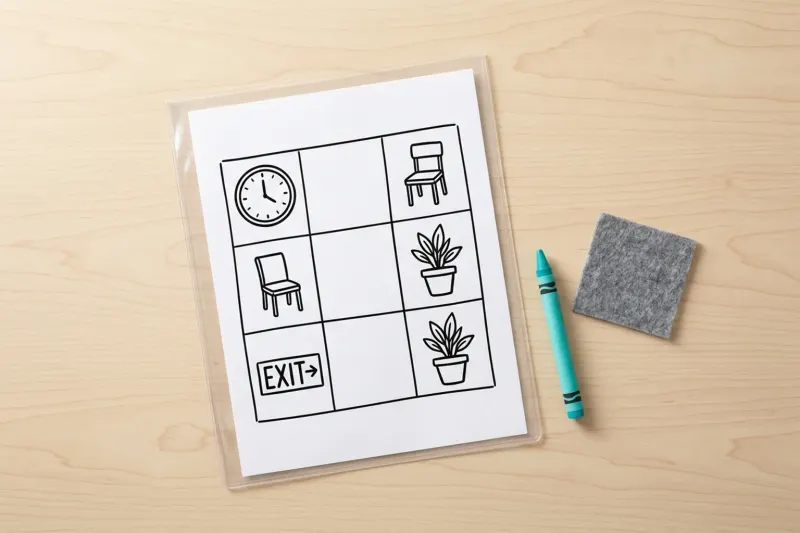
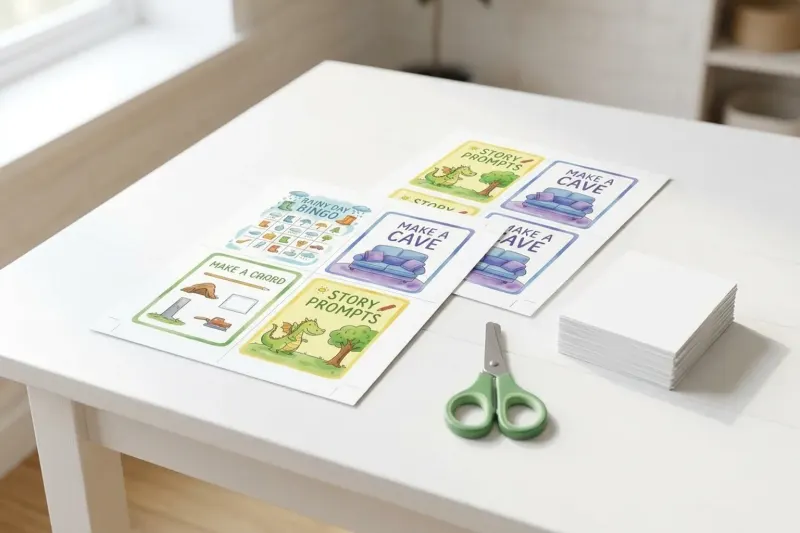
Standard letter-size cardstock (8.5 × 11 inches / 21.6 × 27.9 cm) provides enough weight to withstand repeated handling without tearing. Dividing each page into four equal quadrants produces cards that measure 4.25 × 5.5 inches (10.8 × 14.0 cm), leaving plenty of room for large typography and simple icons. Under U.S. Consumer Product Safety Commission (CPSC) regulations (16 CFR § 1501.3), paper, cardstock, and books are exempt from small-parts bans because paper fibers do not shatter into rigid, dangerous choking fragments. If heavy cardstock is unavailable, standard 20-pound printer paper works well when slipped into clear badge holders or glued to reclaimed cereal-box cardboard. All card preparation requires direct adult supervision: children ages 4 to 8 should use only blunt-tip safety scissors with protected plastic loops, while an adult must handle any rotary cutters, utility blades, or heavy paper trimmers.
Related guide: 10 No-Prep Indoor Games for Kids Ages 4–8
Balancing Movement and Low-Energy Prompts
Relying entirely on high-energy prompts can lead to overstimulated roughhousing, while relying solely on seated worksheets can cause restlessness. Following recommendations from Penn State Extension for indoor rainy-day play, gross-motor tasks can include crawling games, floor-tape balance walks, and animal imitations that exercise large muscle groups without heavy jumping. A balanced 12- to 16-card deck uses three color-coded categories: Active Movement (blue), Quiet Focus (green), and Search-and-Find (orange). Active cards prompt gross-motor imitation, such as crab-crawling across an area rug or stretching tall like a giraffe. Quiet Focus cards invite calm table tasks, such as tracing round kitchen containers onto scratch paper or making repeating color patterns with crayons. Search-and-Find cards encourage a steady walking pace, asking children to find two clean washcloths or spot an object smoother than a polished river stone. Drawing one active card followed immediately by one quiet card creates a predictable rhythm that prevents fatigue.
Related guide: Picture Bingo for Waiting Rooms and Road Trips
Floor Boundaries and Safe Prop Selection
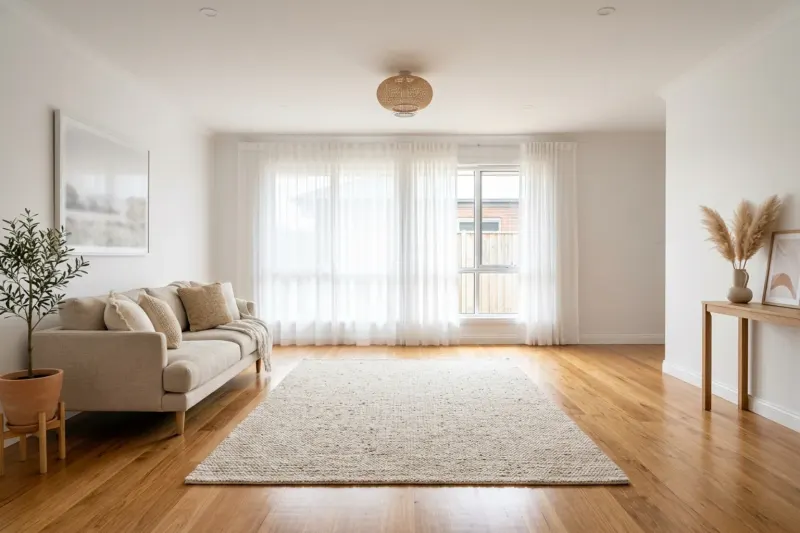
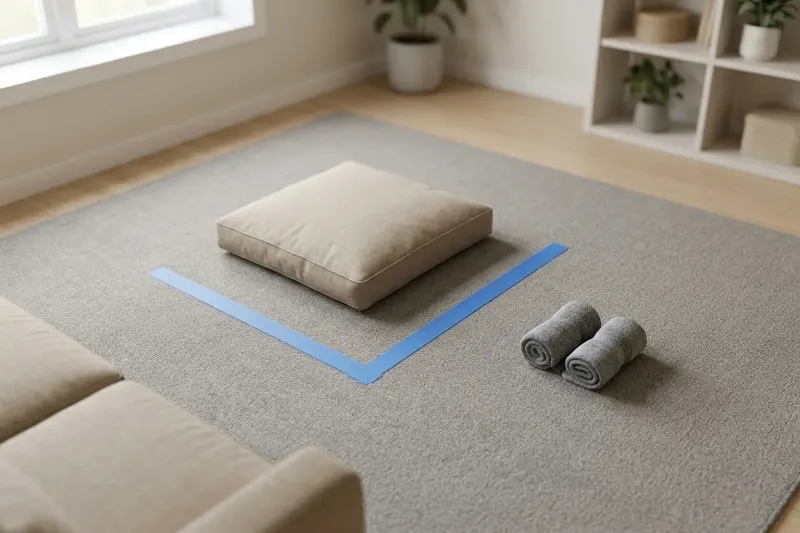
Before drawing the first card, establish a clear indoor movement zone measuring at least 6 × 6 feet (1.8 × 1.8 meters) on a flat, non-slip surface, such as an anchored area rug or clean hard floor. Move lightweight stools, low glass coffee tables, floor lamps, and trailing cords completely outside this perimeter. Never place an active play area near open staircases or active kitchen spaces. Props named on the cards must be selected with care. Under CPSC standard 16 CFR Part 1501, any object that fits entirely into a small-parts test cylinder of 1.25 inches (31.7 mm) in diameter and 1.0 to 2.25 inches (25.4 to 57.1 mm) in depth is classified as a small part and presents a choking hazard. However, choking safety cannot be determined solely by meeting a single diameter measurement, nor does a child reaching age 4 automatically make an object safe. Compressible foams, pliable plastics, round balls, and items that can shear into fragments present airway hazards regardless of dimension. Avoid loose buttons, coins, marbles, and dry beans entirely. Safer household alternatives include purpose-made, large, single-piece items: rolled adult wool socks, wide cardboard paper towel tubes, standard sofa pillows, and low-tack paper tape pressed flat to the floor. Active movement requires continuous adult supervision to keep play within bounds.
Related guide: Printable Neighborhood Walk Hunt for Ages 4 to 8
Adapting Cards for Emerging Readers and Mixed Ages
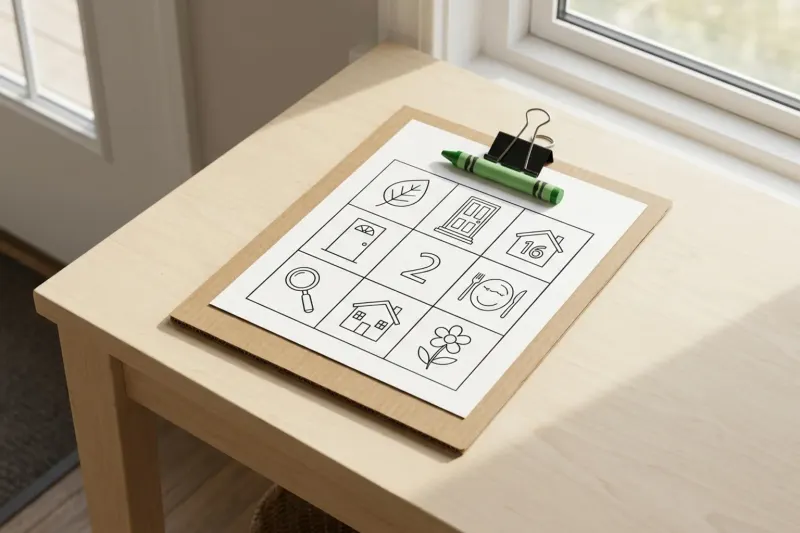
When children ages 4 and 7 play together, activity prompts must accommodate different reading and coordination abilities. Children ages 4 and 5 generally rely on visual cues and single-step instructions, whereas children ages 6 to 8 can follow multi-step written text. To bridge this gap, pair a bold graphic icon with simple text on every card. For instance, a running shoe indicates a movement task, a pencil indicates drawing, and an open magnifying glass signifies a household search. Establish cooperative partner roles rather than competitive races: the older child reads the instruction aloud while the younger child interprets the icon, holds the prop, or leads the movement imitation. This cooperative routine keeps frustration low and ensures every child participates actively.
Managing Card Turnover and Tidy Transitions
Without a clear physical system, cards easily scatter across the floor, making it hard to track completed activities. Set up two small boxes or taped envelopes on a low table, labeled 'Draw' and 'Done'. Children take a single card from the Draw pile, complete the prompt together, and deposit the card into the Done container before drawing the next. To prevent floor clutter from becoming a slipping or tripping hazard, include a tidy prompt card every four or five turns. A prompt such as 'Return two props to their storage basket' or 'Smooth down the tape line' keeps the area clean. Ending the session with a dedicated cleanup card ensures all household items return to their regular storage and paper cards stay orderly for the next rainy day.
Activity Deck Setup and Material Decisions
| Situation | Consider | Why |
|---|---|---|
| Accommodating children ages 4 and 7 playing together | Print cards with large graphic icons alongside clear text and assign cooperative roles | Emerging readers identify visual cues while older children practice reading prompts aloud, removing reading barriers without competition. |
| Living in an upper-floor apartment with downstairs neighbors | Select crawling, floor-tape balancing, and seated stretching over jumping prompts | Engages gross-motor muscle groups while minimizing jumping impact and vibration through floors. |
| Toddler sibling sharing the play environment | Eliminate loose small items entirely and use only large, durable household items like rolled socks and cushions | A single diameter measurement does not guarantee choking safety, so using large, non-compressible, one-piece props avoids airway hazards. |
Worked Example: An Illustrative 60-Minute Rainy Morning Deck Plan
This hypothetical schedule demonstrates how a caregiver might pace a 60-minute indoor session using a 6-card rotation. Estimated materials cost is approximately $0.50 to $1.00 for standard home printer paper and ink. Clear an anchored rug space measuring at least 2.0 × 2.0 m (6.6 × 6.6 ft). Turn 1 (10 minutes): Active card - 'Walk heel-to-toe along a 2.0 m (6.6 ft) straight line of blue painter tape.' Turn 2 (10 minutes): Quiet card - 'Trace the outline of three plastic mixing bowls onto scrap paper.' Turn 3 (10 minutes): Scavenger card - 'Find two clean kitchen washcloths and fold them into squares.' Turn 4 (10 minutes): Active card - 'Crawl like a bear around the perimeter of the rug twice.' Turn 5 (10 minutes): Quiet card - 'Sort eight large, blunt plastic serving spoons by color.' Turn 6 (10 minutes): Cleanup card - 'Peel up the floor tape, return washcloths, and place all cards into the Done envelope.' Direct adult supervision is maintained throughout the session.
- Card 1: Active Animal Move (Blue)
- Card 2: Quiet Drawing Task (Green)
- Card 3: Household Hunt (Orange)
- Card 4: Balance Challenge (Blue)
When this approach is not a good fit
This activity card system is unsuitable for spaces near open staircases, active kitchens, unstable furniture, or unpadded glass tables. It should not be used as an unsupervised activity when scissors are present or when infants and toddlers have access to unvetted props.
PUT THIS GUIDE TO USE
Find an activity for your family
Sources & further reading
AI-assisted writing and concept images. Sources and automated checks support the process; an adult should check materials and adapt activities to their child.
How we create our guides · Suggest a correction