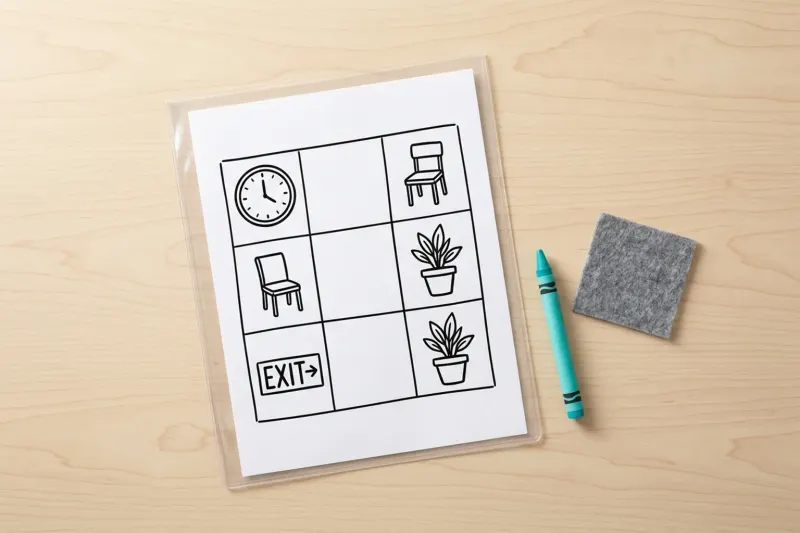
Managing waiting room downtime or long highway stretches with young children requires activities that stay contained. Traditional bingo uses loose tokens, coins, or plastic markers that roll across vehicle floorboards or scatter under waiting area chairs. In moving cars, searching for dropped pieces disrupts passenger restraint positions, while small tokens pose persistent mouthing and choking hazards. A single wipe-clean sheet provides a practical alternative. Placing a paper grid inside a clear, flexible sheet protector allows children to mark squares directly with a washable dry-erase crayon. Based on guidance from child safety agencies on choking prevention and projectile reduction, this guide outlines how to build lightweight, age-appropriate bingo sheets that keep children comfortably seated without screen time.
Replacing Loose Tokens for Safety
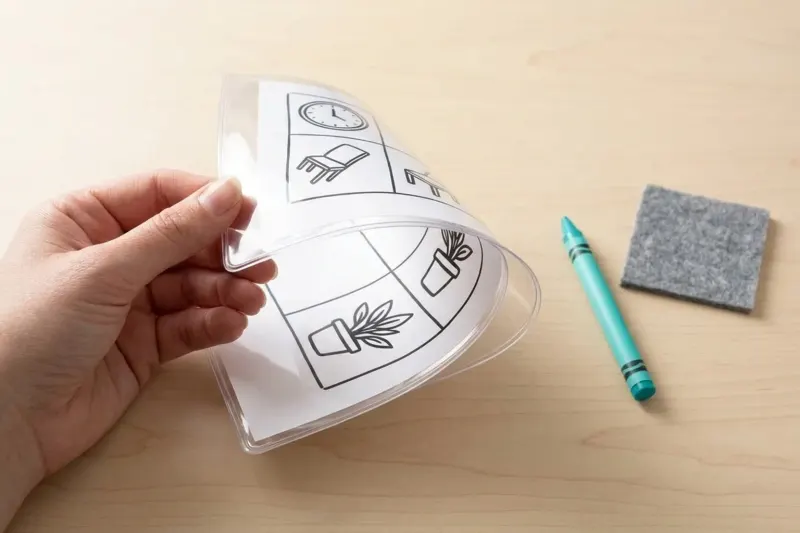
Traditional bingo relies on small counters such as plastic chips, wooden discs, or dry beans. These loose parts present serious safety concerns in waiting areas and moving cars. Under Consumer Product Safety Commission (CPSC) regulations (16 CFR § 1501), any object fitting entirely into a standardized cylinder measuring 1.25 inches (31.7 mm) across and 1.0 to 2.25 inches (25.4 to 57.1 mm) deep is classified as a choking hazard for young children. However, choking safety cannot be determined solely by an object exceeding a single dimension, nor does reaching age 4 guarantee that a child will not mouth objects. Pliable plastics, smooth rounded shapes, and compressible parts still present airway risks, making active adult supervision essential. In vehicles, loose items introduce a secondary hazard: projectile motion. Child passenger safety guidance from the American Academy of Pediatrics (AAP) and the National Highway Traffic Safety Administration (NHTSA) confirms that unsecured items inside a cabin keep traveling at highway speed during sudden deceleration. Heavy clipboards made of solid wood or metal can cause blunt-force injury in a crash. Replacing boards and loose counters with standard paper inside a flexible polypropylene document sleeve—weighing under 1 ounce (28 grams)—eliminates rigid projectile hazards. Children mark squares with non-toxic (ASTM D-4236 compliant) dry-erase markers or wax crayons, keeping the entire activity soft, flat, and token-free.
Related guide: Five-Minute Waiting Games for Everyday Errands
Matching the Grid to Ages 4 Through 8
Grid complexity needs to match a child's visual search capacity and literacy stage rather than an arbitrary age label. For 4- and 5-year-olds who are emerging readers, a 3×3 grid containing 9 items offers manageable variety without causing visual fatigue. Each square should measure approximately 2.25 × 2.25 inches (5.7 × 5.7 cm), filled with a high-contrast black line silhouette of an easily identified everyday object. Avoid intricate illustrations, tiny line weights, or ambiguous sketches that strain vision in dimmed waiting rooms or in vehicles with changing sunlight glare. For children ages 6 to 8, a 4×4 grid (16 items) or a traditional 5×5 grid (24 items plus a center free square) provides greater interest, with squares measuring roughly 1.5 × 1.5 inches (3.8 × 3.8 cm). At this reading level, pairing a recognizable icon with a clear, capitalized printed word—such as BRIDGE or CLOCK—allows children to connect visual images with letter strings. If a child needs a firmer surface to draw on their lap, insert a single sheet of recycled cereal-box paperboard (about 0.02 inches or 0.5 mm thick) inside the plastic sleeve behind the paper. This adds light backing support while keeping overall weight well below that of a rigid clipboard.
Related guide: 10 No-Prep Indoor Games for Kids Ages 4–8
Choosing Practical Items to Spot
Visual targets should fit the specific environment so children can play without leaving their seats or causing distractions. In healthcare waiting rooms, children must stay seated to respect patient privacy and keep walkways open. Grid targets should consist of common stationary items visible from typical clinic seating. Reliable examples include a wall clock, an exit sign, a hand sanitizer dispenser, a blue guest chair, a framed picture, a potted plant, a light switch plate, a box of facial tissues, or a wastebasket. Exclude items that require standing, walking around privacy partitions, or looking toward treatment rooms. For highway driving, targets must account for speed, window sightlines, and rear seat positioning. Children in car seats or booster seats have narrow sight angles through side glass. Avoid tiny, fleeting details like bumper stickers, specific birds, or distant license plate numbers, which require strenuous tracking that can induce car sickness. Instead, select large, repetitive roadside infrastructure: speed limit signs, highway overpasses, commercial semi-trucks, construction equipment, mile markers, railroad signals, and red barns. On car trips, rules can allow duplicate spotting, such as crossing off three commercial trucks, whereas waiting rooms work best with one-to-one matching.
Related guide: Screen-Free Quiet Time for Kids Ages 4–8
Keeping Car Seats Safe on the Road
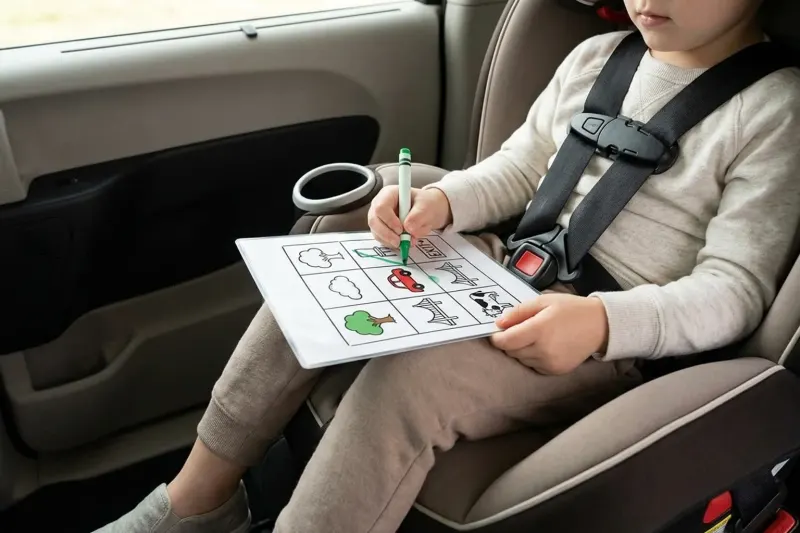
Any activity introduced in a vehicle must never interfere with proper car safety restraints. Child passenger safety guidelines from the AAP and Vanderbilt University Medical Center emphasize that common travel mistakes include loosening harnesses or unbuckling seat belts during transit to retrieve fallen toys. In 5-point harnesses, the chest clip must remain level with the armpits, and harness webbing must pass the pinch test at the collarbones without excess slack. Booster seats require the lap belt to lie low across the upper thighs and the shoulder belt to cross mid-chest. Playing picture bingo must occur strictly within the child's normal upright seated position. If a marker or sheet protector falls to the vehicle floor, maintain a firm family rule: dropped items stay on the floor until an adult stops the vehicle in a designated parking spot. To avoid drops, attach a small piece of low-tack painter's tape to secure the sleeve corner to an armrest, or slide the marker into a dedicated pocket on the sheet protector. Avoid long cords or loose strings that introduce strangulation or entanglement hazards. While ASTM F963 toy safety standards set a 7-inch (17.8 cm) maximum limit on strings for young children's playthings, avoiding tethers altogether by using an adhesive slide-in pocket or a hook-and-loop tab is a cleaner, safer choice. Adult supervision is always necessary when children use drawing tools in transit.
Quiet Rules and Easy Cleanup
Traditional bingo typically ends with a loud shout, which disrupts clinical waiting areas and can startle a driver on the road. Modifying game goals keeps play focused and quiet. In waiting rooms, play Cooperative Cover or Blackout, where caregiver and child work together as a team to spot every item on the board before the child's appointment begins. This reframes the game into a calm observation routine. When siblings share a vehicle backseat, print identical icons in randomized positions on separate cards. This eliminates disputes over who saw an object first and prevents children from leaning across the seat divider to copy each other. For clearing the cards between rounds, avoid wet paper towels, alcohol wipes, or liquid sprays that can spill, stain vehicle upholstery, or irritate sensitive skin. Instead, affix a 2 × 2 inch (5 × 5 cm) square of dry craft felt or soft microfiber fabric to the sleeve border using a flat tape hinge or hook-and-loop dot. Dry-erase marks lift off with a light swipe, allowing repeated rounds without creating waste or liquid mess.
Setup Choices by Travel Environment and Age Band
| Situation | Consider | Why |
|---|---|---|
| Preschooler (ages 4–5) in a quiet medical clinic waiting room | 3×3 picture-only grid on an 8.5 × 11 in (21.6 × 27.9 cm) card in a flexible plastic sleeve with a dry-erase crayon. | Eliminates reading requirements, reduces visual searching fatigue, and keeps marking silent without marker squeaks or loose tokens. |
| Elementary child (ages 6–8) in the backseat during highway driving | 4×4 or 5×5 grid with paired icons and text on a half-sheet card (5.5 × 8.5 in / 14.0 × 21.6 cm) secured in a vinyl sleeve. | Fits compact lap space without sliding off, challenges reading ability, and provides enough targets for a 30- to 60-minute highway drive. |
| Two siblings sharing a back vehicle seat | Individual cards with randomized square layouts and distinct marker colors. | Prevents cross-seat copying, reaching across passenger restraints, or arguing over identical sequential spots. |
| Mixed-age wait where an infant or toddler under age 3 is also present | Wax-crayon marking on paper cards without plastic caps, or laminated cards marked exclusively by the older child with direct adult supervision. | Standard dry-erase marker caps and loose tokens present severe choking hazards under CPSC 16 CFR § 1501 for children under 3. |
Worked Example: Low-Prep Pediatric Waiting Room Bingo
A caregiver prepares for an estimated 45-minute clinic visit with a 4-year-old and a 7-year-old. Before leaving home, the caregiver prints two cards on standard paper. Card A for the 4-year-old features a 3×3 grid of 9 bold black icons: wall clock, hand sanitizer bottle, blue guest chair, exit sign, trash can, potted plant, tissue box, light switch, and wall picture. Card B for the 7-year-old features a 4×4 grid of 16 boxes pairing icons with capital text labels, including items like fire alarm, water fountain, and computer monitor. Each sheet slips into a flexible polypropylene sleeve weighing approximately 0.4 ounces (11 grams). The caregiver provides two non-toxic dry-erase crayons and two small felt eraser squares attached with hook-and-loop tabs. During the wait, both children stay seated. The younger child crosses off items with simple marks; the older child completes rows. When called into the exam room, both children wipe their cards clean in seconds and place them into a tote. Hypothetical preparation time: 8 minutes. Hypothetical stationery cost: about $1.50 using household supplies.
- Top Header and Title Strip
- Primary Picture Grid Area (3x3 or 4x4)
- Marker Storage Sleeve Pocket
- Felt Eraser Tab (Hook-and-Loop Mount)
When this approach is not a good fit
This activity is unsuitable for children prone to motion sickness when looking downward in a moving vehicle, for driving at night without ambient cabin illumination, and for pedestrian situations such as walking through clinic hallways, crossing parking lots, or riding in retail shopping carts where looking at a card distracts from walking safety or adult handholding.
PUT THIS GUIDE TO USE
Find an activity for your family
Sources & further reading
- American Academy of Pediatrics - Car Safety
- National Highway Traffic Safety Administration - Playing It Safe
- U.S. Consumer Product Safety Commission - Small Parts Regulations
- Vanderbilt University Medical Center - Car Seat Safety
AI-assisted writing and concept images. Sources and automated checks support the process; an adult should check materials and adapt activities to their child.
How we create our guides · Suggest a correction