Setting up a comic strip storytelling game for children between ages 4 and 8 works best when you match the physical page layout and turn structure to what young children can comfortably do with drawing tools. Instead of asking a preschooler to invent and illustrate a complete narrative alone, you can set up a simple three-panel template and divide the creative roles. A younger child can sketch the main character or central action, an older sibling or adult caregiver can draw background details or scribe spoken dialogue, and both can decide on the story resolution together. According to developmental milestone checklists from the Centers for Disease Control and Prevention (CDC), most four-year-olds can draw a person with three or more body parts and speak in sentences of four or more words, while the ability to narrate sequential two-event stories and manage structured game turns typically matures around age five. Structuring the page into wide, uncluttered boxes and keeping drawing turns to roughly five minutes helps prevent hand fatigue and keeps the collaborative session calm. This suggested game is an adaptable home craft rather than a clinical tool, and continuous adult supervision is necessary whenever young children handle scissors, markers, and small craft items.
Matching Panel Count to Narrative Stages
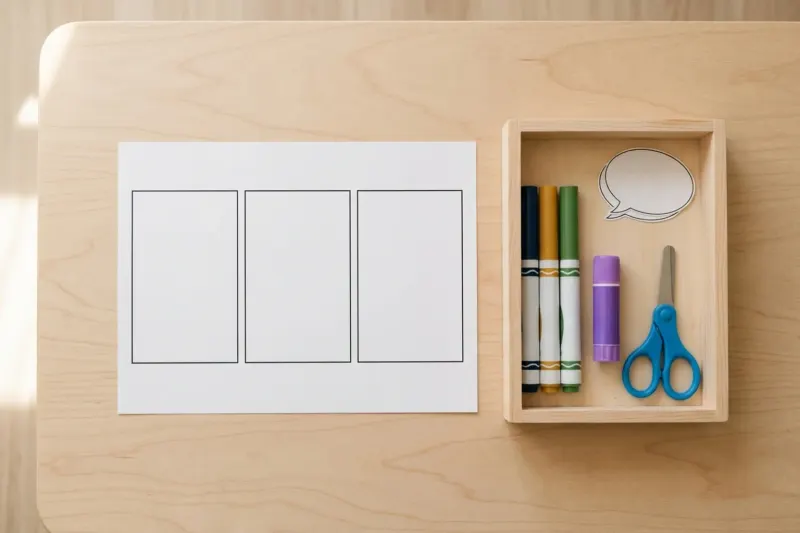
Choosing the right panel layout determines whether a storytelling session stays engaging or ends in frustration. Developmental milestones published by the Centers for Disease Control and Prevention (CDC) note that most four-year-olds can describe what comes next in a familiar book and draw a recognizable person with at least three body parts. By age five, children typically narrate simple sequential stories involving at least two events—such as an animal climbing a fence and finding a treat—and sustain non-screen focus for 5 to 10 minutes during craft activities or story time. Because of these distinct physical and cognitive baselines, standard comic book pages with eight to twelve tight frames are poorly suited for early childhood play. A suggested three-panel horizontal template printed on standard letter paper (8.5 by 11 inches, or 21.6 by 27.9 cm) provides three broad boxes measuring roughly 6 by 2.5 inches (15.2 by 6.4 cm) each. This open surface accommodates broad marker strokes and developing fine-motor control, allowing a younger child to draw without running past paper borders. For older participants ages six to eight, who write words more easily and follow multi-step story arcs, expanding to a four- or six-panel grid allows for setup, a problem, a failed attempt, and a humorous resolution.
Related guide: A 15-Minute Calm Play Routine for Ages 4 to 8
Structuring Alternate Drawing Turns and Scribing
Collaborative turn-taking requires clear boundaries so that one child's enthusiasm does not overwhelm a slower partner. The American Academy of Pediatrics highlights that shared offline activities provide rich opportunities for conversational turn-taking when adults stay actively involved. To balance different skill levels, assign distinct narrative tasks rather than having two children draw inside the same box at once. In a mixed-age pair of a four-year-old and a seven-year-old, the younger player can act as character designer and main penciler, while the older player draws background settings and dialogue bubbles. Fine-motor milestone benchmarks from The OT Toolbox note that children around four years old transition from a full palmar grasp toward a digital pronate or early tripod grip, which makes small handwriting tiring. Caregivers can eliminate this obstacle by serving as scribes: ask the younger child what the character says, repeat their exact phrasing, and write it in light pencil inside an oval bubble. Keeping each player's drawing turn to roughly five minutes matches the CDC attention guidelines for five-year-olds and keeps older siblings engaged while waiting for their turn.
Related guide: Draw-a-Story: A Cooperative Paper Game
Selecting Child-Safe Paper, Markers, and Scissors
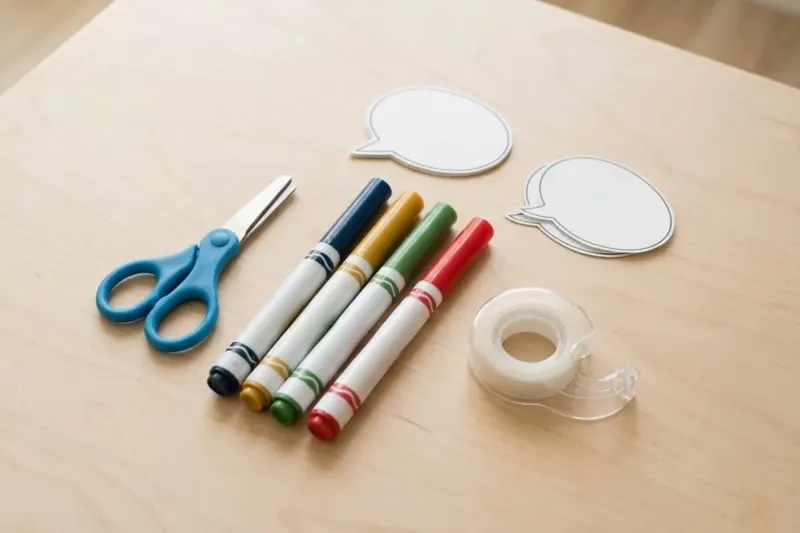
Reliable, age-appropriate art materials keep a tabletop storytelling session focused on drawing rather than cleanup emergencies. Standard white multipurpose office paper (20 lb bond weight, approximately 75 gsm) works well for graphite pencils and wax crayons, but water-based ink can saturate thin sheets. Using medium-weight cardstock (65 lb cover weight, approximately 176 gsm) prevents marker bleed-through when children color heavily inside panel borders. Coloring tools should be non-toxic, water-soluble, broad-line markers that wash cleanly from tabletops and clothing. While non-toxic seals indicate that ingredients do not pose acute health risks under expected craft use, they do not make markers food-safe or harmless if mishandled, so adult oversight remains essential. If speech bubbles or sound effect bursts (such as 'CRASH' or 'POP') are cut from separate paper and glued onto the strip, tool safety standards are critical. Crayola specifies that preschool safety scissors with blunt, rounded plastic tips and plastic-sheathed blades (Item #811458) are age-rated for children 36 months (3 years) and older. These purpose-made blades cut standard paper effectively while preventing cuts to skin, clothing, or hair. Continuous adult supervision is required whenever scissors or glue sticks are on the table. Keep marker caps and small paper cutoffs in a shallow tabletop bowl to minimize choking risks for any younger siblings nearby.
Related guide: Indoor Games for Two Children of Different Ages
Managing Story Stalls and Plot Disagreements
Creative roadblocks and differing story ideas are common during collaborative play. When a four- or five-year-old child stares at a blank box and feels stuck, avoid taking over the marker. Instead, offer two concrete narrative options linked to the previous box: 'Did the turtle find a skateboard, or did a gust of wind blow his hat away?' Providing a binary choice narrows the options while keeping the child in charge of the plot. When older children disagree on story direction—such as an eight-year-old wanting an alien battle while a five-year-old wants to draw a sleeping kitten—use a branching compromise. Let panel one introduce both characters side by side, or assign one child to direct the problem in panel two and the other to determine the ending in panel three. If a child expresses frustration with a drawing mistake, remind them that comics rely on simple, funny doodles rather than realistic portraits. Keeping a tray of pre-cut paper speech bubbles and basic geometric shape cutouts ready allows a tired child to paste down words or sound effects without needing to redraw a character.
Template Layout and Role Allocation by Age
| Situation | Consider | Why |
|---|---|---|
| Single preschooler (age 4) playing with a caregiver | 3-panel wide grid; child illustrates main character while caregiver scribes spoken words | CDC milestones note that four-year-olds can structure narrative events and draw multi-part figures, but require an adult scribe to capture verbal dialogue without writing fatigue. |
| Kindergarten child (age 5) working with minimal adult guidance | 3- to 4-panel template; child writes single-word sound effects (e.g., 'BAM') and draws two sequential actions | By age five, children typically sequence two events and hold attention for 5 to 10 minutes on crafts, making short independent stories achievable. |
| Sibling pair with wide age gap (ages 4 and 8) | 4-panel strip with alternating panel ownership (Younger: panels 1 and 3; Older: panels 2 and 4) | Dedicated frames eliminate competitive erasure and prevent the older child from drawing over the younger child's simpler line art. |
| Child exhibits motor fatigue or line-drawing frustration | Pre-cut speech bubble cutouts, simple paper shapes, and stamp markers | Reduces fine-motor strain while preserving narrative choice and cooperative storytelling pacing. |
Worked Example: The Wandering Snail (Suggested Home Session)
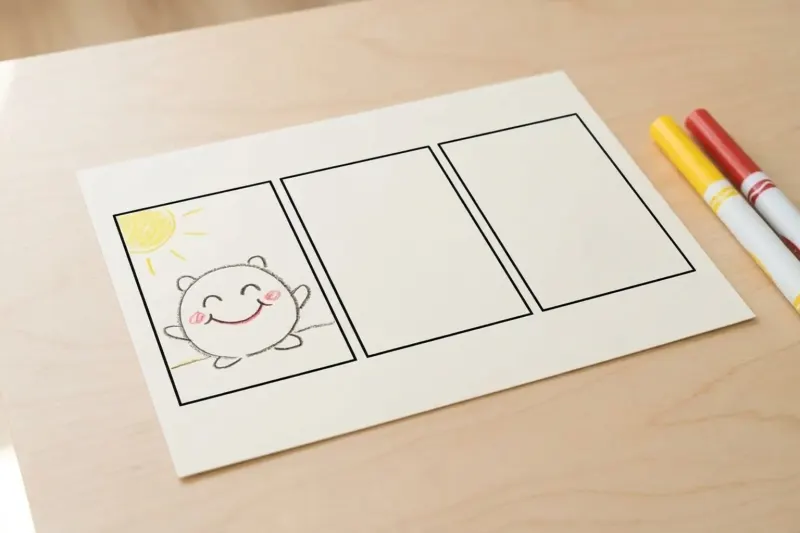
In a suggested 15-minute home play session, an adult guides a 4-year-old child and a 7-year-old sibling using one sheet of letter-sized cardstock (8.5 by 11 inches / 21.6 by 27.9 cm) ruled into three horizontal boxes. Materials come from standard household supplies, using washable markers and scrap paper. Minute 0 to 2: The adult suggests a simple scenario ('A snail who wants to move fast'). Minute 2 to 6: The 4-year-old draws a smiling green spiral shell on wheels in Panel 1. The adult asks what the snail says, scribing 'Beep beep!' into a light pencil bubble above the shell. Minute 6 to 10: The 7-year-old takes Panel 2, using blunt plastic safety scissors to cut out a paper lightning bolt and sketching a hilly road with a red marker. Minute 10 to 14: Both children work on Panel 3 together, with the younger sibling drawing a checkered finish line and the older sibling writing 'WINNER' across the top. Minute 14 to 15: The children read their completed three-panel comic aloud together.
- Cardstock comic sheet (3 panels)
- Washable marker tray
- Pre-cut bubble tray and glue stick
- Supervised safety scissor rest
When this approach is not a good fit
This structured comic activity is unsuitable for unsupervised play, and is not designed for children under three years of age due to the choking hazards posed by marker caps, glue lids, and small paper cutoffs. It is also poorly suited for times when children need vigorous whole-body physical movement rather than seated table tasks, or for children who are experiencing acute behavioral distress and cannot engage in shared turn-taking.
PUT THIS GUIDE TO USE
Find an activity for your family
Sources & further reading
- CDC: Milestones by 4 Years
- CDC: Milestones by 5 Years
- American Academy of Pediatrics: Media Use and Family Habits
- The OT Toolbox: Fine Motor Milestones
- Crayola: Safety Scissors Specifications
AI-assisted writing and concept images. Sources and automated checks support the process; an adult should check materials and adapt activities to their child.
How we create our guides · Suggest a correction