The convergence of retail finance and creator economy has birthed "social copy-trading"—a mechanism where the barrier between an influencer’s broadcast and a follower’s brokerage account is effectively erased. In 2026, this is no longer just a "feature" on platforms like eToro or specialized DeFi protocols; it is a full-blown asset management industry operating in the shadows of legacy regulation, often utilizing sophisticated tactics outlined in The Evolution of DEX Arbitrage: How Traders Extract Alpha in 2026. For the influencer, it is a high-margin monetization engine; for the follower, it is a high-stakes gamble on the social signal of a peer.
The Anatomy of the "Influencer-Led Fund"
At its core, social copy-trading in 2026 relies on automated execution layers—API-driven bridges that sync a "Master Trader’s" portfolio moves with "Follower" wallets in real-time. But the operational reality is far messier than the slick UI of a fintech app suggests, requiring a level of precision similar to how Top Exporters Are Moving to Regional Warehousing to Protect Margins to maintain profitability.
The promise is democratization; the reality is "liquidity-induced slippage." When a charismatic YouTuber with 500,000 subscribers enters a mid-cap altcoin or a thin-volume stock, the act of their 10,000 followers copying the trade simultaneously often moves the market price against the very people who are trying to follow the signal. This is the "Influencer Slippage Paradox"—the more successful the master trader becomes, the less effective their strategy is for their own followers.
The Legal Tightrope: When is a "Signal" Actually Advice?
The regulatory landscape in 2026 is fractured. While the SEC in the US and ESMA in Europe have tightened definitions, social copy-trading occupies a perennial gray zone. Is an influencer providing "general financial content," or are they "managing a discretionary investment vehicle"—a distinction that also impacts those trying to avoid Digital Nomad Tax Alert: How to Avoid Automated Residency Audits in 2026?
- The Registration Trap: Many influencers operate under the assumption that if they don't hold the followers' funds, they aren't an investment manager. This is a dangerous simplification. If you charge a subscription fee or take a performance cut of the gains generated via a copy-trading bridge, many jurisdictions consider you an unregistered Investment Advisor (IA).
- Liability of the Algorithm: If the copy-trading software fails—latency issues in API handshakes, botched trade execution during high volatility—who is liable? The platform claims they are merely a tool; the influencer claims they are a broadcaster; the user is left with a liquidated account and no clear path to legal recourse, highlighting why many investors are now looking into Why Institutional Investors Are Moving Into Fractional Data Center Ownership in 2026 for safer alternatives.
"The regulatory framework for copy-trading is currently a game of whack-a-mole. Regulators are moving toward treating ‘copying’ as a fiduciary relationship. If you take a ‘performance fee,’ you are effectively running a hedge fund. Most influencers are one subpoena away from a massive securities fraud headache." — Anonymous Legal Counsel, Fintech/Compliance Firm, NYC
The Operational Friction of Scaling
Scaling a copy-trading community isn't a technical challenge; it’s a human behavior nightmare, much like the difficulty of trying to Turn Your Private AI Compute Into a Profitable Business by 2026 without proper management. Developers of copy-trading infrastructure frequently cite "the sync-lag issue." When a master trader makes a trade, their followers’ execution time varies based on local server latency, API rate limits, and the broker's own liquidity pools.
Common Failure Modes:
- The API Bottleneck: During market crashes, broker APIs often throttle requests to protect their own infrastructure. The master trader gets out, but the followers get queued, leading to "toxic fills" where followers execute at the bottom of the dip while the influencer is already clear.
- Portfolio Weighting Mismatch: If an influencer has a $1M account and a follower has $100, the smallest trade by the influencer might be impossible for the follower due to "minimum trade size" restrictions on exchanges. The system doesn't always handle fractionalization gracefully, leading to fragmented, broken portfolios for smaller users.
Field Report: The "Alpha-Group" Collapse of 2025
Consider the case of a mid-sized Discord-based trading group that scaled to 2,000 active copy-traders in early 2025. The influencer, a technical analyst with a massive following, used a proprietary "copy-trade bridge" to automate entries.
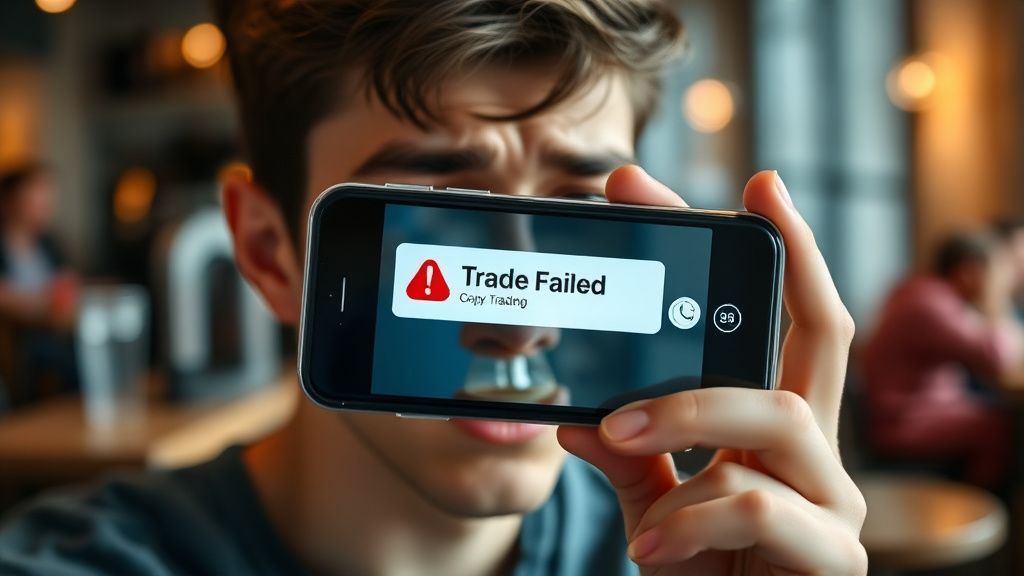
When the market experienced a flash-crash in June 2025, the bridge crashed. The master trader manually executed their exit through their exchange’s mobile app. The followers, relying on the automated bridge, were stuck. Because their accounts weren't "linked" during the outage, the automated stop-losses never triggered. By the time the bridge was manually reset by the developers, the majority of the community had seen 30-40% drawdowns. The fallout wasn't just financial—the influencer’s reputation was permanently tarnished, and the legal team of the platform faced a class-action suit regarding "negligent maintenance of trade execution services."
The Psychology of the "Follower"
Why do people continue to participate in this? It comes down to "outsourced cognition." Following a "guru" reduces the cognitive load of analysis. In an increasingly complex financial market, the follower is paying for conviction, not just the trade.
However, this creates a toxic feedback loop. When the influencer is losing, they feel pressure to "double down" to recover their reputation, leading to risky, emotional trading. The followers, sensing the influencer's panic, often panic-sell, which can actually exacerbate the influencer's losses. It is a social dance performed on a razor’s edge.

The Economics of Monetization: Performance Fees vs. Subscriptions
The economic incentive model for influencers is shifting. Early models relied on affiliate revenue from broker sign-ups. Now, sophisticated "copy-trading" platforms allow for:
- Performance Fees: A percentage of the net profit the follower makes. This is the most aligned model, but it incentivizes the influencer to take "all or nothing" trades to capture the high-water mark.
- Flat Management Fees: An "AUM" style fee. This incentivizes influencers to grow their follower base as large as possible, regardless of the quality of the trades.
The ethical conflict is clear: the influencer’s best interest is often not aligned with the follower’s risk tolerance.
Karşılıklı Eleştiri (Counter-Criticism)
Critics of influencer-led fund management argue that it is simply the "gamification of financial suicide." They point to the lack of transparency in the influencer’s historical performance. Many platforms allow influencers to "reset" their tracking history after a bad run, effectively curating a survivorship-biased profile that lures in new, inexperienced capital.
Conversely, proponents argue that this is the most transparent form of asset management. "In a traditional hedge fund," a London-based fintech analyst notes, "you only see your returns once a quarter, and the fees are obfuscated. With copy-trading, I see exactly what they bought, when they bought it, and I can opt out in milliseconds."

Navigating the Future: A Survival Guide for 2026
If you are an influencer looking to enter this space, or a user looking to follow, consider these non-negotiables:
- Demand Immutable Performance Logs: Do not trust a platform that allows "resets" of public portfolios. Check for third-party auditing tools that verify trade history.
- Understand Your Jurisdiction: If you are in the EU, look for MiFID II compliance in your platform. If you are in the US, assume that any performance fee you charge puts you in the crosshairs of the SEC.
- Stress Test the Latency: Before committing significant capital to a copy-trade signal, perform a "micro-test." Execute a tiny trade and measure the delta between the influencer's entry and your own. If the delay is more than a few seconds, the "alpha" of the strategy is likely being eaten by slippage.
- Community Due Diligence: Go to the forums—Hacker News, specialized Discord channels, and even the "bug report" threads on the platform's GitHub. If you see recurring issues with API disconnects or execution failures, run. A platform with technical debt is a platform where your money will eventually get stuck in a sync-loop.
Is copy-trading legal for influencers in the US?
The legality is highly dependent on how the influencer is compensated. If they receive a cut of profits or a management fee, they are likely acting as an unregistered investment advisor. The SEC is increasingly aggressive about classifying social media financial influencers (finfluencers) who exert control over follower capital as investment entities.
Why do my trades consistently underperform the influencer I follow?
This is usually due to "slippage" and "execution lag." The influencer likely has a faster connection or a direct API feed to the exchange's matching engine. By the time the signal reaches your account and your trade is executed, the price has often moved significantly, especially in high-volatility assets.
Can I get a refund if the copy-trading platform experiences a technical failure?
Almost certainly no. Read the Terms of Service (ToS) of any copy-trading platform. They almost universally include "limitation of liability" clauses that explicitly state the platform is not responsible for losses due to system latency, API outages, or execution failures. You are using these tools at your own risk.
What is the biggest hidden cost in copy-trading?
Beyond the platform fees, the biggest hidden cost is the "liquidity tax." When thousands of people copy a single trade simultaneously, you are effectively front-running each other, driving the price up on buy orders and down on sell orders. You are competing with your own "team" for the best price.
Is there a way to automate copy-trading securely?
Using personal API keys with strict read-only and limited-permission settings is the only way to mitigate risk. Never give a platform "withdrawal" permissions. If a platform requires full API access, including the ability to move funds out of your wallet, that is a massive red flag. Always use a dedicated, isolated sub-account for copy-trading to prevent a bad strategy from wiping out your entire net worth.