
"Data-as-a-Product" (DaaP) is the strategic shift from viewing internal datasets as operational exhaust to treating them as tradeable assets. By applying product management rigor—versioning, SLAs, and lifecycle management—to raw data, organizations can monetize information directly. Success requires moving beyond simple API access to building robust, compliant, and continuously curated data pipelines, much like the sophisticated financial frameworks explored in why institutional capital is moving to Layer-2 liquidity pools in 2026.
The modern enterprise is drowning in data, yet most of it is "dark"—sitting in cold storage, obscured by legacy schemas, or buried under layers of organizational bureaucracy. The 2026 mandate is simple but brutal: stop hoarding what you cannot contextualize, stop maintaining what you cannot monetize, and check out these proven strategies on how to maximize your DePIN node yields in 2026. Data-as-a-Product is not merely a marketing term for selling CSV dumps on a marketplace; it is a fundamental restructuring that mirrors the precision required in why parametric insurance is replacing traditional claims for supply chain resilience.
The Anatomy of a Data Product: Beyond the Raw Stream
If you ask a traditional DB2 administrator what a data product is, they will point to a SQL table. If you ask a 2026-era product lead, they will point to a customer-facing portal with a clear SLA, a changelog, and a deprecation policy.

To move from "database" to "product," your data must possess the following attributes:
- Discoverability: If your consumers cannot find the data in a centralized catalog, it doesn't exist. This requires robust metadata management, utilizing tools like OpenMetadata or DataHub to ensure that tags, definitions, and ownership are clear.
- Addressability: The data must be accessible via standard interfaces (REST APIs, GraphQL, or secure bulk egress points like Parquet files in S3 buckets).
- Trustworthiness: This is where most projects die. You need automated data quality checks that prevent bad data from reaching the consumer. If your data product returns a null value without a defined schema contract, the consumer will churn.
- Security and Compliance: In the GDPR/CCPA era, shipping data is a liability. You need automated PII (Personally Identifiable Information) masking and fine-grained access control (RBAC/ABAC).
The Operational Reality: The "DaaP" Tax
Implementing DaaP is not a technical lift; it is a cultural transformation akin to scaling an AI automation agency and navigating the real challenges of payment system integration. The friction arises when the engineers who build the product are incentivized by system uptime, while the data product owners are incentivized by adoption.
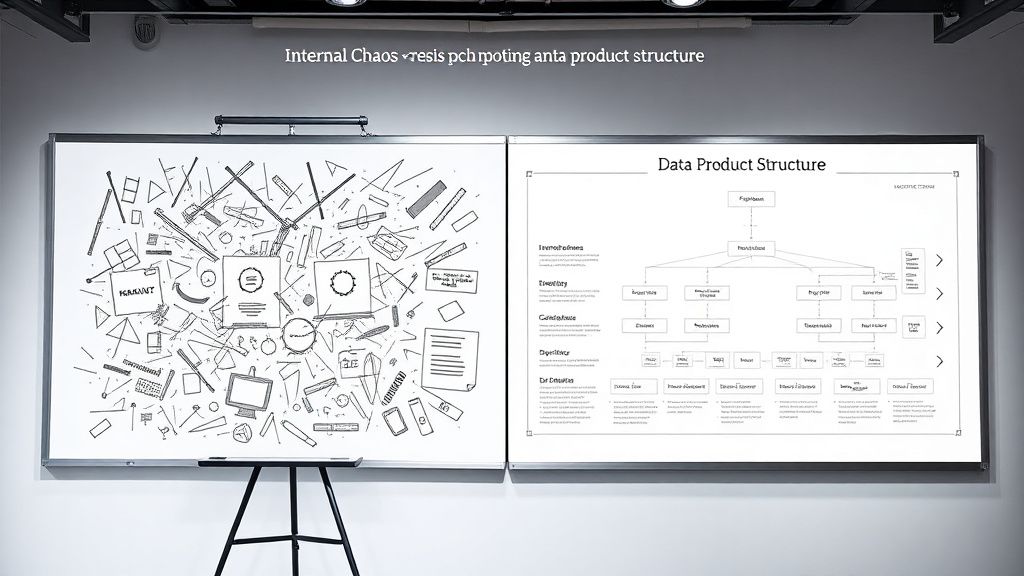
In my time observing the "Data Mesh" implementations at various Fortune 500s, I have seen a recurring failure pattern: the "Bridge to Nowhere". A company spends two years cleaning their data lake, only to realize that the API they built satisfies zero external business needs. They neglected the product discovery phase, assuming that "if we clean it, they will buy it."
The Workaround Culture: Because internal data portals are often clunky and slow to update, power users often revert to "shadow scraping" or building their own rogue ETL pipelines that bypass the official data product. When you see this, your DaaP strategy has failed at the UX layer.
Real Field Report: The Case of the Retail Aggregator
In mid-2025, a major logistics firm attempted to package its proprietary routing data into a premium subscription product. They marketed it to retail planners. The failure was not in the data quality—which was stellar—but in the frequency.
Their internal systems were batch-processed nightly, but the market expected real-time latency. The "Product" could not satisfy the "Consumer." The engineering team spent months trying to force a nightly batch job into a streaming architecture, leading to massive infrastructure cost spikes and a degraded experience for the internal team—a classic bottleneck reminiscent of the issues discussed in how AI-driven algorithmic arbitrage is reshaping global freight logistics. They eventually had to pull the product from the market, causing a significant hit to their Q4 projections.

Counter-Criticism: The "Data-as-a-Product" Fallacy
Critics argue that "Data-as-a-Product" is often just a repackaged "Data-as-a-Service" (DaaS) model, which was famously over-hyped in the early 2020s. The skepticism is warranted. Many companies treat data as a byproduct of their software, yet expect it to have the same market value as a standalone SaaS tool.
The reality is that data is a raw material, not a final product. Without the software wrapper (the UI, the insights, the automated decision-making), raw data is a liability that requires expensive maintenance. If you cannot provide a "time-to-first-query" (TTFQ) that is under 15 minutes, your DaaP strategy will struggle to scale beyond your internal ecosystem.
The 2026 Blueprint for Revenue Monetization
To successfully license data, you must move beyond the "one-size-fits-all" pricing model.
- Usage-Based Licensing: Charge per API call or per Terabyte scanned. This is the most transparent model but creates the most infrastructure stress. You need high-availability rate limiting that doesn't feel like a blockade.
- Tiered Access: Keep a "freemium" data sample available. If developers can't play with a subset of the data in a sandbox, they won't commit to a contract.
- The SLA Contract: This is non-negotiable. If you aren't ready to issue a service credit when the data stream goes down, you aren't selling a product; you're selling a hobby.
Infrastructure Stress: The Scaling Wall
The most common failure point at the "scaling" stage is the degradation of the underlying infrastructure. When you turn your internal DB into a public-facing API, your query patterns change.
Internal usage is predictable. External, commercial usage is chaotic. Customers will run SELECT * on your largest tables during your peak internal processing times. If your architecture is not decoupled—meaning you are not using a read-replica architecture or a modern data warehouse (like Snowflake or BigQuery) with separated compute and storage—you will experience "noisy neighbor" syndrome. Your internal business operations will slow to a crawl because a client in a different timezone is querying your tables.
Engineering Compromise: You must build a separate "export" layer. Never let an external client connect directly to your production transactional database. Always inject an abstraction layer—an Event Mesh or an API Gateway—that queues requests and manages throughput.
Managing the Ecosystem: The "Broken Promise" Problem
Data products have a lifecycle. When you deprecate a schema, you break a customer’s business logic. This creates massive trust erosion.
Maintainers on GitHub and GitLab have noted that the most significant barrier to DaaP adoption is lack of versioning culture. In traditional software, v1 vs v2 is standard. In data, "The table is named user_data_final_final_v2" is a common, embarrassing reality. Adopt strict semantic versioning for your data schemas. If a field changes, it is a breaking change. Treat it like a breaking API change. Document it. Notify your users.
The Human Element: Why People Quit the Platform
User churn in DaaP is rarely about the quality of the bits. It is about the friction of integration. If your documentation is a link to a 400-page PDF, you’ve already lost.
In my research, I’ve found that the best data products have:
- Code-first documentation: Use tools like Docusaurus or Backstage.
- Self-service onboarding: If a client needs to email your sales team to get an API key, you are not a DaaP; you are a legacy services firm.
- Community support: A dedicated Discord or Slack channel where engineers can complain about issues and get actual, human, technical support. Not a bot. Not a "support ticket" that disappears into a void.
Final Synthesis: The Path Forward
The 2026 landscape is not about who has the most data; it’s about who provides the most usable data. The winners will be the organizations that treat their data as a primary product, investing in the same product management, developer experience, and reliability engineering as their flagship software apps.
Beware the hype cycle. The "Data Marketplace" is littered with the corpses of companies that thought they could sell data without building a business. If you aren't willing to support the data as a product, keep it private. If you are, prepare for a long, grinding journey of iteration, API contract management, and constant infrastructure tuning.
FAQ
Is "Data-as-a-Product" just selling access to an API?
Why do most data monetization projects fail?
What is the biggest technical risk in DaaP?
How do I handle PII and privacy if I want to sell my data?
Why is documentation the most critical part of a data product?
status means nothing without metadata defining the states, the last update time, and the source. If your data product isn't self-documenting and easy for a developer to integrate into their stack, it will be abandoned, regardless of how "clean" or "accurate" the underlying values are.