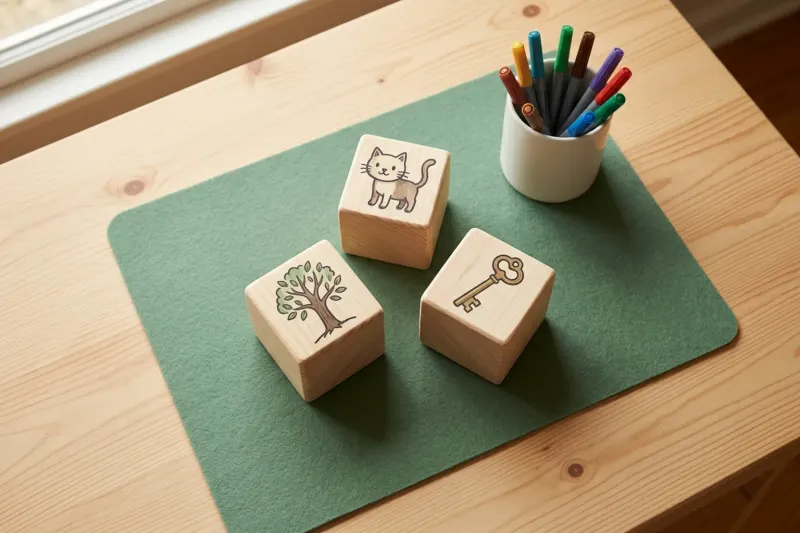
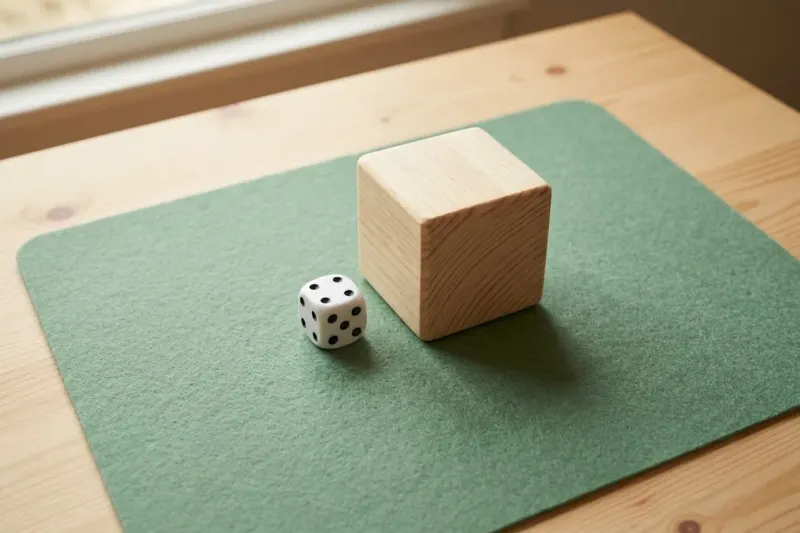
To make a DIY story dice game for children ages 4 to 8, start with oversized cubes measuring at least 2 inches (5.1 cm) per side rather than standard tabletop game dice. Standard commercial game dice measure about 0.63 inches (16 mm) across. That size places them within federal small-parts definitions, creating an airway hazard if younger siblings share the room. Using solid wooden craft blocks, folded cardstock cubes, or repurposed square tissue boxes gives children an easy-to-grasp base with plenty of drawing area for recognizable picture prompts. Once your cubes are prepared, adjust the turn rules to match your child's age. For 4- and 5-year-olds, roll two cubes covering a character and a setting to keep prompts simple and direct. For 6- to 8-year-olds, expand to four cubes that prompt a character, setting, tool, and obstacle. Keep an active adult nearby to oversee construction, manage craft tools, and guide oral storytelling in a calm, collaborative setting.
Cube Dimensions and Choking Prevention
Selecting the proper cube size is the most important physical choice when making homemade game pieces. The Consumer Product Safety Commission (CPSC) enforces the federal Small Parts Regulation under 16 CFR Part 1501. This rule establishes that any toy object fitting entirely within a specialized cylindrical test fixture measuring 1.25 inches (31.7 mm) in diameter and 1.00 to 2.25 inches (25.4 to 57.1 mm) deep constitutes a choking and ingestion hazard for children under 3 years old. While children between ages 4 and 8 are generally past the infant mouthing phase, family environments frequently include younger siblings who share the play area.\n\nTo maintain a conservative safety buffer, avoid repurposing standard plastic 16 mm gaming dice. Instead, choose rigid cubes that measure at least 2.0 inches (5.1 cm) across each edge. Guidance compiled by Nationwide Children's Hospital notes that household items passing loosely through a standard cardboard toilet paper tube—which typically measures 1.25 to 1.50 inches (3.2 to 3.8 cm) in diameter—pose an active airway obstruction risk for young children. A 2.0- to 2.5-inch (5.1 to 6.4 cm) block cannot pass through this opening in any orientation.\n\nHowever, meeting a single measurement threshold does not guarantee complete safety on its own. An oversized object can still become hazardous if it chips, fractures, or sheds paper stickers that an infant could inhale or swallow. Age alone also does not make an item safe, as individual mouthing behaviors vary. Under 16 CFR § 1501.3, paperboard, cardboard, and cardstock are statutory exemptions to small-parts testing because compressed cellulose fibers flatten rather than breaking into rigid, sharp fragments. Even so, wet or chewed paper can present an aspiration risk, meaning homemade paper dice require adult monitoring whenever infants or toddlers are present.
Base Materials and Surface Preparation
When building DIY story dice, caregivers generally choose between three household bases: solid unfinished wood craft blocks, folded cardstock nets, or square facial tissue boxes. Each material requires a specific surface preparation method to prevent paper delamination or small loose parts from peeling away during play.\n\n* Solid Unfinished Wood (1.75 to 2.5 inches / 4.4 to 6.4 cm): Unfinished beech, pine, or birch craft cubes offer durability and a satisfying weight on flat surfaces. Do not use paper glue sticks to attach individual paper squares directly to unfinished wood. Repeated impact and friction will peel paper corners, creating loose scrap debris. Instead, draw icons directly onto the wood grain using certified non-toxic, water-based markers. If you use paper panels, wrap the entire cube in clear, heavy-duty polypropylene packing tape to seal all edges flush against the block.\n* Folded Cardstock Cubes (2 inches / 5.1 cm): Cut and score a standard six-square cross pattern (cube net) out of heavy index cardstock. Have children draw or color the narrative icons onto the flat card before folding. Fasten internal tabs securely with double-sided craft tape, then seal external seam lines with transparent tape so the cube holds its shape under repeated throws.\n* Square Tissue Boxes (4 to 5 inches / 10.2 to 12.7 cm): For active floor play, repurpose empty cube-shaped facial tissue boxes. Stuff the interior with crumpled plain packing paper or newspaper to keep the hollow walls from collapsing when rolled, then cover the open top panel with plain cardstock taped flush along all four borders.\n\nAn adult should manage all cutting tasks with scissors or craft knives and supervise the tape application.
Organizing Dice by Story Category
Rather than placing random pictures across every face, organize each individual die around a single narrative category. Drawing distinct visual symbols allows children to decode the prompt instantly without requiring reading skills.\n\nEarly education frameworks, such as the Talk for Writing methodology documented in primary education research, highlight that young learners succeed in oral composition when they can draw upon concrete visual cues organized by role rather than abstract literary concepts. Assigning one color border or category per die prevents players from rolling three unrelated characters or three competing locations on the same turn.\n\nPrepare your dice according to the following category assignments:\n\n* Die 1: Character (Blue border): Include six distinct figures: a child, an animal (dog, cat, or bear), a community helper (firefighter, doctor, or baker), a mythical figure (dragon or wizard), a friendly vehicle (train or tugboat), and a small creature (bee or turtle).\n* Die 2: Setting (Green border): Include six recognizable places: a living room, a dense forest, an ocean beach, an outer-space planet, a school playground, and a stone bridge.\n* Die 3: Tool or Object (Yellow border): Include six concrete items: a backpack, a flashlight, a brass key, an umbrella, a paper map, and a magnifying glass.\n* Die 4: Obstacle or Event (Red border): Include six simple challenges: sudden heavy rain, a locked wooden gate, a fallen tree limb, a sleeping animal blocking the path, a missing favorite toy, and a flat bicycle tire.
Turn Rules for Ages 4 to 5
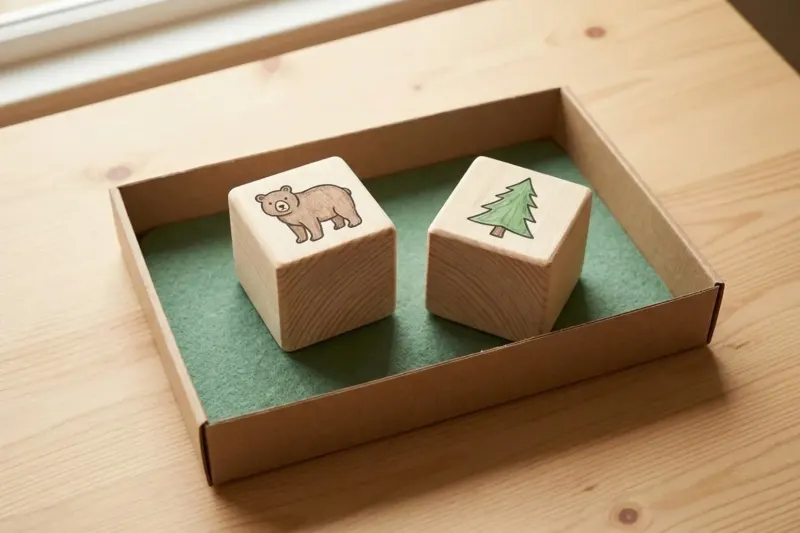
Children ages 4 and 5 typically narrate in short, immediate sequences. Presenting four or five dice simultaneously introduces visual clutter that can cause a child to feel overwhelmed. For this age group, run the game using only two cubes: Die 1 (Character) and Die 2 (Setting).\n\n1. Set Up a Contained Roll Space: Sit side-by-side at a low table or on a short-pile rug. Place a low-sided cardboard tray or baking sheet lined with a dish towel or felt cloth in the center of the play area. This contained rolling zone stops large cubes from clattering loudly or rolling under furniture.\n2. The Two-Die Roll: Under active adult supervision, the child rolls the Character die and the Setting die into the tray.\n3. Name the Elements: The adult points to each landed face and asks the child to name the picture out loud (for example: "A cat" and "A playground").\n4. Provide a Story Starter: Rather than expecting the child to invent a complete plot from scratch, offer a gentle starter sentence: "Once upon a time, a friendly cat walked into a busy playground. What did the cat do first?"\n5. Keep Turns Brief: Allow the child to supply two or three descriptive sentences. Accept any narrative response, whether realistic or imaginative, without correcting their storyline. The adult can then take a turn rolling the same two dice to model sentence sharing in a relaxed, non-competitive rhythm.
Structured Narrative Turns for Ages 6 to 8
Between ages 6 and 8, children begin to understand structured story parts, including characters, settings, initial problems, and resolutions. Analyses of early narrative development compiled in speech and language repositories at the University of the Pacific demonstrate that early elementary students organize oral stories more systematically when provided explicit external scaffolds.\n\nFor this group, play with four dice: Character, Setting, Tool, and Obstacle. Guide the player through a collaborative sequence:\n\n* Roll into the Tray: Have the player roll all four dice together into the roll tray.\n* Line Up the Sequence: Guide the child to arrange the landed cubes physically from left to right along a straight line on the table: Character first, Setting second, Tool third, and Obstacle fourth. Arranging the cubes in a horizontal row provides a concrete visual path from beginning to middle to end.\n* Brief Planning Time: Give the child 30 seconds of quiet planning time to look at the symbols before speaking.\n* Hypothetical Turn Example: A 7-year-old rolls a baker, a forest, a brass key, and a locked wooden gate. With adult encouragement, the child constructs a four-sentence micro-story: "A friendly baker went for a walk in a dense forest. She carried a shiny brass key in her pocket. Along the trail, she found a locked wooden gate covered in vines. She turned the key in the lock, opened the gate, and discovered a patch of wild blackberries."\n\nEncourage older siblings to take turns listening to each other without interruption.
Handling Stalls and Keeping Play Low-Stress
Storytelling games can sometimes stall when a rolled combination feels difficult to connect, such as an astronaut holding an umbrella or a fish next to a stone tower. Young children may freeze or declare that they cannot think of an idea.\n\n* The One-Die Reroll Rule: Establish from the start that every player has one optional reroll per turn. If an icon feels too tricky to integrate, the child may reroll that single die once without penalty.\n* Cooperative Pass-the-Story: If a child stops midway through a sentence, shift the turn into a cooperative relay. The child leaves the challenging die in place, and the next player or caregiver contributes one linking sentence to help resolve the impasse before handing the story back.\n* Eliminate Points and Timers: Avoid stopwatches, point scores, or elimination mechanics. Adding competitive pressure increases anxiety rather than encouraging relaxed verbal expression. Keep the focus entirely on shared conversation and casual family play under supportive adult oversight.
Base Material and Die Selection Guide
| Situation | Consider | Why |
|---|---|---|
| Household includes crawling toddlers or infants under 3 years old | 2.0- to 2.5-inch (5.1 to 6.4 cm) solid wood craft blocks with hand-drawn ink | Exceeds federal small-parts test cylinder dimensions (1.25 inches) and avoids peelable paper sticker scraps that create airway hazards. |
| Ages 6 to 8 crafting dice during an adult-supervised afternoon project | Folded 110 lb (200 gsm) index cardstock nets sealed on all edges with clear packing tape | Allows older children to draw flat scenes easily before assembly; paper qualifies for statutory small-parts testing exemptions under 16 CFR § 1501.3. |
| Playing on hardwood or laminate floors where wood cubes create excessive noise or floor marks | Hollow 4.5-inch (11.4 cm) cardboard tissue boxes stuffed with crumpled scrap paper | Dampens rolling noise and impact on table surfaces while remaining too large to fit into choke-test cylinders. |
Suggested Hypothetical Play Session: Two Siblings (Ages 4 and 7)
In this hypothetical example, a caregiver prepares a homemade story dice set using four 2-inch (5.1 cm) unfinished wood craft blocks and water-based markers. The adult labels each die with a distinct border color: blue for characters, green for settings, yellow for tools, and red for obstacles. During the session, the 4-year-old child rolls only the Character and Setting cubes into an 11-inch (28 cm) felt-lined tray, rolling a 'dog' and a 'beach.' With a prompt from the caregiver, the child shares three sentences about a puppy chasing seagulls along the sand. Next, the 7-year-old child rolls all four cubes, landing 'firefighter,' 'playground,' 'flashlight,' and 'locked gate.' The older child lines up the blocks from left to right along the table and shares a four-sentence story about using the flashlight to inspect a park gate latch at sunset. Each child completes three low-pressure turns over 15 minutes under active adult supervision without competitive point-scoring.
- Felt-Lined Rolling Tray
- Dice Staging Bank
- Active Story Line (Left to Right)
- Player Seating Area
When this approach is not a good fit
This activity is unsuitable for unsupervised play in households with infants or toddlers if paper labels, glue sticks, or lightweight paper nets are used, as chewed paper scraps create an airway obstruction hazard. It is also unsuitable for outdoor play in windy weather when using lightweight cardstock or tissue box cubes.
PUT THIS GUIDE TO USE
Find an activity for your family
Sources & further reading
AI-assisted writing and concept images. Sources and automated checks support the process; an adult should check materials and adapt activities to their child.
How we create our guides · Suggest a correction