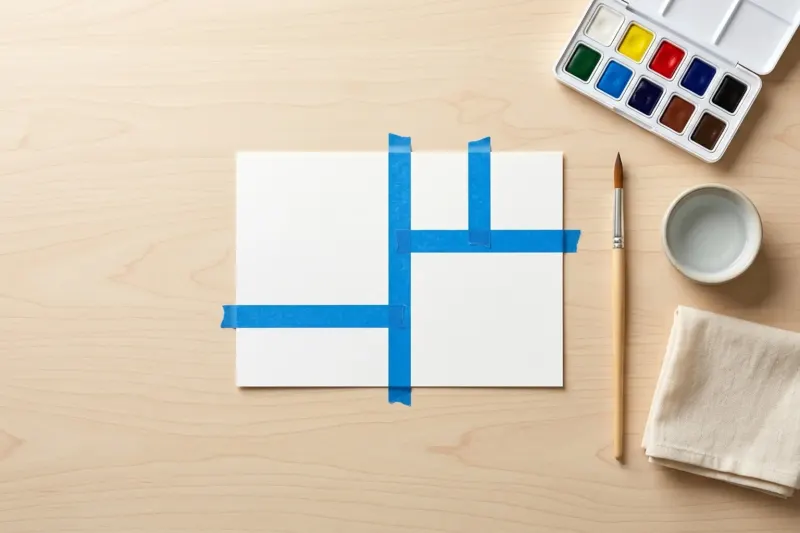
Making tape-resist watercolor postcards with young children requires balancing creative art play with postal machinery standards and household cleanup. A postcard sent through the mail without an envelope must withstand automated sorters, meaning the paper cannot buckle or tear, the tape lines must come away clean without peeling paper fibers, and the art materials must be verified safe for young hands. Using standard 140 lb (300 gsm) cold-press watercolor paper cut to 4 by 6 inches satisfies United States Postal Service thickness and dimension rules while handling water without warping into an unmailable curve. Low-tack delicate painter tape creates clean white resist borders, and solid pan watercolors marked with non-toxic safety seals prevent accidental ingestion hazards and oversaturated puddles. This guide outlines how caregivers and educators can set up a low-mess watercolor station for children ages 4 to 8, manage moisture levels, execute clean tape pulls, and format the card back so each piece travels safely through the mail under active adult supervision.
Sizing and Paper Weight for Postal Sorting Machines
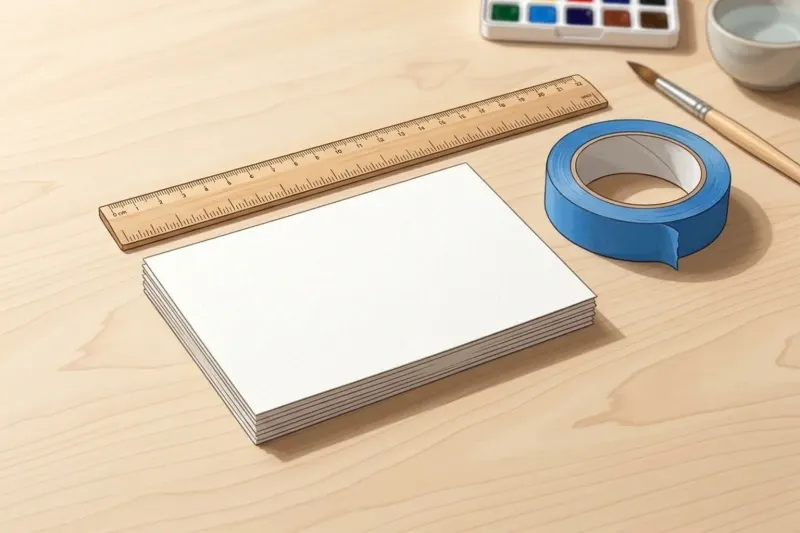
Before children wet their brushes, the postcard base must be chosen to match domestic mail-handling equipment. According to the United States Postal Service (USPS) Quick Service Guide 201 for physical standards of machinable letters and cards, an un-enveloped postcard must be rectangular, at least 3.5 inches high by 5.0 inches long, and at least 0.007 inches thick. For cards larger than 4.25 by 6.0 inches up to 6.0 by 9.0 inches, the USPS requires a minimum thickness of 0.009 inches to prevent jams in sorting transport belts, with a maximum card thickness of 0.016 inches. Standard office copy paper measures roughly 0.004 inches thick, and standard children construction paper measures about 0.006 inches thick. Both papers fail postal minimums and tear or disintegrate under wet brushwork. In contrast, pre-cut 4 by 6 inch postcard pads made from 140 lb (300 gsm) cold-press watercolor paper measure between 0.014 and 0.015 inches thick. This heavy paper stock fits squarely within USPS card-rate thickness standards, absorbs water washes without structural failure, and eliminates the ragged, frayed edges that come from hand-cutting sheets with household scissors. When buying paper stock, choose flat, pre-cut postcard blocks with smooth sheared edges. Direct adult supervision is essential during setup to keep cards flat and verify that dry card stock meets the rectangular shape required by postal sorting stations.
Certified Non-Toxic Paints and Low-Tack Adhesives
Selecting paints and adhesives for children ages 4 to 8 requires checking independent safety certifications rather than relying on informal craft advice. Under the Labeling of Hazardous Art Materials Act (LHAMA) and guidelines published by the U.S. Consumer Product Safety Commission (CPSC) in Publication 5015, art supplies intended for children must conform to ASTM D-4236. To ensure products are safe for early elementary and preschool use, look for the Approved Product (AP) seal from the Art and Creative Materials Institute (ACMI). This seal confirms that a board-certified toxicologist evaluated the chemical formulation and found no acute or chronic health hazards. Adult-grade watercolor tubes or pans bearing the Cautionary Label (CL) seal often contain soluble heavy metals like cadmium, cobalt, or nickel, which are unsuitable for young children. For adhesives, standard tan masking tape, clear packaging tape, and duct tape bond too aggressively, pulling the top layer of paper fibers away when peeled. Instead, select blue delicate-surface painter tape or light washi paper tape. These low-tack tapes feature modified acrylic adhesives engineered to release cleanly from paper cellulose while creating an impermeable boundary against diluted watercolor paints. An adult should handle any tape trimming with scissors and ensure children do not mouth tape strips or brush handles.
Workstation Layout and Managing Water Saturation
Water containment determines whether this activity remains manageable or turns into soggy frustration. A practical workstation pairs each child with a rimmed baking sheet or plastic cafeteria tray measuring approximately 13 by 9 inches. The raised lip keeps errant puddles from flowing onto the table and anchors the postcard while small hands work. For children ages 4 to 5, pre-cut tape strips into simple lengths that they can press across the paper to form horizontal stripes or simple crosses. Children ages 6 to 8 can arrange more intricate intersecting geometric lines or spell out initials. Once the tape is positioned, an adult should run a firm thumb or the back of a plastic spoon along each edge to seal tiny gaps where water might seep underneath. To control liquid saturation, provide each child with a small container containing no more than 2 fluid ounces (60 milliliters) of clean tap water. Shallow water reservoirs limit the spill volume if knocked over. Show children how to swipe their paintbrush against a folded paper towel after dipping it in water so the bristles are merely damp rather than dripping. Using dry cake watercolor palettes rather than liquid watercolor inks further prevents paper flooding, ensuring the postcard retains its structural integrity without buckling.
Touch-Testing Dryness and Peeling at a Shallow Angle
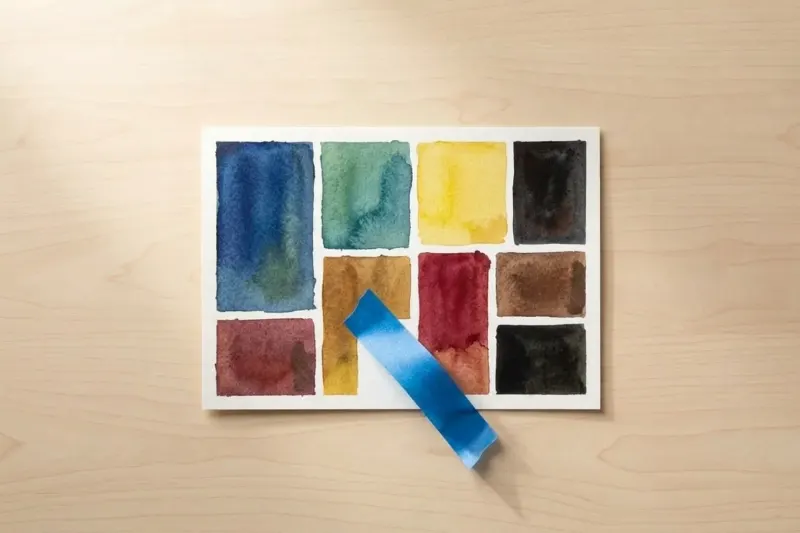
The primary cause of torn postcards is peeling the resist tape while the paper core remains damp. When water penetrates paper pulp, hydrogen bonds between wood fibers weaken temporarily. Peeling tape off damp paper causes mechanical delamination, stripping the surface finish and leaving fuzzy, bleeding edges. Postcards must air-dry completely before removing tape. Ambient room temperature, humidity, and paint saturation dictate drying speed, so caregivers should not rely on a fixed timer. Instead, use a physical touch test: have an adult press a clean, dry fingertip against the painted card. If the surface feels cool, water is still actively evaporating from the interior fibers. Tape removal should begin only when the surface feels room-temperature and dry to the touch, which typically takes between 30 and 60 minutes. When peeling, guide the child to fold the end of the tape strip flat against itself, pulling backwards slowly at an acute 45-degree angle along the paper surface. Pulling tape straight up at a 90-degree angle focuses mechanical stress directly upward on paper fibers, causing surface tears. If a piece of tape sticks stubbornly, an adult can gently warm the tape with a household hair dryer held 8 inches away on low heat for five seconds to soften the adhesive before peeling.
Back-of-Card Layout and Postal Machine Clearances
A completed tape-resist painting must meet postal formatting standards on the address side to travel smoothly through automated sorting centers. The USPS relies on high-speed optical barcode sorters that scan the face of each card. The back of the postcard must remain completely flat. Dimensional decorations such as plastic rhinestones, adhesive gems, thick foam stickers, or dimensional glitter pens will snag inside automated rollers, resulting in torn mail, return to sender, or non-machinable surcharges. When preparing the reverse side, divide the card conceptually into two vertical halves. The left half is reserved for the child message, drawing, or caregiver note. The entire right half must be kept bare and unpainted for the recipient address and postage stamp. Furthermore, USPS specifications require maintaining a 0.625-inch (16 mm) blank margin along the bottom edge of the postcard across its entire width. Postal machines apply a fluorescent barcode along this bottom band to route the item. To prevent ink smear from damp postal sorting belts or outdoor weather, write the recipient address using a waterproof ballpoint pen or non-smearing pencil rather than water-soluble felt markers.
Materials and Workspace Setup Decision Guide
| Situation | Consider | Why |
|---|---|---|
| Selecting paper weight for direct postcard mailing | Pre-cut 140 lb (300 gsm) cold-press watercolor postcards | Meets the USPS 0.007 to 0.016 inch thickness range and resists warping under liquid watercolor washes. |
| Choosing tape to mask resist lines | Blue delicate-surface painter tape or light paper washi tape | Low-tack acrylic adhesive releases cleanly from dry paper cellulose without stripping or tearing surface fibers. |
| Selecting paint sets for children ages 4 to 8 | Solid cake watercolor palettes carrying the ACMI AP non-toxic seal | Complies with ASTM D-4236 and excludes hazardous soluble heavy metals like cadmium or cobalt found in professional artist lines. |
| Formatting the reverse side of the card | Leave the right half and bottom 0.625 inch clear of paint and dark markings | Provides required clearance for recipient addressing, postage stamps, and automated USPS barcode printing. |
Hypothetical Worked Example: Two-Child Family Postcard Session
In this hypothetical example, an adult organizes an afternoon postcard session for two children ages 4 and 7 at a kitchen table. The adult sets out two 13 by 9 inch (33 by 23 cm) rimmed metal baking sheets, four pre-cut 4 by 6 inch (10.16 by 15.24 cm) 140 lb / 300 gsm cold-press watercolor postcards (thickness approximately 0.014 inches / 0.36 mm), one roll of 0.75-inch (1.9 cm) delicate-surface painter tape, an 8-color pan watercolor palette carrying the ACMI AP seal, two cups each holding 2 fluid ounces (60 ml) of water, and folded paper towels. The adult tears tape strips and helps the 4-year-old press three horizontal lines across their card, while the 7-year-old creates an asymmetrical geometric pattern using six intersecting tape segments. The adult uses a thumb to press all tape edges flat against the paper. The children paint within their trays for 20 minutes, blotting wet brushes on paper towels to keep saturation low. The cards remain flat in the trays to air-dry for 50 minutes until a fingertip touch test confirms the paper is room temperature and completely dry. The adult demonstrates how to peel the tape back flat against itself at an acute 45-degree angle. After unmasking, the children dictate their messages, which the adult writes on the left side of each card back using a waterproof ballpoint pen. The adult writes the recipient address on the unpainted right half and applies a USPS postcard stamp before mailing.
- Child 1 Rimmed Tray & Card
- Child 2 Rimmed Tray & Card
- Shared Watercolor Pan & Water
- Tape Strips & Paper Towels
- Caregiver Supervision Area
When this approach is not a good fit
This project is unsuitable for children under age 3 due to choking hazards associated with small tape cutoffs and water cups. It is also unsuitable if cards must be mailed immediately without allowing a 45 to 60 minute drying period, if high-tack packaging or duct tape is used in place of delicate painter tape, or if professional artist paints containing toxic cadmium, nickel, or cobalt pigments are the only available medium.
PUT THIS GUIDE TO USE
Find an activity for your family
Sources & further reading
AI-assisted writing and concept images. Sources and automated checks support the process; an adult should check materials and adapt activities to their child.
How we create our guides · Suggest a correction