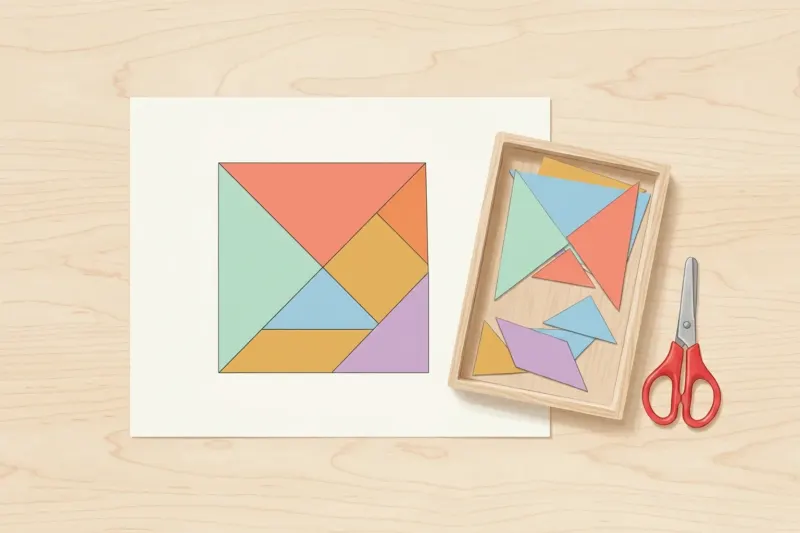
Setting up a printable tangram matching station comes down to one initial design choice: matching the visual guidance of your puzzle sheet to your child's age. For ages 4 and 5, print full-scale 1:1 matching mats that display the interior lines of each individual shape, and cut the pieces yourself to prevent jagged edges from jamming the layout. For children ages 6 to 8, print reduced-scale solid silhouettes without interior seams, and provide 5-inch blunt-tip safety scissors so they can trim their own pieces. This immediate differentiation prevents the two most frequent points of friction in paper tangram play: younger children struggling with complex scissor angles, and older children growing bored by direct shape-overlay puzzles. With standard cardstock, blunt safety scissors, and active adult supervision, you can establish an engaging tabletop math activity in minutes.
The Anatomy of a Seven-Piece Tangram Set
A standard tangram puzzle consists of exactly seven flat geometric pieces, called tans, derived from dissecting a single square. These seven pieces comprise two large right isosceles triangles, one medium right isosceles triangle, two small right isosceles triangles, one square, and one parallelogram. Together, they form an interconnected geometric system where specific pieces combine to duplicate the area and shape of others. For example, the two small right triangles combine to form a square identical to the standalone square piece, a medium triangle identical to the medium piece, and a parallelogram identical to the set's parallelogram. According to educational geometry resources from the National Council of Teachers of Mathematics (NCTM), traditional tangram solving requires adhering to three fundamental geometric constraints: all designated pieces must be used, pieces must lie flat on the surface without overlapping, and every piece must touch at least one other piece along an edge or vertex to form a unified composite figure. While traditional adult puzzles mandate using all seven pieces to form an intricate silhouette, beginning puzzles for 4- and 5-year-olds should isolate a subset, such as using only the two small triangles to make a larger triangle. When printing paper versions at home, standard 20 lb office copy paper tends to wrinkle, curl at the corners, and slide out of position when bumped by small fingers. Printing templates onto 65 lb or 110 lb medium-weight cardstock provides rigid edges that stay flat during play and slide smoothly across the table surface without tearing or bunching up.
Scaffolding Mats from Outlines to Silhouettes
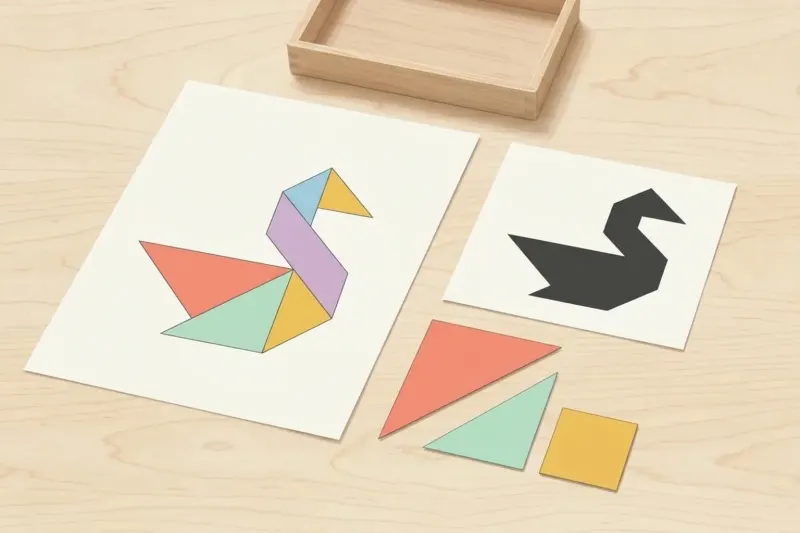
Children do not assemble composite shapes in a single conceptual leap. Research by Douglas Clements and Julie Sarama on early mathematics learning trajectories establishes that children progress through distinct developmental phases when composing two-dimensional geometric figures. In early childhood, learners can place shapes into designated spaces when interior guidelines are visible, but they struggle to deduce internal alignments within a solid, unlined silhouette. To accommodate these stages, prepare two distinct styles of printable puzzle cards. First, create Level 1 matching mats for ages 4 to 5. Print these as full-page sheets at an exact 1:1 scale where the printed boundary lines match the physical paper shapes. Most importantly, print internal dashed seams showing where each specific triangle, square, and parallelogram belongs. The child's task is matching, rotating, and laying physical shapes directly over identical visual footprints. Second, create Level 2 challenge cards for ages 6 to 8. For early elementary learners, remove internal seam lines entirely, leaving only a solid black or dark outline contour. Print these at either 1:1 scale or reduced card sizes, such as 4 by 6 inches. At this level, the child mentally decomposes the composite figure, testing how angles and edges align without printed hints. Introducing solid silhouettes to a 4-year-old frequently triggers frustration because the child cannot determine whether a wide angle requires two small triangles or one large triangle. Providing the correct scaffolding ensures the puzzle remains a manageable matching challenge that builds confidence through hands-on alignment.
Cutting Accuracy and Scissor Safety
Cutting out a set of paper tangrams involves sharp diagonal angles and precise straight lines. If a child cuts along a line with irregular, jagged curves, the resulting pieces will not align flush against each other, distorting the composite geometry and preventing the pieces from forming the intended figures. For children ages 4 to 5, an adult should pre-cut the tangram pieces using a craft trimmer or standard shears. Pre-cutting guarantees crisp, straight edges so the geometric relationships remain physically intact on the table. When children ages 6 to 8 cut their own tangram templates, supply child-sized scissors meeting recognized consumer safety benchmarks. The U.S. Consumer Product Safety Commission (CPSC) guidelines and tool manufacturers like Westcott specify 5-inch blunt-tip scissors with stainless steel safety-edge blades for children in the 4-to-7 age range. Blunt tips prevent puncture hazards while providing functional leverage for cutting cardstock cleanly. Maintain seated adult supervision during all cutting tasks to ensure safe handling. Keep an extra pre-cut reference set on hand so that an errant snip through a triangle hypotenuse does not halt play.
Solving the Flipped Parallelogram Obstacle
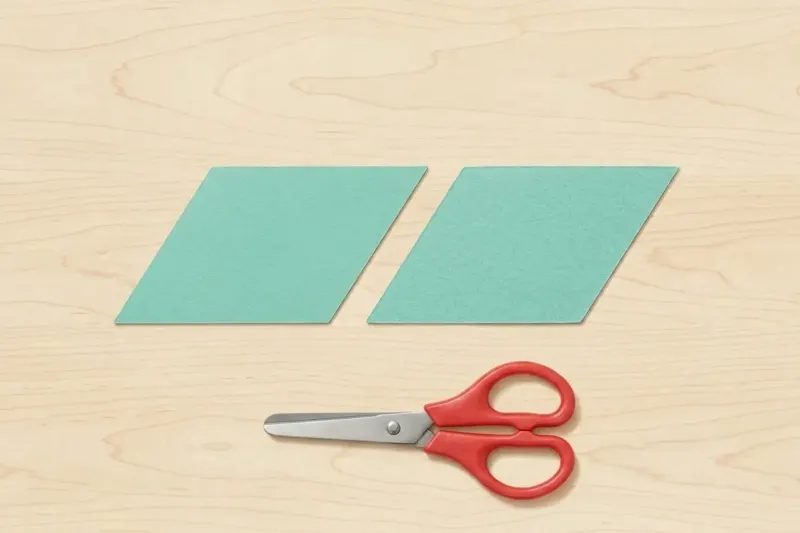
The tangram parallelogram is the source of the most common puzzle obstacle for both children and adults. Unlike the square and the isosceles right triangles, the parallelogram exhibits chirality, meaning it has no bilateral axis of symmetry on a flat plane. A study published by Bofferding and colleagues notes that children frequently attempt to rotate the parallelogram repeatedly on a tabletop, expecting its slanted edges to match a target orientation, without realizing that rotation cannot change the piece's reflective state. To match a mirror-image parallelogram outline, the paper piece must physically be flipped over onto its reverse side. This creates a practical problem when printing on single-sided paper. If a tangram template is printed on white cardstock with colored ink on only the front, flipping the parallelogram reveals a stark white underside. Young children often assume that an unprinted white piece is backwards, damaged, or incorrect, leading them to flip it back over and continue rotating it unsuccessfully. To solve this issue, print the initial tangram square on solid-core colored cardstock, or run the sheet through the printer a second time to apply the same solid hue to both sides. Alternatively, print on cardstock with a non-directional pattern. When both sides share the same color, flipping the chiral parallelogram over feels seamless and does not disrupt visual play.
Setting Up a Low-Friction Play Station
A structured, calm play station prevents loose paper pieces from blowing away or falling under chairs during a puzzle session. Set up the activity on a flat dining or craft table with clear visual boundaries. First, contain the loose pieces by providing a shallow plastic tray, paper plate, or baking sheet to hold the seven loose tans. This containment prevents stray triangles from drifting across the tabletop or sliding onto the floor when bumped. Second, establish a gradual progression for younger children by starting with 2-piece or 3-piece puzzles before introducing the full seven-piece animal or vehicle silhouettes. For example, challenge the child to make a large triangle using only the two small triangles, or a house shape using the square and one medium triangle. Third, provide low-friction storage when the play session ends, typically after 15 to 20 minutes for early learners. Slide each seven-piece set into a labeled letter envelope or a resealable plastic bag. Storing completed sets flat prevents creased corners that cause paper shapes to lift and misalign during future puzzle matching.
Tangram Mat and Cutting Decisions by Age
| Situation | Consider | Why |
|---|---|---|
| Child is 4 to 5 years old and beginning shape matching. | Print 1:1 scale mats with internal cut lines on 65 lb cardstock; adult pre-cuts the shapes. | Eliminates scissor-induced geometric distortions and supports early spatial composition by matching physical shapes directly to drawn footprints. |
| Child is 6 to 8 years old with stable scissor control. | Provide 5-inch blunt-tip scissors and reduced-scale solid silhouette challenge cards. | Allows safe cutting practice under adult supervision and fosters independent problem-solving without direct overlay crutches. |
| Parallelogram must be reflected to complete a puzzle. | Print pieces on double-sided colored cardstock or solid-core paper. | The parallelogram lacks bilateral planar symmetry; double-sided color ensures it remains visually identifiable when flipped over. |
| Paper pieces slide or curl on a smooth tabletop. | Place matching mats inside a shallow baking tray or on a non-slip silicone mat. | Tray edges prevent loose paper pieces from sliding onto the floor when bumped by small hands. |
Hypothetical Worked Setup: Two-Child Animal Puzzle Station
A caregiver sets up a 20-minute tabletop activity for a 4-year-old and a 7-year-old on a 36-inch (91 cm) square kitchen table. For the 4-year-old, the adult prints a 'Running Cat' template at 1:1 scale on 8.5 by 11 inch (21.6 by 27.9 cm) 65 lb cardstock, complete with dashed internal seams. The caregiver spends 2 minutes pre-cutting a 4-inch (10.2 cm) base tangram square with a craft trimmer so all triangles have razor-straight edges. For the 7-year-old, the caregiver prints the same 'Running Cat' as a 4 by 6 inch (10.2 by 15.2 cm) unlined silhouette card and hands them a pair of 5-inch blunt-tip safety scissors along with a printed sheet to cut out independently. Each child receives a shallow tray to catch their cut tans. Seated alongside them, the adult helps the younger child rotate triangles to match the printed lines and reminds the older child to flip the parallelogram when building the cat's tail.
- 4yo 1:1 Outlined Mat
- 4yo Pre-Cut Tans Tray
- Shared Scrap Bin
- 7yo Silhouette Card
- 7yo Scissors & Cut Tans
When this approach is not a good fit
This paper matching activity is unsuitable for children under age 3 due to choking hazards if cardstock scraps are chewed, mouthed, or torn into small fragments. It is also unsuitable for outdoor picnic tables or moving vehicles, where air currents scatter lightweight paper shapes.
PUT THIS GUIDE TO USE
Find an activity for your family
Sources & further reading
- NCTM - Teaching Geometry with Tangrams
- Clements & Sarama - Learning and Teaching Early Math
- ResearchGate - Where Does the Square Go: Reinterpreting Shapes in Tangrams
- Westcott 5-Inch Blunt Tip Kids Scissors
- U.S. Consumer Product Safety Commission - Children's Products
AI-assisted writing and concept images. Sources and automated checks support the process; an adult should check materials and adapt activities to their child.
How we create our guides · Suggest a correction